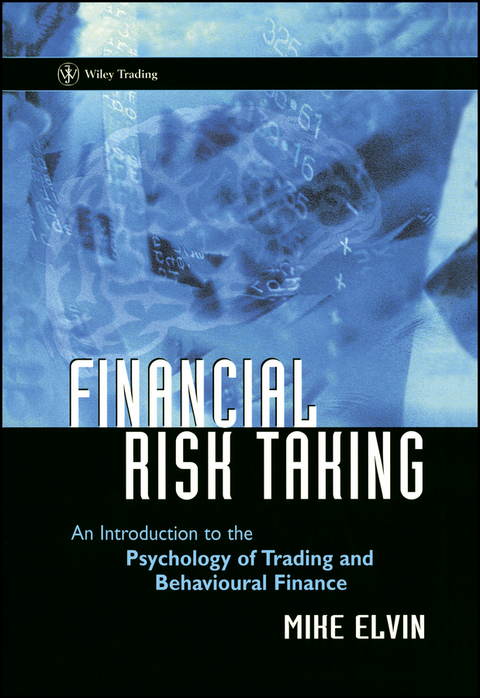
Financial Risk Taking (eBook)
John Wiley & Sons (Verlag)
978-0-470-02072-2 (ISBN)
Areas covered include:
- Emotions - are they functional or disabling? How do the mechanisms of fear, greed and panic work?
- Motivation and perception - how do belief paradigms affect perception and performance?
- What perceptual errors influence decisions to the trader's detriment?
- Information processing and risk assessment - how does information overload affect Stress How does stress affect investment decisions?
- Technological and mathematical anxiety - why do we avoid learning the skills we most need? What levels of ability are required?
- Can psychological and biological theories assist in our understanding of investors' performance?
Mike Elvin graduated in Psychology from the University of Sussex and subsequently received a scholarship from the Home Office to write a thesis at the University of Kent at Canterbury. He was employed as a psychologist by the renowned Professor RG Andry, at the University of London, undertaking research and practice in psychiatric therapeutic communities.
For some years, D. Elvin managed Community Mental Health Services in London, UK, and was seconded to the University of Kingston Business School to study Business Administration. At that time, he was trading stocks and shares part time with considerable success. He resigned his management post o undertake employment as a full-time trader and to develop trading systems with Tom Williams at Genie Software Ltd. Dr. Elvin teaches and writes on the psychology of trading, behavioural finance, and technical analysis giving individual tuition and seminars. He wrote Financial Risk Taking following research over eight years, which included interviewing home and professional traders, mainly in the UK. He holds approved status as an expert witness in Sweet and Maxwell's Law Directory of Experts and is developing a diploma course for traders in the UK.
In Financial Risk Taking, trader and psychologist Mike Elvin explores the complex relationship between human behaviour patterns and the markets, offering the reader a context in which to assess their own strengths and weaknesses as investors. The book offers an apposite and uncomplicated system of skills development in the form of competences and competencies that can be applied anywhere along the continuum from casual investor to full-time day trader. Elvin presents a Comprehensive Model of Trading Competence (the MOT) as well as the concepts of analysis and refutation, the paramouncy principle, and self-sabotaging behaviours such as the Santa Claus syndrome and Bohica effect. Areas covered include: Emotions - are they functional or disabling? How do the mechanisms of fear, greed and panic work? Motivation and perception - how do belief paradigms affect perception and performance? What perceptual errors influence decisions to the trader's detriment? Information processing and risk assessment - how does information overload affect Stress How does stress affect investment decisions? Technological and mathematical anxiety - why do we avoid learning the skills we most need? What levels of ability are required? Can psychological and biological theories assist in our understanding of investors' performance?
Mike Elvin graduated in Psychology from the University of Sussex and subsequently received a scholarship from the Home Office to write a thesis at the University of Kent at Canterbury. He was employed as a psychologist by the renowned Professor RG Andry, at the University of London, undertaking research and practice in psychiatric therapeutic communities. For some years, D. Elvin managed Community Mental Health Services in London, UK, and was seconded to the University of Kingston Business School to study Business Administration. At that time, he was trading stocks and shares part time with considerable success. He resigned his management post o undertake employment as a full-time trader and to develop trading systems with Tom Williams at Genie Software Ltd. Dr. Elvin teaches and writes on the psychology of trading, behavioural finance, and technical analysis giving individual tuition and seminars. He wrote Financial Risk Taking following research over eight years, which included interviewing home and professional traders, mainly in the UK. He holds approved status as an expert witness in Sweet and Maxwell's Law Directory of Experts and is developing a diploma course for traders in the UK.
List of Figures.
Foreword.
Contrarian Investment Strategies.
Acknowledgements.
1. Introduction: Between Scylla and Charybdis.
2. Understanding Trading Competence.
3. A Comprehensive Model of Trading Competence.
Part A: The Tactical Model of Trading Competence.
Part B: The Strategic Model of Trading Competence.
4. Taming Stress to Become a Better Trader.
5. The Psychology of Perceptual Bias.
6. Emotions, Emotional Intelligence, and the Trader.
7. Martial Arts and Budo Zen - Controlling Fear and
Self-Sabotage.
8. Standards and Criteria for Trading Competence.
Appendix 1: Reading List.
Appendix 2: Websites of Interest.
Appendix 3: Courses and Seminars.
Bibliography.
Index.
| Erscheint lt. Verlag | 8.2.2006 |
|---|---|
| Reihe/Serie | Wiley Trading |
| Wiley Trading Series | Wiley Trading Series |
| Sprache | englisch |
| Themenwelt | Geisteswissenschaften ► Psychologie ► Verhaltenstherapie |
| Wirtschaft ► Betriebswirtschaft / Management ► Finanzierung | |
| Schlagworte | anyone • author • Börsenhandel • Behaviour • Between • Börsenhandel • competence • Complex • comprehensive model • Concepts • ConText • depicts • Essential • Explores • Finance & Investments • Financial • Finanz- u. Anlagewesen • Part • Pension • Reader • Reading • Relationship • Risk • selfinvestment • Stocks • Strengths • Trading • years |
| ISBN-10 | 0-470-02072-5 / 0470020725 |
| ISBN-13 | 978-0-470-02072-2 / 9780470020722 |
| Informationen gemäß Produktsicherheitsverordnung (GPSR) | |
| Haben Sie eine Frage zum Produkt? |
 PDF (Adobe DRM)
Kopierschutz: Adobe-DRM
Adobe-DRM ist ein Kopierschutz, der das eBook vor Mißbrauch schützen soll. Dabei wird das eBook bereits beim Download auf Ihre persönliche Adobe-ID autorisiert. Lesen können Sie das eBook dann nur auf den Geräten, welche ebenfalls auf Ihre Adobe-ID registriert sind.
Details zum Adobe-DRM
Dateiformat: PDF (Portable Document Format)
Mit einem festen Seitenlayout eignet sich die PDF besonders für Fachbücher mit Spalten, Tabellen und Abbildungen. Eine PDF kann auf fast allen Geräten angezeigt werden, ist aber für kleine Displays (Smartphone, eReader) nur eingeschränkt geeignet.
Systemvoraussetzungen:
PC/Mac: Mit einem PC oder Mac können Sie dieses eBook lesen. Sie benötigen eine
eReader: Dieses eBook kann mit (fast) allen eBook-Readern gelesen werden. Mit dem amazon-Kindle ist es aber nicht kompatibel.
Smartphone/Tablet: Egal ob Apple oder Android, dieses eBook können Sie lesen. Sie benötigen eine
Geräteliste und zusätzliche Hinweise
Buying eBooks from abroad
For tax law reasons we can sell eBooks just within Germany and Switzerland. Regrettably we cannot fulfill eBook-orders from other countries.
aus dem Bereich