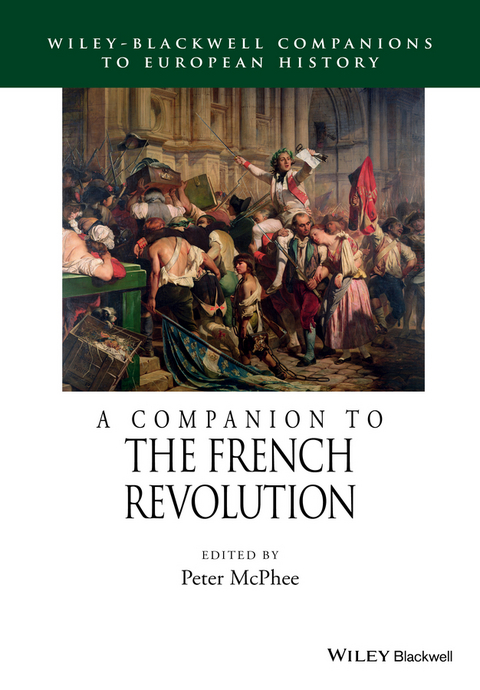
A Companion to the French Revolution (eBook)
John Wiley & Sons (Verlag)
978-1-118-31622-1 (ISBN)
- Examines the origins, development and impact of the French Revolution
- Features original contributions from leading historians, including six essays translated from French.
- Presents a wide-ranging overview of current historical debates on the revolution and future directions in scholarship
- Gives equally thorough treatment to both causes and outcomes of the French Revolution
Peter McPhee is Professorial Fellow at the University of Melbourne. His publications include Living the French Revolution 1789–1799 (2006) and Robespierre: A Revolutionary Life (2012). A Fellow of both the Australian Academy of the Humanities and the Academy of Social Sciences, he was made a Member of the Order of Australia in 2012 for service to education and the discipline of history.
A Companion to the French Revolution comprises twenty-nine newly-written essays reassessing the origins, development, and impact of this great turning-point in modern history. Examines the origins, development and impact of the French Revolution Features original contributions from leading historians, including six essays translated from French. Presents a wide-ranging overview of current historical debates on the revolution and future directions in scholarship Gives equally thorough treatment to both causes and outcomes of the French Revolution
Peter McPhee is Professorial Fellow at the University of Melbourne. His publications include Living the French Revolution 1789-1799 (2006) and Robespierre: a Revolutionary Life (2012). A Fellow of the Australian Academy of the Humanities and the Academy of Social Sciences, McPhee was made a Member of the Order of Australia in 2012 for service to education and the discipline of history.
Notes on Contributors x
Abbreviations xiv
Introduction xv
Peter McPhee
Part I the Origins and nature of the Crisis of 1789 1
1 Rethinking the Origins of the French Revolution 3
Peter Campbell
2 The Social and Economic Crisis in France at the End of the Ancien Régime24
Jean-Pierre Jessenne
3 The Cultural Origins of the French Revolution 42
Sarah Maza
4 France and the Atlantic World 57
Miranda Spieler
Part II Reshaping France, 1789-91 73
5 The Principles of 1789 75
Michael P. Fitzsimmons
6 Reimagining Space and Power 91
Alan Forrest
7 "The Case against the King," 1789-93 107
Barry M. Shapiro
Part III Church, State, and War 121
8 The Ancien Régime, Catholic Europe, and the Revolution's Religious Schism 123
Dale Van Kley
9 The Origins and Outcomes of Religious Schism, 1790-99 145
Edward J. Woell
10 A Tale of Two Narratives: The French Revolution in International Context, 1787-93 161
Thomas E. Kaiser
Part IV Contesting the Limits of Revolution 179
11 Whose Revolution? 181
Serge Aberdam
12 Gender, Sexuality, and Political Culture 196
Anne Verjus
13 The Peasantry, Feudalism, and the Environment, 1789-93 212
Noelle Plack
Part V Revolutionary and Counter-Revolutionary Violence 229
14 Urban Crowds, Riot, Utopia, and Massacres, 1789-92 231
Donald Sutherland
15 The Vendée, Chouannerie, and the State, 1791-99 246
Jean-Clément Martin
Part VI Political Choice and Practice 261
16 Friends, Enemies, and the Role of the Individual 263
Marisa Linton
17 Choosing Revolution and Counter-Revolution 278
Peter M. Jones
18 The Course of the Terror, 1793-94 293
David Andress
Part VII Searching For Stability, 1794-99 311
19 The Thermidorian Reaction 313
Laura Mason
20 The Political Culture of the Directory 328
James Livesey
21 The New Security State 343
Howard G. Brown
22 The White Terror: Factions, Reactions, and the Politics of Vengeance 359
Stephen Clay
Part VIII The Revolution in International Perspective 379
23 The International Repercussions of the French Revolution 381
Mike Rapport
24 Slavery and the Colonies 397
Frédéric Régent
25 The Revolutionary Mediterranean 419
Ian Coller
Part IX Change and Continuity In France 435
26 A Revolution in Political Culture 437
Isser Woloch
27 The Economy, Society, and the Environment 454
Peter McPhee
28 The French Revolution and the Family 470
Suzanne Desan
29 The Revolution in History, Commemoration, and Memory 486
Pascal Dupuy
Index 503
"The essays range widely across the whole revolutionary
era, offering excellent surveys of recent research and suggesting
how contemporary historians are redefining the Revolution's
historical significance." (H-France)
"The Revolution will never be exhausted as a subject of
historical interest; this volume is an excellent survey of the
current state of research." (Reference Reviews)
Notes on Contributors
Serge Aberdam is a researcher with the National Institute for Agronomic Research (INRA), Department of Social Sciences. He completed his doctoral thesis in 2001 under Michel Vovelle on “The Widening of the Right to Vote 1792–95,” for which the statistical material is available online through the Société des Études Robespierristes. He has published on many aspects of popular participation in the French Revolution.
David Andress is Professor of Modern History at the University of Portsmouth, UK. His specialized research has focused on the history of Paris in the period 1789–91, and more recently on the place of melodramatic sentimentality in revolutionary language and perceptions. He has also written extensively on the wider history of the period, most notably The Terror: Civil War in the French Revolution (2004), and 1789: The Threshold of the Modern Age (2008).
Howard G. Brown (D.Phil., Oxford) is Professor of History at Binghamton University (State University of New York). He has published several books, most notably Ending the French Revolution: Violence, Justice, and Repression from the Terror to Napoleon (2006), which received the Leo Gershoy Award from the American Historical Association.
Peter Campbell is Professor of Modern History in the Institute of Cultural Studies (IEC) at the University of Versailles Saint-Quentin. He has published widely on Louis XIV, the early modern state, the court, the Parlement of Paris, the political culture of the ancien régime, patriotic ideology and politics, and the origins of the Revolution.
Stephen Clay is a “Maître de Conférences” at Sciences Po, Paris. His research focuses on political conflict and violence during the French Revolution and Napoleonic periods, chiefly in the Midi, about which he has published numerous articles. He is the author of a forthcoming book on this subject, and is also the general editor of an international dictionary of the French Revolution to be published by Armand Colin.
Ian Coller is Lecturer in European History at La Trobe University in Melbourne, Australia. He is the author of Arab France: Islam and the Making of Modern Europe, 1798–1831 (2011) and is currently working on a history of extraterritorial European spaces in the eighteenth-century Muslim world.
Suzanne Desan is Vilas Distinguished Professor of History at the University of Wisconsin-Madison. Her current research focuses on foreigners and international influences in revolutionary France. She is author of Reclaiming the Sacred: Lay Religion and Popular Politics in Revolutionary France (1990) and The Family on Trial in Revolutionary France (2004).
Pascal Dupuy is “Maître de Conférences” in Modern History at the University of Rouen. He teaches the history of the French Revolution and its memory using imagery, both fixed and moving, which he has made the object of his major studies. He has published several books, including Caricatures anglaises: Face à la Révolution et l’Empire (1789–1815) (2008); and La Révolution française (with Claude Mazauric, 2005).
Michael P. Fitzsimmons is Professor of History at Auburn University Montgomery. He is the author of The Parisian Order of Barristers and the French Revolution (1987), The Remaking of France (1994), The Night the Old Regime Ended (2003), and From Artisan to Worker (2010), as well as articles in various journals.
Alan Forrest is Professor of Modern History at the University of York. He has published widely on the history of the French Revolution and Napoleonic Empire, and on the history of modern warfare. Recent books include The Legacy of the French Revolutionary Wars: The Nation-in-Arms in French Republican Memory (2009) and Napoleon (2011).
Jean-Pierre Jessenne is Emeritus Professor at the University of Lille 3. He is a member of the Conseil d’Administration of the Société des Études Robespierristes. Among his recent publications are Les Campagnes françaises entre mythe et histoire (XVIIIe–XXIe s.) (2006); Vers un ordre bourgeois? Révolution française et changement social (edited, 2007); and “Une Révolution sans ou contre les paysans?”, in Michel Biard (ed.), La Révolution française, une histoire toujours vivante (2009).
Peter M. Jones has written extensively on the French Revolution. He is Professor of French History in the University of Birmingham, UK. Among his books are The French Revolution, 1787–1804 (revised edition, 2009); Liberty and Locality in Revolutionary France, 1760–1820: Six Villages Compared, 1760–1820 (2003); and Reform and Revolution in France: the Politics of Transition, 1774–1791 (1995).
Thomas E. Kaiser is Professor of History at the University of Arkansas at Little Rock. Author of more than twenty-five articles and book chapters on the ancien régime and the French Revolution, he is also co-author of Europe, 1648–1815: From the Old Regime to the Age of Revolution (2004), and co-editor of Conspiracy in the French Revolution (2007) and From Deficit to Deluge: The Origins of the French Revolution (2011). His current research project is a monograph entitled “Marie-Antoinette and the Austrian Plot, 1748–1794.”
Marisa Linton is Reader in History at Kingston University, London. She is the author of The Politics of Virtue in Enlightenment France (2001) and a co-editor of Conspiracy in the French Revolution (2007). Other writings include the political ideas of Robespierre, friendship in Jacobin politics, Saint-Just and antiquity, and the intellectual origins of the French Revolution.
James Livesey works on the cultural history of the eighteenth-century Atlantic with an emphasis on the British Isles and France. Among his books, Making Democracy in the French Revolution (2001) established his position in the historiography of the French Revolution. A current project is on the origins of social change in the Languedoc, a new approach toward synthesizing European history.
Peter McPhee was appointed to a Personal Chair at the University of Melbourne in 1993 and was the university’s provost in 2007–9. He has published widely on the history of modern France, most recently Living the French Revolution (2006) and Robespierre: A Revolutionary Life (2012). He is a Fellow of both the Australian Academy of the Humanities and the Academy of Social Sciences.
Jean-Clément Martin is Emeritus Professor at Paris-1 Panthéon-Sorbonne University, and former director of the Institut d’Histoire de la Révolution Française. He wrote his “Thèse d’État” on the War of the Vendée and its memory (Paris IV, 1989). His recent publications are Violence et Révolution (2006); La Révolte brisée (2008); La Machine à fantasme (2012); and the editing of Dictionnaire de la Contre-Révolution (2011).
Laura Mason is Senior Lecturer in History at Johns Hopkins University. The author of Singing the French Revolution: Popular Culture and Politics (1996) and co-author of The French Revolution: A Document Collection (1998), she is completing a book about the conspiracy trial of Gracchus Babeuf and the politics of the Directory.
Sarah Maza, Northwestern University, is a specialist in the social and cultural history of France from the eighteenth to the twentieth centuries. Her books include Private Lives and Public Affairs: The Causes Célèbres of Pre-Revolutionary France (1993); The Myth of the French Bourgeoisie: An Essay on the Social Imaginary, 1750–1850 (2003); and Violette Nozière: A Story of Murder in 1930s Paris (2011).
Noelle Plack is Reader in French History at Newman University College, Birmingham. Her research interests concern the rural dimensions of the French Revolution as well as the social history of wine and drinking in Revolutionary and Napoleonic France. In addition to numerous articles and chapters, she is the author of Common Land, Wine and the French Revolution (2009).
Mike Rapport teaches European history at the University of Stirling in Scotland. Among his books are Nationality and Citizenship in Revolutionary France: The Treatment of Foreigners, 1789–1799 (2000) and Nineteenth-Century Europe, 1789–1914 (2005). His most recent book is 1848: Year of Revolution (2008), but he remains mostly obsessed with the French Revolution and its wider impact.
Frédéric Régent is “Maître de Conférences” in Modern History at the University of Paris 1-Panthéon-Sorbonne in the Institut d’Histoire de la Révolution Française. He is the author of Esclavage, métissage, liberté: La Révolution française en Guadeloupe (1789–1802) (2004) and La France et ses esclaves, de la colonisation aux abolitions (1620–1848) (2007).
Barry M. Shapiro is Professor of...
| Erscheint lt. Verlag | 2.10.2012 |
|---|---|
| Reihe/Serie | Blackwell Companions to European History |
| Blackwell Companions to European History | Blackwell Companions to European History |
| Sprache | englisch |
| Themenwelt | Geschichte ► Allgemeine Geschichte ► Neuzeit (bis 1918) |
| Geisteswissenschaften ► Geschichte ► Regional- / Ländergeschichte | |
| Schlagworte | Enlightenment, Ancien Regime, Fall of Bastille, Jacobins, Robespierre, Napoleon, Bonaparte • Französische Revolution • Französische Revolution • Geschichte • Geschichte der europäischen Moderne • Geschichte der europäischen Moderne • Geschichte der Neuzeit (1780-1900) • History • Modern European history • Modern History (1780-1900) |
| ISBN-10 | 1-118-31622-3 / 1118316223 |
| ISBN-13 | 978-1-118-31622-1 / 9781118316221 |
| Informationen gemäß Produktsicherheitsverordnung (GPSR) | |
| Haben Sie eine Frage zum Produkt? |
 EPUB (Adobe DRM)
Kopierschutz: Adobe-DRM
Adobe-DRM ist ein Kopierschutz, der das eBook vor Mißbrauch schützen soll. Dabei wird das eBook bereits beim Download auf Ihre persönliche Adobe-ID autorisiert. Lesen können Sie das eBook dann nur auf den Geräten, welche ebenfalls auf Ihre Adobe-ID registriert sind.
Details zum Adobe-DRM
Dateiformat: EPUB (Electronic Publication)
EPUB ist ein offener Standard für eBooks und eignet sich besonders zur Darstellung von Belletristik und Sachbüchern. Der Fließtext wird dynamisch an die Display- und Schriftgröße angepasst. Auch für mobile Lesegeräte ist EPUB daher gut geeignet.
Systemvoraussetzungen:
PC/Mac: Mit einem PC oder Mac können Sie dieses eBook lesen. Sie benötigen eine
eReader: Dieses eBook kann mit (fast) allen eBook-Readern gelesen werden. Mit dem amazon-Kindle ist es aber nicht kompatibel.
Smartphone/Tablet: Egal ob Apple oder Android, dieses eBook können Sie lesen. Sie benötigen eine
Geräteliste und zusätzliche Hinweise
Buying eBooks from abroad
For tax law reasons we can sell eBooks just within Germany and Switzerland. Regrettably we cannot fulfill eBook-orders from other countries.
aus dem Bereich