


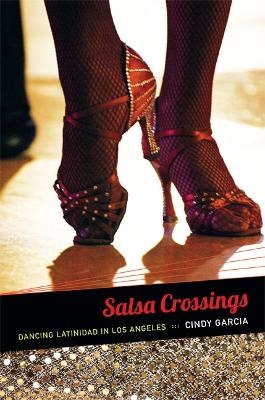
Salsa Crossings
Dancing Latinidad in Los Angeles
Seiten
2013
Duke University Press (Verlag)
978-0-8223-5481-9 (ISBN)
Duke University Press (Verlag)
978-0-8223-5481-9 (ISBN)
- Lieferbar (Termin unbekannt)
- Versandkostenfrei
- Auch auf Rechnung
- Artikel merken
Salsa Crossings is an ethnography describing how hierarchies of gender, race, and class, and of migration, citizenship, and belonging, are enacted on and off the dance floors of Los Angeles salsa clubs.
In Los Angeles, night after night, the city's salsa clubs become social arenas where hierarchies of gender, race, and class, and of nationality, citizenship, and belonging are enacted on and off the dance floor. In an ethnography filled with dramatic narratives, Cindy GarcÍa describes how local salseras/os gain social status by performing an exoticized L.A.–style salsa that distances them from club practices associated with Mexicanness. Many Latinos in Los Angeles try to avoid "dancing like a Mexican," attempting to rid their dancing of techniques that might suggest that they are migrants, poor, working-class, Mexican, or undocumented. In L.A. salsa clubs, social belonging and mobility depend on subtleties of technique and movement. With a well-timed dance-floor exit or the lift of a properly tweezed eyebrow, a dancer signals affiliation not only with a distinctive salsa style but also with a particular conceptualization of latinidad.
In Los Angeles, night after night, the city's salsa clubs become social arenas where hierarchies of gender, race, and class, and of nationality, citizenship, and belonging are enacted on and off the dance floor. In an ethnography filled with dramatic narratives, Cindy GarcÍa describes how local salseras/os gain social status by performing an exoticized L.A.–style salsa that distances them from club practices associated with Mexicanness. Many Latinos in Los Angeles try to avoid "dancing like a Mexican," attempting to rid their dancing of techniques that might suggest that they are migrants, poor, working-class, Mexican, or undocumented. In L.A. salsa clubs, social belonging and mobility depend on subtleties of technique and movement. With a well-timed dance-floor exit or the lift of a properly tweezed eyebrow, a dancer signals affiliation not only with a distinctive salsa style but also with a particular conceptualization of latinidad.
Cindy GarcÍa is Assistant Professor in the Department of Theatre Arts and Dance at the University of Minnesota.
About the Series ix
Preface xi
Acknowledgments xxiii
Introduction: Salsa's Lopsided Global Flow 1
1. The Salsa Wars 21
2. Dancing Salsa Wrong 43
3. Un/Sequined Corporealities 66
4. Circulations of Gender and Power 94
5. "Don't Leave Me, Celia!": Salsera Homosociality and Latina Corporealities 124
Conclusion 147
Notes 155
References 165
Index 177
| Erscheint lt. Verlag | 18.6.2013 |
|---|---|
| Reihe/Serie | Latin America Otherwise |
| Zusatzinfo | 4 illustrations |
| Verlagsort | North Carolina |
| Sprache | englisch |
| Maße | 152 x 229 mm |
| Gewicht | 413 g |
| Themenwelt | Sachbuch/Ratgeber ► Sport ► Tanzen / Tanzsport |
| Geschichte ► Teilgebiete der Geschichte ► Kulturgeschichte | |
| Sozialwissenschaften ► Ethnologie | |
| Sozialwissenschaften ► Soziologie ► Spezielle Soziologien | |
| ISBN-10 | 0-8223-5481-0 / 0822354810 |
| ISBN-13 | 978-0-8223-5481-9 / 9780822354819 |
| Zustand | Neuware |
| Informationen gemäß Produktsicherheitsverordnung (GPSR) | |
| Haben Sie eine Frage zum Produkt? |
Mehr entdecken
aus dem Bereich



aus dem Bereich
Die Revolution des Gemeinen Mannes
Buch | Softcover (2024)
C.H.Beck (Verlag)
CHF 16,80
Eine Geschichte des Geschmacks
Buch | Hardcover (2025)
C.H.Beck (Verlag)
CHF 49,95
vom Mittelalter bis zur Gegenwart
Buch | Softcover (2024)
C.H.Beck (Verlag)
CHF 16,80


