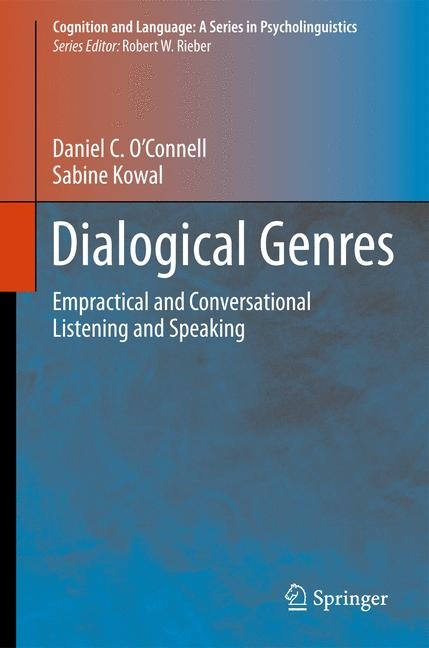
Dialogical Genres (eBook)
XXII, 226 Seiten
Springer New York (Verlag)
9781461435297 (ISBN)
The authors are experimental psychologists who have been engaged in research together for more than 40 years now. Dan O'Connell studied at St. Louis University and did doctoral work at the University of Illinois (Champaign/Urbana); Sabine Kowal studied at the Free University of Berlin and did doctoral work at St. Louis University. O'Connell's career was at St. Louis, Loyola of Chicago, and Georgetown Universities, while Kowal's was at both the Technical University of Berlin and the Anna Freud Oberschule in Berlin. For many years, the team was oriented toward mainstream psycholinguistics and experimental research on speech production. Throughout the last decades of the 20th century, their interest shifted to spontaneous spoken discourse under field observational conditions. This shift had as its origin their observation that professional speakers known for their eloquence in public dialogue violate both ideal delivery and syntactic well-formedness - concepts established in mainstream psycholinguistics as norms for effective communication. O'Connell and Kowal have ascribed the use of these norms to a written language bias and have accordingly turned their attention - both empirically and theoretically - to the use of genuine spoken discourse. Radio and TV political interviews have provided much of the empirical database for their recent research, and their emphasis on spontaneous spoken discourse has led to the investigation of neglected speech phenomena such as fillers, pauses, interjections, and laughter in both English- and German-language corpora. In recent decades too, they have become interested in criteria for adequate transcription of spoken dialogue, especially in light of irreconcilable differences between orality and literacy; their interest has also extended to revisionist approaches to the history of psycholinguistics. The present book itself applies new methods of analysis to corpora of empractical and conversational speech derived from American feature films. As an ubiquitous everyday genre of spoken dialogue, empractical speech demands empirical recognition.
This work gives a thorough revision of history through a psychological approach to verbal interaction between listeners and speakers. This book offers a large amount of information on the psychology of language and on psycholinguistics, and focuses on a new direction for a psychology of verbal communication. Empirical research includes media interviews, public speeches, and dramatic performances.
The authors are experimental psychologists who have been engaged in research together for more than 40 years now. Dan O’Connell studied at St. Louis University and did doctoral work at the University of Illinois (Champaign/Urbana); Sabine Kowal studied at the Free University of Berlin and did doctoral work at St. Louis University. O’Connell’s career was at St. Louis, Loyola of Chicago, and Georgetown Universities, while Kowal’s was at both the Technical University of Berlin and the Anna Freud Oberschule in Berlin. For many years, the team was oriented toward mainstream psycholinguistics and experimental research on speech production. Throughout the last decades of the 20th century, their interest shifted to spontaneous spoken discourse under field observational conditions. This shift had as its origin their observation that professional speakers known for their eloquence in public dialogue violate both ideal delivery and syntactic well-formedness – concepts established in mainstream psycholinguistics as norms for effective communication. O’Connell and Kowal have ascribed the use of these norms to a written language bias and have accordingly turned their attention – both empirically and theoretically – to the use of genuine spoken discourse. Radio and TV political interviews have provided much of the empirical database for their recent research, and their emphasis on spontaneous spoken discourse has led to the investigation of neglected speech phenomena such as fillers, pauses, interjections, and laughter in both English- and German-language corpora. In recent decades too, they have become interested in criteria for adequate transcription of spoken dialogue, especially in light of irreconcilable differences between orality and literacy; their interest has also extended to revisionist approaches to the history of psycholinguistics. The present book itself applies new methods of analysis to corpora of empractical and conversational speech derived from American feature films. As an ubiquitous everyday genre of spoken dialogue, empractical speech demands empirical recognition.
Part I: Taxonomoy and selectivity.- Historical sources: Credit where credit is due.- An historical search for genres of spoken dialogue.- An empirical search for genres of spoken dialogue.- Part II: Theoretical considerations of empractical speech.- Empractical speech: The forgotten sibling in spoken dialogue.- Time - Arbiter of continuity.- Listener roles in genres of spoken dialogue.- Social responsibility in spoken dialogue.- New directions.- Epilogue.
| Erscheint lt. Verlag | 9.7.2012 |
|---|---|
| Reihe/Serie | Cognition and Language: A Series in Psycholinguistics | Cognition and Language: A Series in Psycholinguistics |
| Zusatzinfo | XXII, 226 p. |
| Verlagsort | New York |
| Sprache | englisch |
| Themenwelt | Geisteswissenschaften ► Psychologie ► Allgemeine Psychologie |
| Geisteswissenschaften ► Psychologie ► Verhaltenstherapie | |
| Geisteswissenschaften ► Sprach- / Literaturwissenschaft ► Sprachwissenschaft | |
| Schlagworte | Communication • Linguistic • listening • Psycholinguistic • Speaking |
| ISBN-13 | 9781461435297 / 9781461435297 |
| Informationen gemäß Produktsicherheitsverordnung (GPSR) | |
| Haben Sie eine Frage zum Produkt? |
 PDF (Wasserzeichen)
DRM: Digitales Wasserzeichen
Dieses eBook enthält ein digitales Wasserzeichen und ist damit für Sie personalisiert. Bei einer missbräuchlichen Weitergabe des eBooks an Dritte ist eine Rückverfolgung an die Quelle möglich.
Dateiformat: PDF (Portable Document Format)
Mit einem festen Seitenlayout eignet sich die PDF besonders für Fachbücher mit Spalten, Tabellen und Abbildungen. Eine PDF kann auf fast allen Geräten angezeigt werden, ist aber für kleine Displays (Smartphone, eReader) nur eingeschränkt geeignet.
Systemvoraussetzungen:
PC/Mac: Mit einem PC oder Mac können Sie dieses eBook lesen. Sie benötigen dafür einen PDF-Viewer - z.B. den Adobe Reader oder Adobe Digital Editions.
eReader: Dieses eBook kann mit (fast) allen eBook-Readern gelesen werden. Mit dem amazon-Kindle ist es aber nicht kompatibel.
Smartphone/Tablet: Egal ob Apple oder Android, dieses eBook können Sie lesen. Sie benötigen dafür einen PDF-Viewer - z.B. die kostenlose Adobe Digital Editions-App.
Buying eBooks from abroad
For tax law reasons we can sell eBooks just within Germany and Switzerland. Regrettably we cannot fulfill eBook-orders from other countries.
aus dem Bereich