


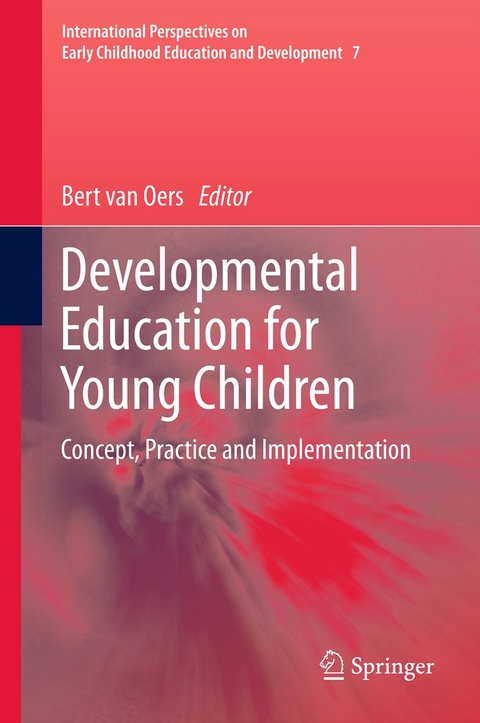
Developmental Education for Young Children (eBook)
XVIII, 302 Seiten
Springer Netherland (Verlag)
978-94-007-4617-6 (ISBN)
Developmental Education is an approach to education in school that aims at promoting children's cultural development and their abilities to participate autonomously and well-informed in the cultural practices of their community. From the point of view of Cultural-historical Activity theory (CHAT), a play-based curriculum has been developed over the past decades for primary school, which presents activity contexts for pupils in the classroom that create learning and teaching opportunities for helping pupils with appropriating cultural knowledge, skills, and moral understandings in meaningful ways. The approach is implemented in numerous Dutch primary schools classrooms with the explicit intention to support the learning of both pupils and teachers. The book focuses especially on education of young children (4 - 8 years old) in primary school and presents the underpinning concepts of this approach, and chapters on examples of good practices in a variety of subject matter areas, such as literacy (vocabulary acquisition, reading, writing), mathematics, and arts. Successful implementation of Developmental Education in the classroom strongly depends on dynamic assessment and continuous observations of young pupils' development. Strategies for implementation of both the teaching practices and assessment strategies are discussed in detail in the book.
Introduction; Bert van Oers.- Part 1: Developmental Education: Core issues.- 2. Developmental Education: Foundations of a Play-based Curriculum; Bert van Oers.- 3. Responsible Teaching; Wim Wardekker.- 4. Developmental Education for Young Children: Basic Development; Frea Janssen-Vos and Bea Pompert.- Part 2: Good practices of Developmental Education.- 5. Learning to Communicate in Young Children’s Classrooms; Dorian de Haan.- 6. Assessing Vocabulary Development; Renata Adan.- 7. Dynamic Assessment of Narrative Competence; Chiel van der Veen and Mariëlle Poland.- 8. Promoting Abstract Thinking in Young Children’s Play; Bert van Oers and Mariëlle Poland.- 9. Teaching Arts: Promoting Aesthetic Thinking; Lieke Roof.- 10. Every Child is Special: Teaching Young Children with Special Needs; Isabel Peters and Barbara Nellesteijn.- 11. Fostering the Teacher – Parent Partnership; André Weijers and Frea Janssen-Vos.- Part 3: Implementing the play-based curriculum of Developmental Education.- 12. Coaching the Transition towards Developmental Education: Exploring the Situation with Teachers; Lorien de Koning.- 13. Creating Knowledge and Practice in the Classroom: Bea Pompert.- 14. Evaluation of Learning and Development; Ester van Oers.- 15. Teaching Reading by Writing; Bea Pompert.- 16. Learning to Communicate about Number; Niko Fijma.- 17. Developmental Education Schools as Learning Organisations; Hans Bakker.- Conclusion: Actual and future consequences of implementing and researching Developmental Education; Bert van Oers.- Index.
| Erscheint lt. Verlag | 16.6.2012 |
|---|---|
| Reihe/Serie | International Perspectives on Early Childhood Education and Development | International Perspectives on Early Childhood Education and Development |
| Zusatzinfo | XVIII, 302 p. |
| Verlagsort | Dordrecht |
| Sprache | englisch |
| Themenwelt | Geisteswissenschaften ► Psychologie ► Entwicklungspsychologie |
| Geisteswissenschaften ► Psychologie ► Pädagogische Psychologie | |
| Sozialwissenschaften ► Pädagogik ► Vorschulpädagogik | |
| Sozialwissenschaften ► Politik / Verwaltung | |
| Schlagworte | cultural-historical theory • Curriculum • dynamic assessment • Early childhood education • Good Practice • implementation • Play • school innovation • subject matter learning • Teaching |
| ISBN-10 | 94-007-4617-2 / 9400746172 |
| ISBN-13 | 978-94-007-4617-6 / 9789400746176 |
| Informationen gemäß Produktsicherheitsverordnung (GPSR) | |
| Haben Sie eine Frage zum Produkt? |
 PDF (Wasserzeichen)
DRM: Digitales Wasserzeichen
Dieses eBook enthält ein digitales Wasserzeichen und ist damit für Sie personalisiert. Bei einer missbräuchlichen Weitergabe des eBooks an Dritte ist eine Rückverfolgung an die Quelle möglich.
Dateiformat: PDF (Portable Document Format)
Mit einem festen Seitenlayout eignet sich die PDF besonders für Fachbücher mit Spalten, Tabellen und Abbildungen. Eine PDF kann auf fast allen Geräten angezeigt werden, ist aber für kleine Displays (Smartphone, eReader) nur eingeschränkt geeignet.
Systemvoraussetzungen:
PC/Mac: Mit einem PC oder Mac können Sie dieses eBook lesen. Sie benötigen dafür einen PDF-Viewer - z.B. den Adobe Reader oder Adobe Digital Editions.
eReader: Dieses eBook kann mit (fast) allen eBook-Readern gelesen werden. Mit dem amazon-Kindle ist es aber nicht kompatibel.
Smartphone/Tablet: Egal ob Apple oder Android, dieses eBook können Sie lesen. Sie benötigen dafür einen PDF-Viewer - z.B. die kostenlose Adobe Digital Editions-App.
Buying eBooks from abroad
For tax law reasons we can sell eBooks just within Germany and Switzerland. Regrettably we cannot fulfill eBook-orders from other countries.
aus dem Bereich


