


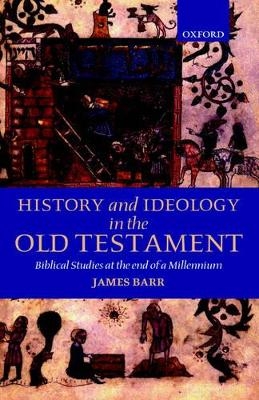
History and Ideology in the Old Testament
Biblical Studies at the End of a Millennium
Seiten
2000
Oxford University Press (Verlag)
978-0-19-826987-8 (ISBN)
Oxford University Press (Verlag)
978-0-19-826987-8 (ISBN)
Professor Barr has brought together aspects of controversy about the Bible at the end of the millennium with an emphasis on the Old Testament and the history of Israel. The central question is how far the Bible gives us a vision into a real world of the past and how far it expresses a world imagined for religious reasons by writes who lived many centuries later.
The end of the millennium sees biblical study in a state of transition. The traditional position of historical approaches is widely questioned and 'historical criticism' is regarded as passé. There is a search for approaches literary or sociological that are less tied to history. On the other hand there is a more radical approach to the history of Israel, that sees true history as distinct from the biblical narrative and dependent on sources other than the Bible. Biblical narratives thus express not the actual events but the ideological and religious aspirations of writers in much later times. 'Ideology' has become one of the key words, but is used in very divergent ways. All this is linked with the intellectual movement known as post-modernism. Some connections between post-modernism and theology are suggested by Professor Barr in the final chapter. This book is important because it tries to bring together various threads of these different movements and to state a position from which we may advance into the next millennium.
The end of the millennium sees biblical study in a state of transition. The traditional position of historical approaches is widely questioned and 'historical criticism' is regarded as passé. There is a search for approaches literary or sociological that are less tied to history. On the other hand there is a more radical approach to the history of Israel, that sees true history as distinct from the biblical narrative and dependent on sources other than the Bible. Biblical narratives thus express not the actual events but the ideological and religious aspirations of writers in much later times. 'Ideology' has become one of the key words, but is used in very divergent ways. All this is linked with the intellectual movement known as post-modernism. Some connections between post-modernism and theology are suggested by Professor Barr in the final chapter. This book is important because it tries to bring together various threads of these different movements and to state a position from which we may advance into the next millennium.
| Erscheint lt. Verlag | 18.5.2000 |
|---|---|
| Verlagsort | Oxford |
| Sprache | englisch |
| Maße | 145 x 225 mm |
| Gewicht | 353 g |
| Themenwelt | Religion / Theologie ► Christentum ► Kirchengeschichte |
| ISBN-10 | 0-19-826987-0 / 0198269870 |
| ISBN-13 | 978-0-19-826987-8 / 9780198269878 |
| Zustand | Neuware |
| Informationen gemäß Produktsicherheitsverordnung (GPSR) | |
| Haben Sie eine Frage zum Produkt? |
Mehr entdecken
aus dem Bereich

aus dem Bereich
eine andere Geschichte der Papststadt
Buch | Softcover (2024)
C.H.Beck (Verlag)
CHF 25,20
die Macht des Dunklen in unserer Zeit und wie wir ihr entgegentreten
Buch | Hardcover (2025)
Verlag Herder
CHF 27,90


