The book looks at the process of empirical research into the following seven stages:
- Formulation of the problem
- Stipulation of the precision requirements
- Selecting the statistical model for the planning and analysis
- The (optimal) design of the experiment or survey
- Performing the experiment or the survey
- Statistical analysis of the observed results
- Interpretation of the results.
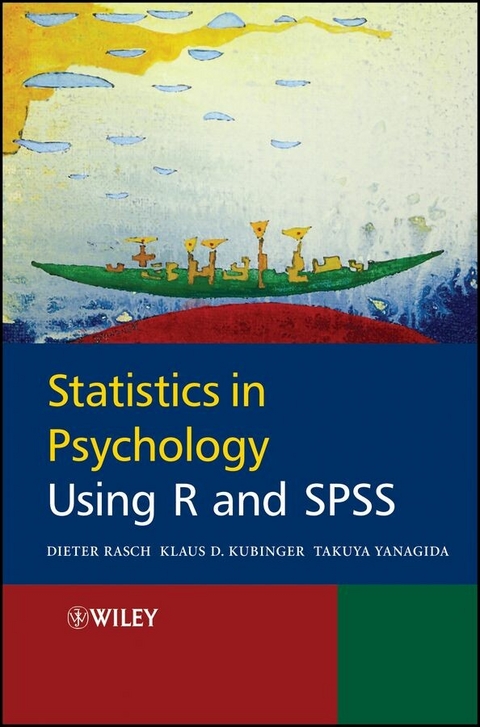
Statistics in Psychology covers all statistical methods needed in education and research in psychology. This book looks at research questions when planning data sampling, that is to design the intended study and to calculate the sample sizes in advance. In other words, no analysis applies if the minimum size is not determined in order to fulfil certain precision requirements. The book looks at the process of empirical research into the following seven stages: Formulation of the problem Stipulation of the precision requirements Selecting the statistical model for the planning and analysis The (optimal) design of the experiment or survey Performing the experiment or the survey Statistical analysis of the observed results Interpretation of the results.
Dieter Rasch, Department of Applied Statistics, University of Life Sciences, Vienna Klaus D. Kubinger, Division of Psychological Assessment and Applied Psychometrics, University of Vienna Takuya Yanagida, Division of Psychological Assessment and Applied Psychometrics, University of Vienna
Introduction.
1 Concept of the Book.
2 Measuring in Psychology.
2.1 Types of psychological measurements.
2.2 Measurement techniques in psychological assessment.
2.3 Quality criteria in psychometrics.
2.4 Additional psychological measurement techniques.
2.5 Statistical models of measurement with psychologicalroots.
3 Psychology: An Empirical Science.
3.1 Gain of insight in psychology.
3.2 Steps of empirical research.
4 Definition: Character, Chance, Experiment, andSurvey.
4.1 Nominal scale.
4.2 Ordinal scale.
4.3 Interval scale.
4.4 Ratio scale.
4.5 Characters and factors.
II Descriptive Statistics.
5 Numerical and graphical Data Analysis.
5.1 Introduction to data analysis.
5.2 Frequencies and empirical distributions.
5.3 Statistics.
5.4 Frequency distribution for several characters.
III Inferential Statistics for one Character.
6 Probability and distribution.
6.1 Relative frequencies and probabilities.
6.2 Random variable and theoretical distributions.
6.3 Quantiles of theoretical distribution functions.
6.4 Mean and variance of theoretical distributions.
6.5 Estimation of unknown parameters.
7 Assumptions: Random Sampling and Randomization.
7.1 Simple random sampling in surveys.
7.2 Principles of random sampling and randomization.
8 One Sample from one Population.
8.1 Introduction.
8.2 The Parameter mof acharacter modeled by a normallydistributed random variable.
8.3 Planning a study for hypothesis testing with respect tom.
8.4 Sequential tests for the unknown parameter m.
8.5 Estimation, hypothesis testing, planning the study, andsequential testing concerning other parameters.
9 Two Samples from two Populations.
9.1 Hypothesis testing, study planning and sequential testingregarding the unknown parameters m1 andm2.
9.2 Hypothesis testing, study planning and sequential testingfor other parameters.
9.3 Equivalence testing.
10 Samples from more than two Populations.
10.1 The various problem situations.
10.2. Selection procedures.
10.3 Multiple comparisons of means.
10.4 Analysis of variance.
IV Descriptive and Inferential Statistics for twoCharacters.
11 Regression and Correlation.
11.1 Introduction.
11.2 Regression model.
11.3 Correlation coefficients and measures of association.
11.4 Hypothesis testing and planning the study concerningcorrelation coefficients.
11.5 Correlation analysis in two samples.
V Inferential Statistics for more than twoCharacters.
12 One Sample from one Population.
12.1 Association between three or more characters.
12.2 Hypothesis testing concerning a vector of meansm.
12.3 Comparisons of means and "homological" methods for matchedobservations.
13 Samples from more than one Population.
13.1 General linear model.
13.2 Analysis of covariance.
13.3. Multivariate analysis of variance.
13.4 Discriminant analysis.
VI Model Generation and Theory-Generating Procedures.
14 Model Generation.
14.1 Theoretical basics of model generation.
14.2 Methods for determining the quality and excellence of amodel.
14.2.1 Goodness of fit tests.
14.2.2 Coefficients of the goodness of fit.
14.2.3 Cross-validation.
14.4 Simulation: Non-analytical solutions to statisticalproblems.
15 Theory-Generating Procedures.
15.1 Descriptive statistics' methods.
15.2 Methods of inferential statistics.
| Erscheint lt. Verlag | 27.10.2011 |
|---|---|
| Sprache | englisch |
| Themenwelt | Geisteswissenschaften ► Psychologie |
| Mathematik / Informatik ► Mathematik ► Statistik | |
| Mathematik / Informatik ► Mathematik ► Wahrscheinlichkeit / Kombinatorik | |
| Schlagworte | Angewandte Psychologie • Applied Psychology • Book • Design • Education • Empirical • Experiment • Experimental Design • Formulation • Model • Optimal • Planning • precision requirements • Problem • Process • Psychologie • Psychology • Research • R (Programm) • SEVEN • SPSS • Stages • Statistical • Statistical Methods • Statistics • Statistics for Social Sciences • Statistik • Statistik in den Sozialwissenschaften • stipulation • Survey • Versuchsplanung |
| ISBN-13 | 9781119952022 / 9781119952022 |
| Informationen gemäß Produktsicherheitsverordnung (GPSR) | |
| Haben Sie eine Frage zum Produkt? |
 EPUB (Adobe DRM)
Kopierschutz: Adobe-DRM
Adobe-DRM ist ein Kopierschutz, der das eBook vor Mißbrauch schützen soll. Dabei wird das eBook bereits beim Download auf Ihre persönliche Adobe-ID autorisiert. Lesen können Sie das eBook dann nur auf den Geräten, welche ebenfalls auf Ihre Adobe-ID registriert sind.
Details zum Adobe-DRM
Dateiformat: EPUB (Electronic Publication)
EPUB ist ein offener Standard für eBooks und eignet sich besonders zur Darstellung von Belletristik und Sachbüchern. Der Fließtext wird dynamisch an die Display- und Schriftgröße angepasst. Auch für mobile Lesegeräte ist EPUB daher gut geeignet.
Systemvoraussetzungen:
PC/Mac: Mit einem PC oder Mac können Sie dieses eBook lesen. Sie benötigen eine
eReader: Dieses eBook kann mit (fast) allen eBook-Readern gelesen werden. Mit dem amazon-Kindle ist es aber nicht kompatibel.
Smartphone/Tablet: Egal ob Apple oder Android, dieses eBook können Sie lesen. Sie benötigen eine
Geräteliste und zusätzliche Hinweise
Buying eBooks from abroad
For tax law reasons we can sell eBooks just within Germany and Switzerland. Regrettably we cannot fulfill eBook-orders from other countries.
aus dem Bereich