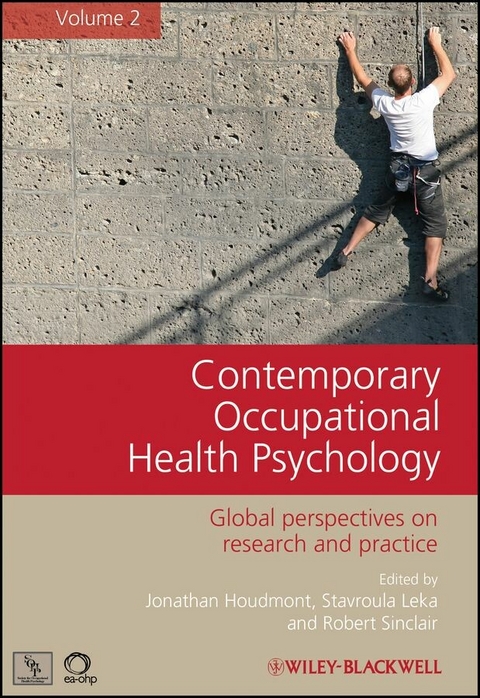
Contemporary Occupational Health Psychology, Volume 2 (eBook)
John Wiley & Sons (Verlag)
978-1-119-94215-3 (ISBN)
- Volume 2 of the most important and influential research series in the rapidly growing field of occupational health psychology
- Presents state-of-the-art research along with its implications for real-world practice
- Provides in-depth reviews of hot topics, including new work from several top international experts in the field
- Volume 2 includes increased North American contributions, sourced by a dedicated North America editor
Dr. Jonathan Houdmont is a Lecturer in Occupational Health Psychology and Director of the Workplace Health & Wellbeing postgraduate studies program in the Institute of Work, Health and Organisations (IWHO) at the University of Nottingham, UK. His research interests focus on measurement and intervention issues in relation to work-related stress and psychosocial risk.
Dr. Stavroula Leka is an Associate Professor in Occupational Health Psychology at IWHO and Director of its program of work for the World Health Organization. Her primary research interests are the translation of occupational health and safety knowledge and policy into practice, and psychosocial risk management. She has been awarded an early career achievement award in occupational health psychology by the American Psychological Association, US NIOSH and the Society of Occupational Health Psychology. She is Chair of the Education Forum of the European Academy of Occupational Health Psychology.
Dr. Robert R. Sinclair is an Associate Professor of Industrial-Organizational Psychology at Clemson University. He is a founding member and Past-President of the Society for Occupational Health Psychology. His research appears in leading journals such as the Journal of Applied Psychology, Journal of Organizational Behavior, and Journal of Occupational Health Psychology.
Contemporary Occupational Health Psychology: Global Perspectives on Research and Practice, Volume 2 continues a definitive reference series published in association with the European Academy of Occupational Health Psychology (EAOHP) and the Society for Occupational Health Psychology (SOHP). The series summarizes state-of-the-art research and practice in the field of occupational health psychology. Volume 2 of the most important and influential research series in the rapidly growing field of occupational health psychology Presents state-of-the-art research along with its implications for real-world practice Provides in-depth reviews of hot topics, including new work from several top international experts in the field Volume 2 includes increased North American contributions, sourced by a dedicated North America editor
Dr. Jonathan Houdmont is a Lecturer in Occupational Health Psychology and Director of the Workplace Health & Wellbeing postgraduate studies program in the Institute of Work, Health and Organisations (IWHO) at the University of Nottingham, UK. His research interests focus on measurement and intervention issues in relation to work-related stress and psychosocial risk. Dr. Stavroula Leka is an Associate Professor in Occupational Health Psychology at IWHO and Director of its program of work for the World Health Organization. Her primary research interests are the translation of occupational health and safety knowledge and policy into practice, and psychosocial risk management. She has been awarded an early career achievement award in occupational health psychology by the American Psychological Association, US NIOSH and the Society of Occupational Health Psychology. She is Chair of the Education Forum of the European Academy of Occupational Health Psychology. Dr. Robert R. Sinclair is an Associate Professor of Industrial-Organizational Psychology at Clemson University. He is a founding member and Past-President of the Society for Occupational Health Psychology. His research appears in leading journals such as the Journal of Applied Psychology, Journal of Organizational Behavior, and Journal of Occupational Health Psychology.
About the Editors vii
Contributors ix
Preface xiii
1 Organizational Politics and Occupational Health Psychology: A Demands-Resources Perspective 1 Simon L. Albrecht and Erin M. Landells
2 Employee Commitment and Well-being 19
John P. Meyer, Elyse R. Maltin, and Sabrina P. C. Thai
3 Developing Evidence-Based Occupational Health Psychology 36
Rob B. Briner
4 Understanding Mental Health Treatment-Seeking in High Stress Occupations 57
Thomas W. Britt and Anna C. McFadden
5 Humor as a Human Resource Tool in Organizations 74
Josje Dikkers, Sibe Doosje, and Annet de Lange
6 Predicting Abusive Supervision 92
M. Sandy Hershcovis and Alannah E. Rafferty
7 Designing Jobs for an Aging Workforce: An Opportunity for Occupational Health 109
Donald M. Truxillo, David M. Cadiz, and Jennifer R. Rineer
8 Moving Towards Positive Organizational Health: Challenges and a Proposal for a Research Model of Organizational Health Development 126
Georg F. Bauer and Gregor J. Jenny
9 New Directions in Positive Psychology: Implications for a Healthy Workplace 146
Clive Fullagar and E. Kevin Kelloway
10 The Management of Psychosocial Risks Across the European Union: Findings from ESENER 162
William Cockburn, Malgorzata Milczarek, Xabier Irastorza, and Eusebio Rial González
11 The Public Health Perspective: Useful for Occupational Health Psychologists and Health and Safety Professionals? 184
Birgit A. Greiner
12 Presenteeism: A Short History and a Cautionary Tale 204
Gary Johns
13 Workload: A Review of Causes, Consequences, and Potential Interventions 221
Nathan A. Bowling and Cristina Kirkendall
14 Work, Stress and Health Behaviors 239
Nicola Paynev, Gail Kinman, and Fiona Jones
Index 257
Contents of Previous Volume 269
"This book by psychology academics and practitioners
provides an overview of current practice in occupational health
psychology . . . Nevertheless, this is not a light read but a book
to dip into chapter at a time rather than read from cover to
cover." (Occupational Medicine, 18 November
2012)
"Ideal for advanced scholars of OHP, the book will also be
of interest to students of applied psychology. Summing Up:
Recommended. Upper-division undergraduates through faculty
and professionals." (Choice, 1 October 2012)
Chapter 2
Employee Commitment and Well-being
John P. Meyer and Elyse R. Maltin
The University of Western Ontario, Canada
Sabrina Thai
University of Toronto, Canada
Interest in employee commitment was initially stimulated by concerns over employee retention (Mowday, Porter & Steers, 1982) and gradually expanded to include other employer-relevant outcomes such as attendance, job performance, and organizational citizenship behavior (Meyer & Allen, 1997). It is only recently that researchers have started to address the implications of commitment for employees' own health and well-being (Meyer & Maltin, 2010). Our objective in this chapter is to provide a theoretical framework to explain how and why commitment is relevant to employee well-being. This framework derives from and integrates theory and research from the commitment, motivation, and occupational health psychology literatures, and is intended to serve as a guide for future research and management practice.
We begin by explaining what we mean by commitment and well-being. Both concepts are complex and multifaceted and this has important implications for how they relate to one another. Next, we provide a general theoretical framework to organize our review of existing studies and serve as a guide for future research. As we work through this framework, we first review the evidence linking commitment to various indices of employee well-being. Then, having established the relevance of commitment for well-being, we draw on self-determination theory (SDT: Ryan & Deci, 2000) and the job demand-resources model (JD-R: Bakker & Demerouti, 2007) to explain the effects of commitment and identify work conditions associated with employee commitment and well-being. Finally, we offer directions for future research and discuss the implications of our theoretical framework for the design of workplace policies and practices intended to foster commitment and employee well-being.
The Meaning of Commitment and Well-being
Over the last several decades, commitment has been conceptualized in various ways (for reviews, see Klein, Molloy & Cooper, 2009b; Meyer & Allen, 1997). For present purposes, we adapt the approach taken in the well-established three-component model (TCM: Meyer & Allen, 1991, 1997; Meyer & Herscovitch, 2001) and view commitment as “a force that binds an individual to a target (social or non-social) and to a course of action of relevance to that target” (Meyer, Becker & Van Dick, 2006, p. 666). This binding force can be experienced in different ways (i.e., can be accompanied by different mindsets), including: an affective attachment and involvement with the target, a felt obligation to the target, and an awareness of the costs associated with discontinuing involvement with the target. In their pure forms, these mindsets are referred to as affective (AC), normative (NC), and continuance (CC) commitment, respectively.
The vast majority of research on workplace commitments has focused on employee commitment to the organization, and this is particularly true for research pertaining to commitment and well-being. However, increased attention is now being given to other workplace commitments, including commitments to other organizations (e.g., professions and unions; see Vandenberghe, 2009), people (e.g., supervisors and teams; see Becker, 2009), and actions (e.g., goals and programs; see Neubert & Wu, 2009). These commitments have all been found to have outcomes of relevance to the specific target and, in many cases, to the organization as a whole. To date, only a few studies have addressed the implications of these other commitments for employee well-being, but they are included in our review where relevant.
The meaning of employee well-being is arguably even more complex than the meaning of commitment. Varying definitions and models of well-being have been proposed over the years, and a detailed discussion of this issue goes beyond our current objectives (see Tetrick, 2002, for more information). To date, most research linking commitment to well-being has been based on a medical model wherein wellness is conceptualized as the absence of illness. More recently, the promotion of positive psychology (e.g., Seligman & Csikszentmihalyi, 2000) has contributed to efforts to define well-being more broadly, in terms of optimal functioning (e.g., personal growth and development; cf. Ryan & Deci, 2001; Ryff & Singer, 2008). Because of the nature of the existing research, our review is largely restricted to the implications of commitment for the presence/absence of stress and strain. However, we adapt a broader conceptualization of well-being in our discussion of directions for future research.
Commitment and Well-being: A Theoretical Framework
Although growing, the existing body of research linking commitment to employee well-being continues to be somewhat fragmented and unsystematic. This may be due, at least in part, to the lack of a clear and cohesive theoretical framework (Meyer & Maltin, 2010). Our objective here is to provide a model that can be used to organize and explain existing findings and serve as a guide for future investigation. This model, depicted in Figure 2.1, positions commitment as a direct contributor to employees' physical and psychological health as well as a mediator of the effects of work conditions. More importantly, it identifies a set of mechanisms that might help to account for the health-related effects of commitment and explain when and why organizational policies and practices are effective in promoting the forms of commitment most likely to benefit employers and their employees.
Figure 2.1 Employee Commitment and Well-being: A Conceptual Framework
Before elaborating on our theoretical framework, we offer several caveats. First, research examining the relevance of commitment for well-being has generally focused on direct relations between commitment and indices of physical and mental health or ill-heath, as well as the moderating effects of commitment on the relations between workplace stressors and strain. In the interest of space, we focus on the former. For more information pertaining to moderating effects, interested readers are directed to a recent review by Meyer and Maltin (2010). Second, our discussion of theory-relevant work conditions, mechanisms, and outcomes is also limited. For example, there are other theories of stress/well-being (e.g., Hobfoll & Shirom, 2001) and motivation (e.g., Higgins, 1998) that might help to explain the implications of commitment for employee well-being and warrant attention in future research. Finally, although we refer to work conditions as antecedents, commitment as a mediator, and well-being as an outcome, it is important to note that virtually all of the research upon which our theoretical framework is based is non-experimental. Therefore, while causal effects are implied, they cannot be firmly established. We address this limitation in more detail later in the context of future directions for research.
Well-being as an Outcome of Commitment
According to our theoretical model, commitment has a direct link to employee health and well-being. As we discuss below, the strength and direction of this relationship is expected to vary depending on the nature of the commitment. Commitment is also expected to relate indirectly to well-being through its association with regulatory processes reflected in employees' motivational state. In this section, we focus on the evidence establishing a link between commitment and well-being. We return to a discussion of regulatory processes below in an effort to understand these links.
The vast majority of research examining relations between commitment and employee well-being has focused on affective commitment (AC), especially AC directed at the organization. AC has consistently been shown to relate positively to indices of health and negatively to indices of ill-health. For example, AC has been found to correlate positively with overall physical well-being (e.g., Siu, 2002), general health (e.g., Bridger, Kilminster & Slaven, 2007), mental health (e.g., Grawitch, Trares & Kohler, 2007), positive affect (e.g., Thoresen et al., 2003), job-related well-being (e.g., Epitropaki & Martin, 2005), self-esteem (e.g., Frone, 2007), and life satisfaction (e.g., Zickar, Gibby & Jenny, 2004). AC has also been found to correlate negatively with measures of strain, including psychosomatic symptoms (e.g., Addae & Wang, 2006), physical health complaints (e.g., Wegge et al., 2006), mental health complaints such as anxiety and depression (e.g., Hepburn, Kelloway & Franche, 2010), negative affect (e.g., Thoresen et al., 2003), burnout (e.g., Grawitch, Barber & Kruger, 2010), and felt stress, distress, general strain, and job-related tension (e.g., Lambert, Hogan & Griffin, 2008). Among the exceptions to this general trend are a few studies that reported non-significant relations with physical or psychological strain (e.g., Jamal, 2005; Littrell, Billingsley & Cross, 1994; Tan & Akhtar, 1998); we found no evidence of positive relations.
Interestingly, although not as widely studied, relations between continuance commitment (CC) to the organization and employee well-being have sometimes been found to be the reverse of those observed for AC. For example, Zickar et al. (2004) found a negative correlation with life satisfaction, and other studies have reported positive relations with indices of strain,...
| Erscheint lt. Verlag | 30.3.2012 |
|---|---|
| Sprache | englisch |
| Themenwelt | Geisteswissenschaften ► Psychologie ► Arbeits- und Organisationspsychologie |
| Medizin / Pharmazie ► Medizinische Fachgebiete ► Psychiatrie / Psychotherapie | |
| Schlagworte | academics • Academy • Arbeitspsychologie • association • biennial • Book • Contemporary • European • Field • Global • Health • Health Psychology • highlyacclaimed • important • New • Occupational • Organizational & Industrial Psychology • Overview • Perspectives • Psychologie • Psychologie i. d. Arbeitswelt • Psychology • Research • series • Updates • valuable • Volume • Work |
| ISBN-10 | 1-119-94215-2 / 1119942152 |
| ISBN-13 | 978-1-119-94215-3 / 9781119942153 |
| Informationen gemäß Produktsicherheitsverordnung (GPSR) | |
| Haben Sie eine Frage zum Produkt? |
 EPUB (Adobe DRM)
Kopierschutz: Adobe-DRM
Adobe-DRM ist ein Kopierschutz, der das eBook vor Mißbrauch schützen soll. Dabei wird das eBook bereits beim Download auf Ihre persönliche Adobe-ID autorisiert. Lesen können Sie das eBook dann nur auf den Geräten, welche ebenfalls auf Ihre Adobe-ID registriert sind.
Details zum Adobe-DRM
Dateiformat: EPUB (Electronic Publication)
EPUB ist ein offener Standard für eBooks und eignet sich besonders zur Darstellung von Belletristik und Sachbüchern. Der Fließtext wird dynamisch an die Display- und Schriftgröße angepasst. Auch für mobile Lesegeräte ist EPUB daher gut geeignet.
Systemvoraussetzungen:
PC/Mac: Mit einem PC oder Mac können Sie dieses eBook lesen. Sie benötigen eine
eReader: Dieses eBook kann mit (fast) allen eBook-Readern gelesen werden. Mit dem amazon-Kindle ist es aber nicht kompatibel.
Smartphone/Tablet: Egal ob Apple oder Android, dieses eBook können Sie lesen. Sie benötigen eine
Geräteliste und zusätzliche Hinweise
Buying eBooks from abroad
For tax law reasons we can sell eBooks just within Germany and Switzerland. Regrettably we cannot fulfill eBook-orders from other countries.
aus dem Bereich