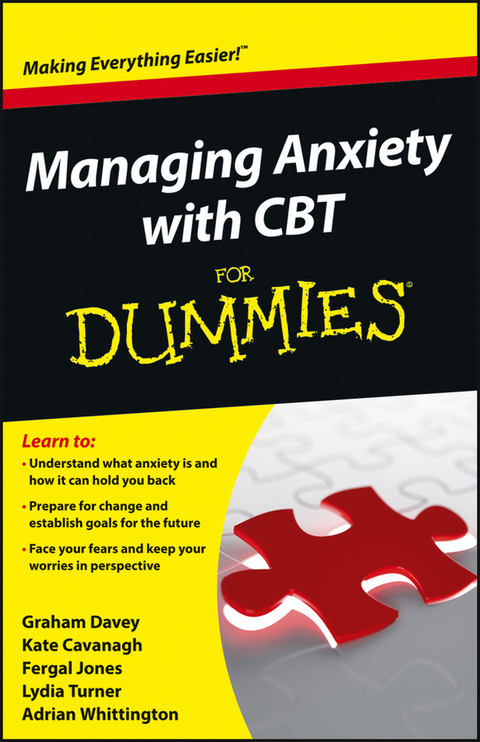
Cognitive Behavioural Therapy (CBT) is a hugely popular self-help technique, which teaches you to break free from destructive or negative behaviors and make positive changes to both your thoughts and your actions. This practical guide to managing anxiety with CBT will help you understand your anxiety, identify solutions to your problems, and maintain your gains and avoid relapse.
Managing Anxiety with CBT For Dummies is a practical guide to using CBT to face your fears and overcome anxiety and persistent, irrational worries. You'll discover how to put extreme thinking into perspective and challenge negative, anxiety-inducing thoughts with a range of effective CBT techniques to help you enjoy a calmer, happier life.
- Helps you understand anxiety and how CBT can help
- Guides you in making change and setting goals
- Gives you tried-and-true CBT techniques to face your fears and keep a realistic perspective
Managing Anxiety with CBT For Dummies gives you the tools you need to overcome anxiety and expand your horizons for a healthy, balanced life.
Graham Davey is Professor of Psychology at the University of Sussex and Editor-in-Chief of the Journal of Experimental Psychopathology. Kate Cavanagh is a Senior Lecturer in Clinical Psychology at the University of Sussex. Fergal Jones is a Senior Lecturer in Clinical Psychology at Canterbury Christ Church University in Kent. Lydia Turner is a Consultant Psychological Therapist, and Adrian Whittington is a Consultant Clinical Psychologist, both based at the Sussex Partnership NHS Foundation Trust.
Don't panic! Combat your worries and minimize anxiety with CBT! Cognitive Behavioural Therapy (CBT) is a hugely popular self-help technique, which teaches you to break free from destructive or negative behaviors and make positive changes to both your thoughts and your actions. This practical guide to managing anxiety with CBT will help you understand your anxiety, identify solutions to your problems, and maintain your gains and avoid relapse. Managing Anxiety with CBT For Dummies is a practical guide to using CBT to face your fears and overcome anxiety and persistent, irrational worries. You'll discover how to put extreme thinking into perspective and challenge negative, anxiety-inducing thoughts with a range of effective CBT techniques to help you enjoy a calmer, happier life. Helps you understand anxiety and how CBT can help Guides you in making change and setting goals Gives you tried-and-true CBT techniques to face your fears and keep a realistic perspective Managing Anxiety with CBT For Dummies gives you the tools you need to overcome anxiety and expand your horizons for a healthy, balanced life.
Graham Davey is Professor of Psychology at the University of Sussex and Editor-in-Chief of the Journal of Experimental Psychopathology. Kate Cavanagh is a Senior Lecturer in Clinical Psychology at the University of Sussex. Fergal Jones is a Senior Lecturer in Clinical Psychology at Canterbury Christ Church University in Kent. Lydia Turner is a Consultant Psychological Therapist, and Adrian Whittington is a Consultant Clinical Psychologist, both based at the Sussex Partnership NHS Foundation Trust.
Introduction 1
Part I: Understanding Your Anxiety 7
Chapter 1: All About Anxiety 9
Chapter 2: Making a Map of Your Anxiety 23
Part II: Tackling Your Anxiety 37
Chapter 3: Going for Goals 39
Chapter 4: Facing Your Fears 51
Chapter 5: Finding Out if Your Fears Are Fact or Fiction 63
Chapter 6: Letting Go of Worry 81
Chapter 7: Anxiety Rules and How to Break Them 93
Part III: Making Progress and Moving On 107
Chapter 8: Looking at the Bigger Picture 109
Chapter 9: Creating Your Route Map for a Brighter Future 123
Part IV: The Part of Tens 135
Chapter 10: Ten Tips for Tackling Anxiety 137
Chapter 11: Ten Inspiring Tips for Moving On from Anxiety 145
Index 157
Chapter 1
All About Anxiety
In This Chapter
Finding out why and how you experience anxiety
Discovering the benefits of anxiety
Knowing when anxiety becomes a problem
Using CBT to alleviate anxiety
Anxiety is just one of a number of important emotions that you experience on a daily basis and that have important effects on the way you think and behave. Most importantly, anxiety is an emotion that can have beneficial effects (making you alert and focused when faced with potential challenges) or it can be debilitating and distressing if it takes over your life and feels uncontrollable.
In this chapter we lay the foundations for a thorough understanding of anxiety. We explain what exactly anxiety is, and why and how you experience it. We determine when it is that anxiety becomes a problem, and seems to control you. Finally, we introduce you to cognitive behavioural therapy (CBT): what it is, and how it can help you.
Understanding the Basics of Anxiety
Everyone experiences many emotions on a daily basis. In this section we look at some of those emotions, including anxiety, and explain that emotions – even anxiety – can be useful when experienced at the right time and in the right amount.
Knowing that anxiety is a normal, and useful, emotion
Your feelings have evolved to serve adaptive purposes and, in most cases, they help you to solve problems that you encounter. Here are some important emotions that you experience pretty much daily:
- Anger in response to feeling challenged or thwarted.
- Anxiety in response to anticipated threats.
- Disgust in response to repulsive or sickening things or events.
- Fear in response to immediate perceived threats.
- Happiness/joy in response to things that you find positive or rewarding.
- Sadness/sorrow in response to losses or failures you experience.
In general, positive emotions like joy make you feel good (because you associate them with achievement and reward) and negative emotions like anger tend to feel unpleasant (because you associate then with threats, challenges and losses). Nevertheless, the significance of all emotions is that they help you react to, adapt to and deal more successfully with these various types of life events.
So in the case of anxiety, most people are willing to put up with the unpleasant feeling that anxiety gives them because the emotion helps them to deal more effectively with the threats and challenges they face in day-to-day life. Yes, we’re talking about a positive side to anxiety. Table 1-1 provides everyday examples of the advantages of the emotion.
Table 1-1 The Benefits of Anxiety
| Threat or Challenge | Benefits of Anxiety |
| Preparing for an interview | Feeling a bit anxious makes you focus on the interview and provides a level of arousal that ensures that you’re motivated and alert to answer questions. |
| Meeting an important person for the first time (for example on a date) | Normal levels of anxiety enable you to think through a few of the things that might happen during the meeting and prepare yourself to deal with these possibilities. |
| Finding your bank balance is overdrawn | A bit of anxiety focuses you on the problem and helps you to problem-solve how you could get your bank balance back into the black. |
Appreciating the purpose of anxiety
To survive as living organisms, people must be able to effectively deal with all those things in the world that are likely to pose threats to survival. Many unsophisticated organisms survive by having biologically pre-wired responses to basic threats. Humans too have some responses they’re born with that help them to deal with potential threats. For example, people have pre-wired startle responses that make them suddenly alert to the kinds of things that might signal threats. People are startled by:
- Sudden loud noises.
- Looming shadows.
- Rapid movement of things towards them.
- Rapid, unpredictable movements around them.
- Staring eyes.
Interestingly, all these things that startle people are also characteristic of potential predators, so the startle response is a primitive one designed to make you alert to, and avoid, physical threat. However, the modern world is made up of many more potential threats and challenges than this, so people have evolved a more flexible system to help them deal with the vast range of threats and challenges that confront them during a normal lifetime. This situation is where anxiety and its various elements comes in as a means of helping you to deal with anything that you’ve labelled as threatening.
So, if you’ve thought about something and decided – for whatever reason – that it’s potentially threatening, you begin to experience anxiety as an emotion that helps you deal with this perceived threat by making you more alert and focused.
The more things you interpret as threatening, the more anxiety you experience. So, the more you tend to interpret events as threats, the more anxious you feel.
Experiencing anxiety
You experience anxiety in a variety of ways:
- Feelings: You experience an unpleasant feeling of apprehension (as if you’re under threat).
- Bodily sensations: You may have tense muscles and a dry mouth, a shirt stuck to you with sweat, and be trembling and struggling to swallow.
- Physiological changes: Your heart beats faster, you feel more alert and vigilant, and your reactions are faster.
- Behaviours: You want to avoid the source of what’s making you anxious.
- Thoughts: Perhaps paradoxically (given how unpleasant anxiety can make you feel), anxiety makes you think more closely and more directly about threats and challenges. Anxiety can affect your thinking by:
- Controlling your attention: Anxiety forces you to focus on things that may be threatening or problematic.
- Determining how you interpret things: If something could be good or bad, anxiety compels you to adopt the bad interpretation.
- Affecting your reasoning: Anxiety makes you search for reasons that things might be bad or problematic.
- Making you think that things are worse than they really are: This catastrophising causes you to make mountains out of molehills.
- Making you expect bad things happening: You think life will hand you lemons more often than in fact it does.
The relationship between anxiety and thinking works both ways – anxiety can affect the way you think, but the way you think can also cause you to feel anxious. So if you’re not careful, the interaction between thoughts and feelings can spiral out of control and leave you with distressing levels of anxiety.
All these elements form the basis of normally experienced anxiety. As we emphasise throughout this book, normally experienced anxiety is an unpleasant feeling, but in most cases is a short-lived experience and one that’s a common reaction to future threats and challenges. In proper amounts, normally experienced anxiety is adaptive and beneficial.
Knowing When Anxiety Becomes a Problem
Anxiety is an emotion that serves a purpose in specific situations. Even though anxiety isn’t necessarily a pleasant experience, most people can usually control it. They turn on the emotion when necessary, and then turn if off when they no longer need it. But some people lose their ability to manage their anxiety, and it begins to become a regular unpleasant experience. Anxiety becomes a relatively pervasive emotion that they experience on a regular basis, from waking up in the morning to going to bed at night.
So how does anxiety change from being a benefit to a problem?
Seeing how anxiety takes over
A number of factors can make your anxiety seem uncontrollable:
- Awareness: You become overly aware of your feelings of anxiety when they occur and focus on them to the point where this attention to the feelings just makes them feel worse.
- Rules and beliefs: You develop rules and beliefs that you must do certain things when you encounter something that’s threatening or challenging, and these act to maintain anxiety. Examples include:
- ‘Worry is a necessary thing to do.’
- ‘I must resolve all uncertainty.’
- ‘If anything bad happens it will be my fault, so I must try to ensure that nothing bad ever happens.’
We discuss breaking out of these limiting rules and beliefs in Chapter 7.
- Strategies: You develop strategies and responses to try to prevent anxiety occurring – for example, repeatedly checking that things are okay and avoiding things that make you feel anxious. But your attempts to prevent anxiety occurring only reinforce your view that anxiety is both bad and still uncontrollable. Head to Chapter 4 for pointers on putting yourself in situations you’ve been avoiding.
- Stress: If you’re experiencing stress (for example, at work, at home or in relationships), you find it more difficult to exert control over your feelings of anxiety and to switch anxiety off.
- Thought patterns: You may develop...
| Erscheint lt. Verlag | 28.8.2012 |
|---|---|
| Sprache | englisch |
| Themenwelt | Sachbuch/Ratgeber ► Gesundheit / Leben / Psychologie ► Lebenshilfe / Lebensführung |
| Sachbuch/Ratgeber ► Gesundheit / Leben / Psychologie ► Psychologie | |
| Geisteswissenschaften ► Psychologie ► Angst / Depression / Zwang | |
| Schlagworte | Kognitive Verhaltenstherapie • Managing Anxiety with CBT For Dummies, Managing Anxiety For Dummies, CBT book, CBT books, Cognitive Behavioural Therapy book, Cognitive Behavioural Therapy books, managing anxiety, how to manage anxiety, guide to managing anxiety, Cognitive Behavioral Therapy book, Cognitive Behavioral • Ratgeber • Self-Help |
| ISBN-13 | 9781118366080 / 9781118366080 |
| Informationen gemäß Produktsicherheitsverordnung (GPSR) | |
| Haben Sie eine Frage zum Produkt? |
 EPUB (Adobe DRM)
Kopierschutz: Adobe-DRM
Adobe-DRM ist ein Kopierschutz, der das eBook vor Mißbrauch schützen soll. Dabei wird das eBook bereits beim Download auf Ihre persönliche Adobe-ID autorisiert. Lesen können Sie das eBook dann nur auf den Geräten, welche ebenfalls auf Ihre Adobe-ID registriert sind.
Details zum Adobe-DRM
Dateiformat: EPUB (Electronic Publication)
EPUB ist ein offener Standard für eBooks und eignet sich besonders zur Darstellung von Belletristik und Sachbüchern. Der Fließtext wird dynamisch an die Display- und Schriftgröße angepasst. Auch für mobile Lesegeräte ist EPUB daher gut geeignet.
Systemvoraussetzungen:
PC/Mac: Mit einem PC oder Mac können Sie dieses eBook lesen. Sie benötigen eine
eReader: Dieses eBook kann mit (fast) allen eBook-Readern gelesen werden. Mit dem amazon-Kindle ist es aber nicht kompatibel.
Smartphone/Tablet: Egal ob Apple oder Android, dieses eBook können Sie lesen. Sie benötigen eine
Geräteliste und zusätzliche Hinweise
Buying eBooks from abroad
For tax law reasons we can sell eBooks just within Germany and Switzerland. Regrettably we cannot fulfill eBook-orders from other countries.
aus dem Bereich