


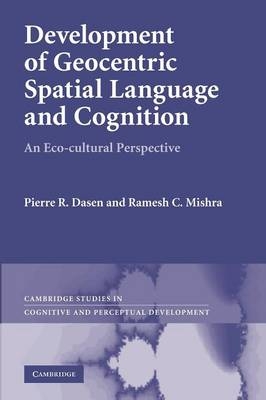
Development of Geocentric Spatial Language and Cognition
An Eco-cultural Perspective
Seiten
2013
Cambridge University Press (Verlag)
9781107412484 (ISBN)
Cambridge University Press (Verlag)
9781107412484 (ISBN)
When talking about the location of objects inside a room, we can use small-scale egocentric directions (right and left) or large-scale geocentric ones (North, South, East and West). This book explores children's acquisition and use of spatial frames of reference in different cultural contexts, including Bali, India, Nepal, and Switzerland.
Egocentric spatial language uses coordinates in relation to our body to talk about small-scale space ('put the knife on the right of the plate and the fork on the left'), while geocentric spatial language uses geographic coordinates ('put the knife to the east, and the fork to the west'). How do children learn to use geocentric language? And why do geocentric spatial references sound strange in English when they are standard practice in other languages? This book studies child development in Bali, India, Nepal, and Switzerland and explores how children learn to use a geocentric frame both when speaking and performing non-verbal cognitive tasks (such as remembering locations and directions). The authors examine how these skills develop with age, look at the socio-cultural contexts in which the learning takes place, and explore the ecological, cultural, social, and linguistic conditions that favor the use of a geocentric frame of reference.
Egocentric spatial language uses coordinates in relation to our body to talk about small-scale space ('put the knife on the right of the plate and the fork on the left'), while geocentric spatial language uses geographic coordinates ('put the knife to the east, and the fork to the west'). How do children learn to use geocentric language? And why do geocentric spatial references sound strange in English when they are standard practice in other languages? This book studies child development in Bali, India, Nepal, and Switzerland and explores how children learn to use a geocentric frame both when speaking and performing non-verbal cognitive tasks (such as remembering locations and directions). The authors examine how these skills develop with age, look at the socio-cultural contexts in which the learning takes place, and explore the ecological, cultural, social, and linguistic conditions that favor the use of a geocentric frame of reference.
Part I. Introduction and Methods: 1. Theory and research questions; 2. Methods; 3. Settings; Part II. Results: 4. Pilot study in Bali and first study (India and Nepal, 1999–2000); 5. Returning to Bali: main study 2002–7; 6. Varanasi; 7. Kathmandu; 8. Panditpur; 9. Geneva; Part III. Additional Studies: 10. Spatial language addressed to children; 11. Geocentric gestures before language?; 12. Spatial organization schemes; 13. Neurophysiological correlates of geocentric space; 14. Geocentric dead reckoning; Part IV. Conclusions: 15. Discussion and conclusions; Appendix 1. Summary of instructions, questionnaires, and coding schemes; Appendix 2. Examples of language in each location; Appendix 3. Extracts from school manuals.
| Erscheint lt. Verlag | 3.1.2013 |
|---|---|
| Reihe/Serie | Cambridge Studies in Cognitive and Perceptual Development |
| Verlagsort | Cambridge |
| Sprache | englisch |
| Maße | 152 x 229 mm |
| Gewicht | 550 g |
| Themenwelt | Geisteswissenschaften ► Psychologie ► Allgemeine Psychologie |
| Geisteswissenschaften ► Psychologie ► Entwicklungspsychologie | |
| Geisteswissenschaften ► Psychologie ► Verhaltenstherapie | |
| Geisteswissenschaften ► Sprach- / Literaturwissenschaft ► Sprachwissenschaft | |
| ISBN-13 | 9781107412484 / 9781107412484 |
| Zustand | Neuware |
| Informationen gemäß Produktsicherheitsverordnung (GPSR) | |
| Haben Sie eine Frage zum Produkt? |
Mehr entdecken
aus dem Bereich


aus dem Bereich
Lernen, Emotion, Motivation, Gedächtnis
Buch | Softcover (2025)
Beltz (Verlag)
CHF 39,20
Wahrnehmung, Aufmerksamkeit, Denken, Sprache
Buch | Softcover (2025)
Julius Beltz (Verlag)
CHF 39,20


