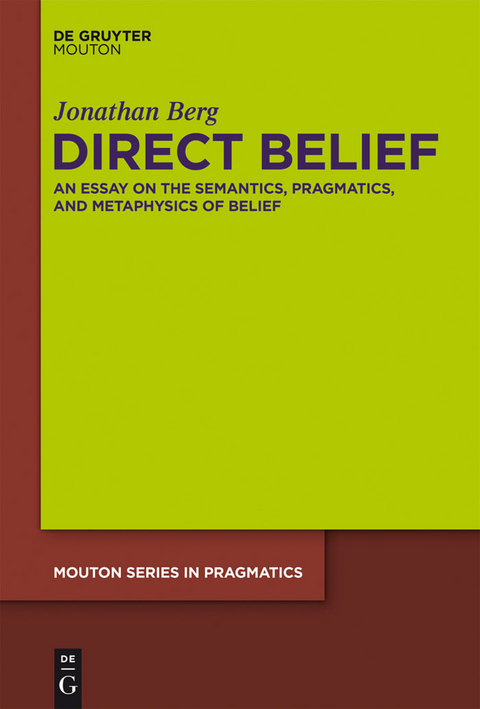
Direct Belief (eBook)
167 Seiten
De Gruyter (Verlag)
978-1-61451-082-6 (ISBN)
Jonathan Berg argues for the Theory of Direct Belief, which treats having a belief about an individual as an unmediated relation between the believer and the individual the belief is about. After a critical review of alternative positions, Berg uses Grice's theory of conversational implicature to provide a detailed pragmatic account of substitution failure in belief ascriptions and goes on to defend this view against objections, including those based on an unwarranted 'Inner Speech' Picture of Thought. The work serves as a case study in pragmatic explanation, dealing also with methodological issues about context-sensitivity in language and the relation between semantics and pragmatics.
Jonathan Berg, University of Haifa, Israel.
Jonathan Berg argues for the Theory of Direct Belief, which treats having a belief about an individual as an unmediated relation between the believer and the individual the belief is about. After a critical review of alternative positions, Berg uses Grice's theory of conversational implicature to provide a detailed pragmatic account of substitution failure in belief ascriptions and goes on to defend this view against objections, including those based on an unwarranted "e;Inner Speech"e; Picture of Thought. The work serves as a case study in pragmatic explanation, dealing also with methodological issues about context-sensitivity in language and the relation between semantics and pragmatics.
lt;!doctype html public "-//w3c//dtd html 4.0 transitional//en">
Jonathan Berg, University of Haifa, Israel.
Preface 6
Acknowledgements 8
Introduction 12
Chapter 1: The instability of belief ascriptions (and how not to explain it) 18
1. From language to thought 18
2. Accommodating shifty intuitions 21
3. The appeal to ambiguity 23
3.1. Lexical ambiguity 23
3.2. Syntactic ambiguity 28
3.3. Multigrade status 32
3.4. The persistence of shifty intuitions 35
4. The indexical view 35
4.1. Implicit modes of presentation 35
4.2. Hidden-indexical semantics 38
4.3. Articulated indexicality 47
5. Semantic indeterminacy 51
5.1. Incompleteness 51
5.2. Similarity 53
5.3. Hopelessness 57
6. Direct belief 59
7. Summary 60
Chapter 2: The pragmatics of substitutivity 65
1. Truth and appropriateness 65
2. Conversational implicature 67
3. Implicated normalcy 68
4. Normalcy for belief ascriptions 71
5. Variations on verbatim acceptability 74
6. Identity beliefs 81
7. Availability 86
8. Semantic intuitions 93
9. Iterability 102
10. Other pragmatic accounts of substitution failure 106
10.1. Soames and what is said 106
10.2. Thau and what is implicated 110
11. Summary 114
Chapter 3: Conceptions, belief, and “inner speech” 119
1. The medium view of conceptions 119
2. The behavior problem 122
2.1. The problem 122
2.2. The Higher Order View of conceptions 124
2.3. A solution to the problem 125
3. Suspended belief 126
4. The inner speech picture of thought 134
5. Thinking in words 141
5.1. Silent uttering 141
5.2. Imagining 145
6. Two paradigms of belief 148
7. Summary 151
References 154
Index 164
| Erscheint lt. Verlag | 26.4.2012 |
|---|---|
| Reihe/Serie | ISSN |
| ISSN | |
| Mouton Series in Pragmatics [MSP] | Mouton Series in Pragmatics [MSP] |
| Verlagsort | Boston |
| Sprache | englisch |
| Themenwelt | Geisteswissenschaften ► Philosophie ► Geschichte der Philosophie |
| Geisteswissenschaften ► Philosophie ► Logik | |
| Geisteswissenschaften ► Philosophie ► Metaphysik / Ontologie | |
| Geisteswissenschaften ► Philosophie ► Philosophie der Neuzeit | |
| Geisteswissenschaften ► Sprach- / Literaturwissenschaft ► Sprachwissenschaft | |
| Schlagworte | Gricean maxims • Philosophy of Language • semantics and pragmatics |
| ISBN-10 | 1-61451-082-2 / 1614510822 |
| ISBN-13 | 978-1-61451-082-6 / 9781614510826 |
| Informationen gemäß Produktsicherheitsverordnung (GPSR) | |
| Haben Sie eine Frage zum Produkt? |
 PDF (Wasserzeichen)
Größe: 626 KB
DRM: Digitales Wasserzeichen
Dieses eBook enthält ein digitales Wasserzeichen und ist damit für Sie personalisiert. Bei einer missbräuchlichen Weitergabe des eBooks an Dritte ist eine Rückverfolgung an die Quelle möglich.
Dateiformat: PDF (Portable Document Format)
Mit einem festen Seitenlayout eignet sich die PDF besonders für Fachbücher mit Spalten, Tabellen und Abbildungen. Eine PDF kann auf fast allen Geräten angezeigt werden, ist aber für kleine Displays (Smartphone, eReader) nur eingeschränkt geeignet.
Systemvoraussetzungen:
PC/Mac: Mit einem PC oder Mac können Sie dieses eBook lesen. Sie benötigen dafür einen PDF-Viewer - z.B. den Adobe Reader oder Adobe Digital Editions.
eReader: Dieses eBook kann mit (fast) allen eBook-Readern gelesen werden. Mit dem amazon-Kindle ist es aber nicht kompatibel.
Smartphone/Tablet: Egal ob Apple oder Android, dieses eBook können Sie lesen. Sie benötigen dafür einen PDF-Viewer - z.B. die kostenlose Adobe Digital Editions-App.
Zusätzliches Feature: Online Lesen
Dieses eBook können Sie zusätzlich zum Download auch online im Webbrowser lesen.
Buying eBooks from abroad
For tax law reasons we can sell eBooks just within Germany and Switzerland. Regrettably we cannot fulfill eBook-orders from other countries.
aus dem Bereich