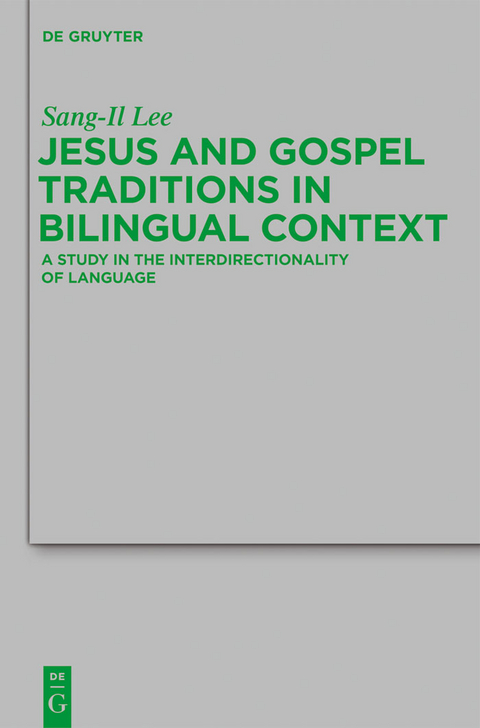
Jesus and Gospel Traditions in Bilingual Context (eBook)
540 Seiten
De Gruyter (Verlag)
9783110267143 (ISBN)
Most historical Jesus and Gospel scholars have supposed that the Jesus and Gospel traditions were unidirectionally transmitted from Judaeo-Palestinian into Hellenistic, from oral into written and from Aramaic into Greek, and never vice versa. However, this book proposes that linguistic milieus of 1st-century Palestine and the Roman Near East were bilingual in Greek and vernacular languages and that the earliest church in Jerusalem was a bilingual Christian community. The study of bilingualism creates fresh insights into the origins of Jesus and Gospel traditions, historical Jesus research and the beginnings of Christianity.
Sang-Il Lee,Chongshin Theological Seminary, Yongin, Republic of Korea.
lt;!doctype html public "-//w3c//dtd html 4.0 transitional//en">
Sang-Il Lee,Chongshin Theological Seminary, Yongin, Republic of Korea.
Acknowledgements 8
Abbreviations 18
1 The Directionality of the Transmission of the Jesus and Gospel Traditions: A History of Research 20
1.1 Herman Gunkel 21
1.2 Sitz im Leben Unidirectionality from Judaeo-Palestinian into Hellenistic Tradition 25
1.2.1 Martin Dibelius 25
1.2.2 Rudolf Bultmann 31
1.2.3 Gerd Theissen 35
1.3 Modal Unidirectionality from Oral into Written Tradition 39
1.3.1 Scandinavian School 41
1.3.1.1 Harald Riesenfeld 41
1.3.1.2 Birger Gerhardsson 42
1.3.2 Orality Theory 44
1.3.2.1 Werner Kelber 46
1.3.2.2 Joanna Dewey 50
1.3.3 The Earliest Written Tradition: Earle Ellis 52
1.4 Linguistic Unidirectionality from Aramaic into Greek Tradition 55
1.4.1 Aramaic Language as a Criterion 57
1.4.1.1 Charles C. Torrey 58
1.4.1.2 Matthew Black 62
1.4.1.3 Joachim Jeremias 64
1.4.1.4 Joseph Fitzmyer 66
1.4.2 Greek Language as a Criterion 69
1.4.2.1 Alexander Roberts 70
1.4.2.2 Aubrey Argyle 72
1.4.2.3 Nigel Turner 73
1.4.2.4 Robert Gundry 73
1.4.2.5 Stanley Porter 74
1.5 Interdirectionality Hypothesis 77
1.5.1 Sitz im Leben Interdirectionality: Martin Hengel 77
1.5.2 Modal Interdirectionality 80
1.5.2.1 Form Criticism: Helmut Koester 80
1.5.2.2 Textual Criticism: David Parker 82
1.5.2.3 Scandinavian School: Samuel Byrskog 83
1.5.2.4 Liturgical Use and Canon Formation: Harry Gamble 85
1.5.2.5 Notebook Theory: Graham Stanton and Richard Bauckham 86
1.5.3 Linguistic Interdirectionality: E. P. Sanders 89
1.5.4 Interdirectionality Hypotheses and Gospel Studies 91
Part I: Bilingualism of First-Century Palestine and the Roman Near East 94
2 Bilingualism and Diglossia 96
2.1 Definitions 98
2.1.1 Bilingualism 98
2.1.2 Bilingual Community 100
2.1.3 Bilingualism and Multilingualism 100
2.1.4 Early Bilingualism vs. Late Bilingualism 100
2.1.5 Primary Bilingualism vs. Acquired Bilingualism 101
2.1.6 Oral Bilingualism vs. Literate Bilingualism 102
2.1.7 Stages of Bilingualism 103
2.1.8 Balanced Bilingualism vs. Dominant Bilingualism 103
2.1.9 Matrix Language vs. Embedded Language 103
2.1.10 Substratum, Adstratum and Superstratum 104
2.1.11 Ancestor, Daughter and Sister Language 104
2.2 Diglossia in First Century Palestine? 105
2.2.1 Charles Ferguson 106
2.2.2 Joshua Fishman 107
2.2.3 Pinchas Lapide 107
2.2.4 Chaim Rabin 109
2.2.5 Bernard Spolsky 111
2.2.6 Jonathan Watt 113
2.3 Bilingualism and Diglossia Models 115
2.3.1 Characteristics of the Four Languages in First-Century Palestine 115
2.3.2 Language Preference Theory 116
2.3.3 Maximalism and Minimalism 118
2.3.4 Biliteracy of First-Century Palestine 122
3 Bilingualism of Jews in First-Century Palestine 124
3.1 Regional Bilingualism 124
3.1.1 Inscriptional Evidence 125
3.1.2 Papyrological Evidence 127
3.1.3 Population Geographical Evidence 129
3.2 Personal Bilingualism 131
3.2.1 Military Invasion and Colonization 132
3.2.2 Migration or Inflow 133
3.2.3 Ethnic Awareness 133
3.2.4 Bilingual Parents or Region 134
3.2.5 Formal Education 139
3.2.6 Occupation 149
3.3 Bilingualism of First-Century Palestine and Interdirectionality 152
4 Bilingualism of Jews in the First-Century Diaspora 154
4.1 Grounds for Bilingualism in the Jewish Diaspora 156
4.1.1 Bilingualism of the Roman Empire 157
4.1.2 Successive Immigration 160
4.1.3 Periodic Connection with Jerusalem 164
4.1.4 Learning Aramaic in Jerusalem 166
4.2 Alexandria 169
4.2.1 Bilingualism of Ptolemaic and Early Roman Alexandria 170
4.2.2 Archaeological Evidence 175
4.2.3 Successive Immigration 179
4.2.4 Periodic Connection with Jerusalem 180
4.3 Antioch 181
4.3.1 Bilingualism of Roman Antioch 182
4.3.2 Bilingualism of the Antiochene Jews 186
4.3.3 Bilingualism of the Antiochene Christians 189
4.4 Bilingualism of the Jewish Diaspora and Interdirectionality 191
5 The Bilingualism of the Earliest Christian Church in Jerusalem 194
5.1 The State of Affairs 195
5.2 Bilingualism of the Hebrews and Hellenists 201
5.2.1 Hebrews: Aramaic-Matrix Christians 203
5.2.2 Hellenists: Greek-Matrix Christians 208
5.3 The Bilingual Seven 216
5.3.1 Onomastica 216
5.3.2 Geographical Evidence 217
5.3.2.1 Caesarea Maritima 218
5.3.2.2 Samaria 219
5.3.2.3 Ethiopia 220
5.3.2.4 Antioch 222
5.3.3 Performance of Their Duty 223
5.4 Bilingualism of the Jerusalem Church and the Interdirectionality of the Jesus Tradition 228
Part II: Interdirectional Transmission of the Jesus and Gospel Traditions in Bilingual Contexts at the Levels of Syntax, Phonology, and Semantics 232
6 Syntax 242
6.1 Contact-Induced Syntactic Change Hypothesis in New Testament Scholarship 244
6.1.1 Adolf Deissmann 245
6.1.2 Linguistic Relatedness between Syntactic Changes 249
6.1.3 Bilingual Jewish Greek Theory 250
6.1.4 Hellenistic Greek Theory 253
6.1.5 Semitisms and Septuagintalisms 256
6.2 Internal-Induced Syntactic Change Hypothesis 259
6.2.1 Comparisons between Cognitive Linguistics and Other Linguistic Theories 260
6.2.1.1 Theoretical and Empirical 260
6.2.1.2 Diachronic and Synchronic 261
6.2.1.3 Langue and Parole 261
6.2.1.4 Significance of Semantics 263
6.2.2 Some Basic Concepts 263
6.2.2.1 Grammaticalization 263
6.2.2.2 Unidirectionality Hypothesis 264
6.2.2.3 Five Principles of Grammaticalization 265
6.2.2.4 Metaphor and Metonymy 266
6.2.2.5 Abstractness 267
6.2.2.6 Grammatical Polysemy 268
6.2.3 Grammaticalization and Language Contact 268
6.3 Syntactic Change of New Testament Greek as Grammatical Polysemy 269
6.3.1 Verbs 270
6.3.1.1 SAY Verb: .... 271
6.3.1.2 Movement Verbs: ....µa. and p..e..µa. 274
6.3.1.3 Posture Verbs 275
6.3.1.3.1 st... and .st.µ. 276
6.3.1.3.2 ...st.µ. and ..e... 278
6.3.1.3.3 .a.... and ....µa. 279
6.3.2 Conjunctions 280
6.3.2.1 ..a 280
6.3.2.2 .t. 289
6.3.3 Adverbs: Matthean t.te, Marcan e...., and Johannine ... 293
6.4 Syntactic Change as Grammatical Polysemy and Interdirectionality 297
7 Phonology 300
7.1 Linguistic Factors of Transliterated Variants in Bilingual Contexts 302
7.1.1 Different Phonetic System 302
7.1.2 Representation 307
7.1.3 Phonetic Change 311
7.1.4 Dialects 313
7.2 Three Views of Variant Spellings in Transliteration 314
7.2.1 Orthographical View 314
7.2.2 Variational View 317
7.2.2.1 Ephraim Speiser 317
7.2.2.2 James Barr 318
7.2.2.3 Alan Millard 318
7.2.2.4 Some Scholars of New Testament Greek 319
7.2.3 Bilingual View 320
7.3 Variant Spellings as Transliterated Allolexemes in Bilingual Contexts 321
7.3.1 Transliterated Allolexemes 321
7.3.2 Consonants 323
7.3.2.1 Plosives and Fricatives 324
7.3.2.2 Sibilants 324
7.3.2.3 Liquids 325
7.3.2.4 Gutturals 325
7.3.2.5 Additions of Consonants 326
7.3.3 Vowels 327
7.4 Variant Spellings as Transliterated Allolexemes in the Four Gospels and Acts 329
7.4.1 Local Proper Nouns 329
7.4.1.1.e...sa..µ and .e..s...µa 330
7.4.1.2 .a.a.. and .a.a... 330
7.4.1.3 Ge...s.. and Ge...sa..t 333
7.4.2 Personal Proper Nouns 336
7.4.2.1 S.µ../S.µe.. and ..t.../..... 336
7.4.2.2 ...s.ß. and ...s.ßet 338
7.4.3 Other Transliterated Words 339
7.4.3.1 The Cry from the Cross 339
7.4.3.2 .ess.a./...st.. 344
7.5 Variant Spellings as Allolexemes and Interdirectionality 347
8 Semantics 350
8.1 Aramaic Embedded Words as Codeswitching 353
8.1.1 Codeswitching, Interference, and Borrowing in a Bilingual Society 354
8.1.2 Codeswitching in New Testament Scholarship 360
8.1.3 Types of Codeswitching 365
8.1.4 Pragmatic Functions of Codeswitching 365
8.1.4.1 Vividness 366
8.1.4.2 Emphasis 366
8.1.4.3 Politeness 366
8.1.4.4 Solidarity 367
8.2 .µ.. Found in All Four Gospels 368
8.3 Codeswitchings in the Gospel of Mark 379
8.3.1 .ßßa . pat.. 381
8.3.2 .a...a ...µ and effa.a in the Miracle Stories 389
8.4 Codeswitchings in the Gospel of Luke and Acts 395
8.4.1 Language Change 396
8.4.2 Personal Names 397
8.4.2.1 S.µ../S.µe.. and ..t.../..f.. 399
8.4.2.2 Sa..../.a.... and Sa... 402
8.4.3 Names of Places 404
8.4.3.1 .e...sa..µ and .e..s...µa 404
8.4.3.2 .a.a.. and .a.a... 406
8.5 Embedded Aramaic Words as Codeswitchings and Interdirectionality 410
9 Summary and Suggestions for Further Study 414
9.1 Summary of Results 414
9.2 The Gospel Tradition as Jesus Tradition 428
9.3 The Relationship between Historical Criticism and Literary Criticism 429
9.4 The Synoptic Problem 429
9.5 The Historical Jesus 433
9.6 Textual Criticism 435
9.7 Jewish Christianity and Gentile Christianity 436
9.8 Bilingual Christology 436
Bibliography 438
Index of Ancient Sources 506
Index of Languages and Place Names 522
Index of Modern Authors 524
Index of Subjects 534
| Erscheint lt. Verlag | 26.4.2012 |
|---|---|
| Reihe/Serie | Beihefte zur Zeitschrift für die neutestamentliche Wissenschaft |
| Beihefte zur Zeitschrift für die neutestamentliche Wissenschaft | |
| ISSN | ISSN |
| Verlagsort | Berlin/Boston |
| Sprache | englisch |
| Themenwelt | Religion / Theologie ► Christentum ► Kirchengeschichte |
| Geisteswissenschaften ► Sprach- / Literaturwissenschaft ► Sprachwissenschaft | |
| Schlagworte | Bilingualism • Bilingualität • Evangelien Tradition • Gospel Tradition • Historical Jesus • Historischer Jesus • Jerusalem Church • Jerusalemer Urgemeinde • Jesus Tradition |
| ISBN-13 | 9783110267143 / 9783110267143 |
| Informationen gemäß Produktsicherheitsverordnung (GPSR) | |
| Haben Sie eine Frage zum Produkt? |
 PDF (Wasserzeichen)
Größe: 3,0 MB
DRM: Digitales Wasserzeichen
Dieses eBook enthält ein digitales Wasserzeichen und ist damit für Sie personalisiert. Bei einer missbräuchlichen Weitergabe des eBooks an Dritte ist eine Rückverfolgung an die Quelle möglich.
Dateiformat: PDF (Portable Document Format)
Mit einem festen Seitenlayout eignet sich die PDF besonders für Fachbücher mit Spalten, Tabellen und Abbildungen. Eine PDF kann auf fast allen Geräten angezeigt werden, ist aber für kleine Displays (Smartphone, eReader) nur eingeschränkt geeignet.
Systemvoraussetzungen:
PC/Mac: Mit einem PC oder Mac können Sie dieses eBook lesen. Sie benötigen dafür einen PDF-Viewer - z.B. den Adobe Reader oder Adobe Digital Editions.
eReader: Dieses eBook kann mit (fast) allen eBook-Readern gelesen werden. Mit dem amazon-Kindle ist es aber nicht kompatibel.
Smartphone/Tablet: Egal ob Apple oder Android, dieses eBook können Sie lesen. Sie benötigen dafür einen PDF-Viewer - z.B. die kostenlose Adobe Digital Editions-App.
Zusätzliches Feature: Online Lesen
Dieses eBook können Sie zusätzlich zum Download auch online im Webbrowser lesen.
Buying eBooks from abroad
For tax law reasons we can sell eBooks just within Germany and Switzerland. Regrettably we cannot fulfill eBook-orders from other countries.
aus dem Bereich