


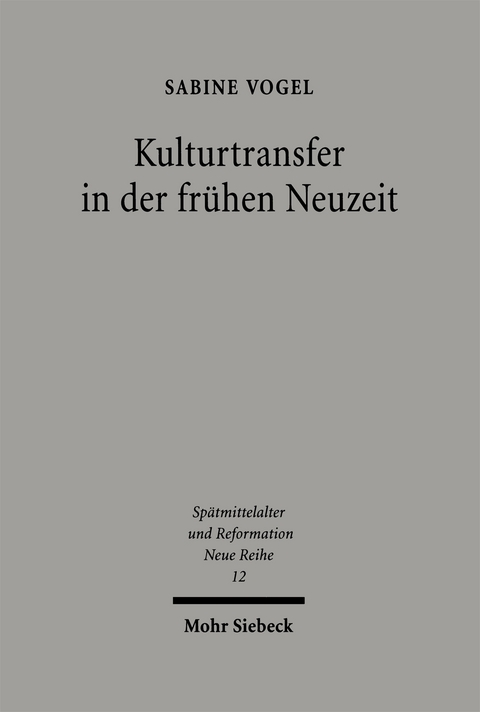
Kulturtransfer in der frühen Neuzeit
Die Vorworte der Lyoner Drucke des 16. Jahrhunderts
Seiten

Was las der gebildete Franzose im 16. Jahrhundert? Anhand einer 'imaginären Bibliothek' rekonstruiert Sabine Vogel das intellektuelle Profil französischer Amateurgelehrter vor dem Hintergrund der Entwicklung der humanistischen Wissenschaften.
Was las der gebildete Franzose im 16. Jahrhundert? Anhand einer 'imaginären Bibliothek' rekonstruiert Sabine Vogel das intellektuelle Profil französischer Amateurgelehrter vor dem Hintergrund der Entwicklung der humanistischen Wissenschaften. Sabine Vogel studies the Renaissance as a process of mediation in which the previous knowledge and the intentions of the recipients affected the prevailing conception of antiquity. Using random samples from the books produced in Lyons, she analyzes those aspects of humanistic thought and of the legacy of antiquity which the Lyons publishers offered their customers in compilations, textbooks and reference books. The author shows that apart from the professional scholars there was a French readership with its own intellectual image. This readership was so well-established that it had been given its own name: bons esprits. The publishers of Lyons produced compendia in French which contained a very reduced form of humanistic scholarship supplemented by medieval and contemporary knowledge for these readers.
Was las der gebildete Franzose im 16. Jahrhundert? Anhand einer 'imaginären Bibliothek' rekonstruiert Sabine Vogel das intellektuelle Profil französischer Amateurgelehrter vor dem Hintergrund der Entwicklung der humanistischen Wissenschaften. Sabine Vogel studies the Renaissance as a process of mediation in which the previous knowledge and the intentions of the recipients affected the prevailing conception of antiquity. Using random samples from the books produced in Lyons, she analyzes those aspects of humanistic thought and of the legacy of antiquity which the Lyons publishers offered their customers in compilations, textbooks and reference books. The author shows that apart from the professional scholars there was a French readership with its own intellectual image. This readership was so well-established that it had been given its own name: bons esprits. The publishers of Lyons produced compendia in French which contained a very reduced form of humanistic scholarship supplemented by medieval and contemporary knowledge for these readers.
Geboren 1963; Studium der Geschichte, Romanistik und Philosophie in Freiburg/Br., Berlin und Lyon; 1996 Promotion; 1997 wiss. Mitarbeiterin des Einstein Forums, Potsdam; seit 1998 wiss. Mitarbeiterin des Deutschen Historischen Museums, Berlin.
| Erscheint lt. Verlag | 15.2.1999 |
|---|---|
| Reihe/Serie | Spätmittelalter, Humanismus, Reformation / Studies in the Late Middle Ages, Humanism, and the Reformation |
| Verlagsort | Tübingen |
| Sprache | deutsch |
| Maße | 162 x 241 mm |
| Gewicht | 639 g |
| Themenwelt | Geschichte ► Allgemeine Geschichte ► Neuzeit (bis 1918) |
| Geisteswissenschaften ► Geschichte ► Geschichtstheorie / Historik | |
| Religion / Theologie ► Christentum ► Kirchengeschichte | |
| Schlagworte | HC/Religion/Theologie/Sonstiges • Kulturtransfer • Mohr Siebeck • Neuzeit |
| ISBN-10 | 3-16-147109-1 / 3161471091 |
| ISBN-13 | 978-3-16-147109-4 / 9783161471094 |
| Zustand | Neuware |
| Informationen gemäß Produktsicherheitsverordnung (GPSR) | |
| Haben Sie eine Frage zum Produkt? |
Mehr entdecken
aus dem Bereich


aus dem Bereich
Geschichte einer wilden Handlung
Buch | Hardcover (2024)
C.H.Beck (Verlag)
CHF 47,60


