


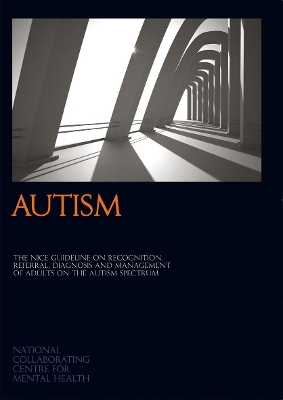
Autism
The NICE Guideline on Recognition, Referral, Diagnosis and Management of Adults on the Autism Spectrum
Seiten
2012
RCPsych Publications
978-1-908020-51-2 (ISBN)
RCPsych Publications
978-1-908020-51-2 (ISBN)
- Keine Verlagsinformationen verfügbar
- Artikel merken
Under-recognition of autism leads to poor care, social and economic exclusion, and masks coexisting health problems. This sets out clear recommendations for healthcare staff (based on the best available evidence) on how to identify, assess and diagnose autism; on organisation, delivery, psychosocial interventions and biomedical interventions.
Autism
is a lifelong condition with particular issues for adults, which are addressed
by this NICE guideline. While some people are diagnosed in childhood, a large
proportion of adults with autism find obtaining a diagnosis in adulthood
difficult or impossible. Under-recognition of autism in adults can lead to
inadequate care, masking of coexisting mental and physical health problems, and
to social and economic exclusion. This guideline aims to address these
widespread problems and increase the uptake of interventions by adults with
autism to enable them to live more independent lives.
This
guideline reviews the evidence for care of adults with autism across the care
pathway, from identification, assessment and diagnosis, to organisation,
delivery and settings for care, through to psychosocial and biomedical
interventions for autism, challenging behaviour and coexisting mental health
problems. The guideline also contains a chapter on the experience of care for
adults with autism, and their families and carers, which provides a context for
the evidence reviews that follow.
The
guideline contains all the evidence on which the recommendations were based,
including further data on a free CD-ROM which includes: characteristics of
included studies; profile tables that summarise both the quality of the
evidence and the results of the evidence synthesis; all meta-analytical data,
presented as forest plots, and detailed information about how to use and
interpret them.
The
guideline contains all the evidence on which the recommendations were based,
including further data on a free CD-ROM:
[if !supportLists]·
[endif]characteristics
of included studies
[if !supportLists]·
[endif]profile
tables that summarise both the quality of the evidence and the results of the
evidence synthesis
[if !supportLists]·
[endif]all
meta-analytical data presented as forest plots
[if !supportLists]·
[endif]detailed
information about how to use and interpret forest plots.
Autism
is a lifelong condition with particular issues for adults, which are addressed
by this NICE guideline. While some people are diagnosed in childhood, a large
proportion of adults with autism find obtaining a diagnosis in adulthood
difficult or impossible. Under-recognition of autism in adults can lead to
inadequate care, masking of coexisting mental and physical health problems, and
to social and economic exclusion. This guideline aims to address these
widespread problems and increase the uptake of interventions by adults with
autism to enable them to live more independent lives.
This
guideline reviews the evidence for care of adults with autism across the care
pathway, from identification, assessment and diagnosis, to organisation,
delivery and settings for care, through to psychosocial and biomedical
interventions for autism, challenging behaviour and coexisting mental health
problems. The guideline also contains a chapter on the experience of care for
adults with autism, and their families and carers, which provides a context for
the evidence reviews that follow.
The
guideline contains all the evidence on which the recommendations were based,
including further data on a free CD-ROM which includes: characteristics of
included studies; profile tables that summarise both the quality of the
evidence and the results of the evidence synthesis; all meta-analytical data,
presented as forest plots, and detailed information about how to use and
interpret them.
The
guideline contains all the evidence on which the recommendations were based,
including further data on a free CD-ROM:
[if !supportLists]·
[endif]characteristics
of included studies
[if !supportLists]·
[endif]profile
tables that summarise both the quality of the evidence and the results of the
evidence synthesis
[if !supportLists]·
[endif]all
meta-analytical data presented as forest plots
[if !supportLists]·
[endif]detailed
information about how to use and interpret forest plots.
The National Collaborating Centre for Mental Health (NCCMH) was established in 2001 by the UK-based National Institute for Health and Clinical Excellence (NICE) to develop guidance on the appropriate treatment and care of people with mental health problems and then write the clinical guidelines. The NCCMH is a partnership between the Royal College of Psychiatrists and the British Psychological Society.
Contents
Preface
Introduction to autism in adults
Methods used to develop this guideline
Experience of care
Case identification, assessment and diagnosis
Principles and practice for the effective organisation and
delivery of care
Psychosocial interventions
Biomedical interventions
Summary of recommendations
Appendices
References
Abbreviations
| Erscheint lt. Verlag | 1.11.2012 |
|---|---|
| Reihe/Serie | NICE Guidelines |
| Verlagsort | London |
| Sprache | englisch |
| Maße | 170 x 240 mm |
| Gewicht | 803 g |
| Themenwelt | Geisteswissenschaften ► Psychologie ► Klinische Psychologie |
| Medizin / Pharmazie ► Gesundheitswesen | |
| Medizin / Pharmazie ► Medizinische Fachgebiete ► Psychiatrie / Psychotherapie | |
| ISBN-10 | 1-908020-51-2 / 1908020512 |
| ISBN-13 | 978-1-908020-51-2 / 9781908020512 |
| Zustand | Neuware |
| Informationen gemäß Produktsicherheitsverordnung (GPSR) | |
| Haben Sie eine Frage zum Produkt? |
Mehr entdecken
aus dem Bereich



aus dem Bereich
Lehr- oder Lernkarte (2025)
Beltz
CHF 49,95


