


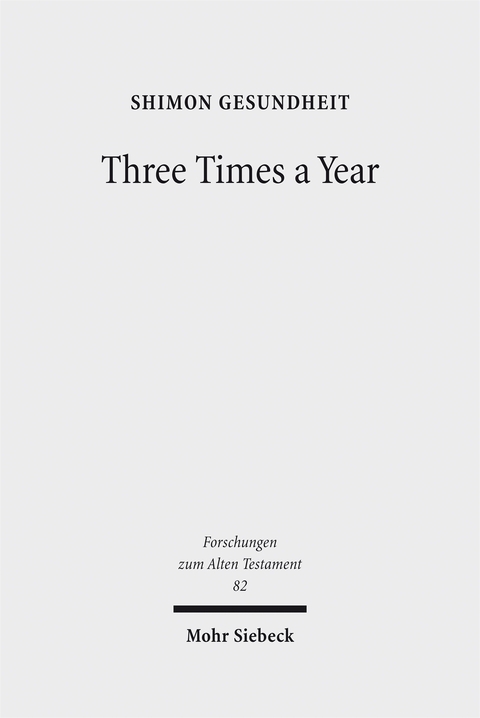
Three Times a Year
Studies on Festival Legislation in the Pentateuch
Seiten
Shimon Gesundheit zeigt, dass die Festtagskalender im Pentateuch nicht - den klassischen historischen Rekonstruktionen folgend - bestimmte kultische und soziale Realitäten tatsächlicher historischer Perioden widergeben. Sie formen vielmehr durch ihren Rechtsdiskurs neue Ideen und machen diese mit Hilfe von Textrevision und -redaktion im lemmatischen Stil des Midrasch geltend. Damit verkörpern sie den Prozess einer progressiven literarischen Entwicklung.
The festival calendars in the Pentateuch have made up the heart of critical biblical research from the beginning. Each of the calendars was thought to have taken shape against its own specific historical background and to accurately reflect a distinct stage in the development of Israel's cultic and social institutions. Classical hypotheses used them to distinguish the different legal codes in the Pentateuch from each other, to define the original compositions, and to arrange them relative to each other in an historical, chronological sequence. Shimon Gesundheit challenges the classical historical reconstructions and the methodology driving them. He presents an alternate point of view, according to which the festival laws do not simplistically reflect the specific cultic or social realities of actual historical periods. Rather, through their legal discourse, they shape and promote new ideas by textual revision and redaction, in the lemmatic style of midrash, and they represent a process of progressive literary development.
The festival calendars in the Pentateuch have made up the heart of critical biblical research from the beginning. Each of the calendars was thought to have taken shape against its own specific historical background and to accurately reflect a distinct stage in the development of Israel's cultic and social institutions. Classical hypotheses used them to distinguish the different legal codes in the Pentateuch from each other, to define the original compositions, and to arrange them relative to each other in an historical, chronological sequence. Shimon Gesundheit challenges the classical historical reconstructions and the methodology driving them. He presents an alternate point of view, according to which the festival laws do not simplistically reflect the specific cultic or social realities of actual historical periods. Rather, through their legal discourse, they shape and promote new ideas by textual revision and redaction, in the lemmatic style of midrash, and they represent a process of progressive literary development.
Born 1961; studied at the Department of Bible, Hebrew University of Jerusalem (2000 PhD) and Department of Near Eastern Civilizations and Languages at Harvard University (2001 Post-Doc); since 2002 he has been teaching at Hebrew University of Jerusalem.
| Erscheint lt. Verlag | 20.6.2012 |
|---|---|
| Reihe/Serie | Forschungen zum Alten Testament |
| Verlagsort | Tübingen |
| Sprache | englisch |
| Maße | 160 x 237 mm |
| Gewicht | 590 g |
| Themenwelt | Religion / Theologie ► Christentum ► Bibelausgaben / Bibelkommentare |
| Geisteswissenschaften ► Religion / Theologie ► Judentum | |
| Geisteswissenschaften ► Sprach- / Literaturwissenschaft ► Literaturwissenschaft | |
| Schlagworte | Feste • Israel (Alt-I.) • Jüdische Feste • Kalender • Kult • Literarkritik • Pentateuch • Pentateuch / Die Fünf Bücher Mose |
| ISBN-13 | 9783161509803 / 9783161509803 |
| Zustand | Neuware |
| Informationen gemäß Produktsicherheitsverordnung (GPSR) | |
| Haben Sie eine Frage zum Produkt? |
Mehr entdecken
aus dem Bereich

aus dem Bereich
Buch | Softcover (2021)
De Gruyter (Verlag)
CHF 44,90


