


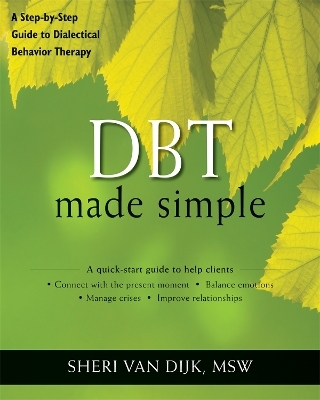
DBT Made Simple
A Step-by-Step Guide to Dialectical Behavior Therapy
Seiten
2013
New Harbinger Publications (Verlag)
978-1-60882-164-8 (ISBN)
New Harbinger Publications (Verlag)
978-1-60882-164-8 (ISBN)
In the tradition of ACT Made Simple, DBT Made Simple is a manual for therapists seeking to understand and apply the four dialectical behaviour therapy (DBT) skills in individual therapy. DBT is an effective treatment for borderline personality disorder, self-injury, chemical dependency, trauma related to sexual abuse, and various mood disorders.
Originally developed for the treatment of borderline personality disorder, dialectical behaviour therapy, or DBT, has rapidly become one of the most popular and most effective treatments for all mental health conditions rooted in out-of-control emotions.
However, there are limited resources for psychologists seeking to use DBT skills with individual clients. DBT Made Simple provides clinicians with everything they need to know to start using DBT in the therapy room.
The first part briefly covers the theory and research behind DBT and explains how DBT differs from traditional cognitive behavioural therapy approaches. The second part focuses on strategies professionals can use in individual client sessions, while the third section teaches the four skills modules that form the backbone of DBT: core mindfulness, distress tolerance, emotion regulation, and interpersonal effectiveness. The book includes handouts, case examples, and example therapist-client dialogue.
Originally developed for the treatment of borderline personality disorder, dialectical behaviour therapy, or DBT, has rapidly become one of the most popular and most effective treatments for all mental health conditions rooted in out-of-control emotions.
However, there are limited resources for psychologists seeking to use DBT skills with individual clients. DBT Made Simple provides clinicians with everything they need to know to start using DBT in the therapy room.
The first part briefly covers the theory and research behind DBT and explains how DBT differs from traditional cognitive behavioural therapy approaches. The second part focuses on strategies professionals can use in individual client sessions, while the third section teaches the four skills modules that form the backbone of DBT: core mindfulness, distress tolerance, emotion regulation, and interpersonal effectiveness. The book includes handouts, case examples, and example therapist-client dialogue.
Sheri Van Dijk, MSW, is a mental health therapist in Newmarket, Ontario, Canada. She is the author of a number of dialectical behaviour therapy skills books, including The Dialectical Behaviour Therapy Skills Workbook for Bipolar Disorder, Don't Let Your Emotions Run Your Life for Teens, and Calming the Emotional Storm. In 2010, Sheri received the R.O. Jones Award from the Canadian Psychiatric Association for her research on using DBT. For skills to treat bipolar disorder visit her online at www.sherivandijk.com.
| Reihe/Serie | The New Harbinger Made Simple Series |
|---|---|
| Verlagsort | Oakland, CA |
| Sprache | englisch |
| Maße | 202 x 252 mm |
| Gewicht | 447 g |
| Themenwelt | Geisteswissenschaften ► Psychologie |
| Medizin / Pharmazie ► Medizinische Fachgebiete ► Psychiatrie / Psychotherapie | |
| ISBN-10 | 1-60882-164-1 / 1608821641 |
| ISBN-13 | 978-1-60882-164-8 / 9781608821648 |
| Zustand | Neuware |
| Informationen gemäß Produktsicherheitsverordnung (GPSR) | |
| Haben Sie eine Frage zum Produkt? |
Mehr entdecken
aus dem Bereich

aus dem Bereich
Buch | Softcover (2025)
Urban & Fischer in Elsevier (Verlag)
CHF 57,35
Zwischen Normvariante, Persönlichkeitsstörung und …
Buch | Softcover (2022)
Kohlhammer (Verlag)
CHF 49,95


