


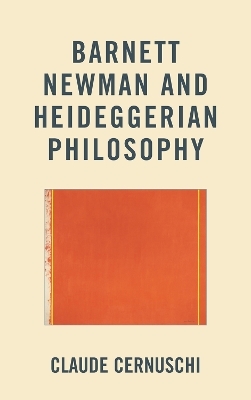
Barnett Newman and Heideggerian Philosophy
Seiten
2012
Fairleigh Dickinson University Press (Verlag)
978-1-61147-519-7 (ISBN)
Fairleigh Dickinson University Press (Verlag)
978-1-61147-519-7 (ISBN)
As a major member of the New York School, Barnett Newman is celebrated for his radical explorations of color and scale and, as a precursor to the Minimalist movement, for his significant contribution to the development of twentieth-century American art. But if his reputation and place in history have grown progressively more secure, the work he produced remains highly resistant to interpretation. His paintings are rigorously abstract, and his writings full of references to arcane metaphysical concepts. Frustrated over their inability to reconcile the works with what the artist said about them, some critics have dismissed the paintings as impenetrable. The art historian Yve-Alain Bois called Newman “the most difficult artist” he could name, and the philosopher Jean-François Lyotard declared that “there is almost nothing to ‘consume’ [in his work], or if there is, I do not know what it is.”
In order to advance interpretation, this book investigates both Newman’s writings and paintings in light of ideas articulated by one of Germany’s most important and influential philosophers: Martin Heidegger. Many of the themes explored in Newman’s statements, and echoed in the titles of his paintings, betray numerous points of intersection with Heidegger’s philosophy: the question of origins, the distinctiveness of human presence, a person’s sense of place, the sensation of terror, the definition of freedom, the importance of mood to existence, the particularities of art and language, the impact of technology on modern life, the meaning of time, and the human being’s relationship to others and to the divine. When examined in the context of Heideggerian thought, these issues acquire greater concreteness, and, in turn, their relation to the artist’s paintings becomes clearer. It is the contention of this book that, at the intersection of art history and philosophy, an interdisciplinary framework emerges wherein the artist’s broader motivations and the specific meanings of his paintings prove more amenable to elucidation.
In order to advance interpretation, this book investigates both Newman’s writings and paintings in light of ideas articulated by one of Germany’s most important and influential philosophers: Martin Heidegger. Many of the themes explored in Newman’s statements, and echoed in the titles of his paintings, betray numerous points of intersection with Heidegger’s philosophy: the question of origins, the distinctiveness of human presence, a person’s sense of place, the sensation of terror, the definition of freedom, the importance of mood to existence, the particularities of art and language, the impact of technology on modern life, the meaning of time, and the human being’s relationship to others and to the divine. When examined in the context of Heideggerian thought, these issues acquire greater concreteness, and, in turn, their relation to the artist’s paintings becomes clearer. It is the contention of this book that, at the intersection of art history and philosophy, an interdisciplinary framework emerges wherein the artist’s broader motivations and the specific meanings of his paintings prove more amenable to elucidation.
Claude Cernuschi is professor of art history at Boston College.
Preface and acknowledgments
Chapter 1: Barnett Newman…and Martin Heidegger
Chapter 2: Beginnings
Chapter 3: Presence
Chapter 4: Place: Da-sein
Chapter 5: The Void
Chapter 6: Others
Chapter 7: Freedom
Chapter 8: Mood
Chapter 9: Technology
Chapter 10: Language
Chapter 11: Time
Chapter 12: God
Chapter 13: Epistemology
Chapter 14: Politics
Selected Bibliography
About the Author
Index
| Erscheint lt. Verlag | 22.3.2012 |
|---|---|
| Zusatzinfo | 65 b/w photos; |
| Verlagsort | Cranbury |
| Sprache | englisch |
| Maße | 160 x 235 mm |
| Gewicht | 721 g |
| Themenwelt | Kunst / Musik / Theater ► Kunstgeschichte / Kunststile |
| Geisteswissenschaften ► Philosophie ► Philosophie der Neuzeit | |
| ISBN-10 | 1-61147-519-8 / 1611475198 |
| ISBN-13 | 978-1-61147-519-7 / 9781611475197 |
| Zustand | Neuware |
| Informationen gemäß Produktsicherheitsverordnung (GPSR) | |
| Haben Sie eine Frage zum Produkt? |
Mehr entdecken
aus dem Bereich


aus dem Bereich
ein Dialog mit Simone Weil
Buch | Softcover (2025)
Matthes & Seitz Berlin (Verlag)
CHF 19,55


