


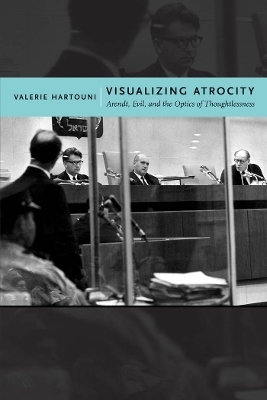
Visualizing Atrocity
Arendt, Evil, and the Optics of Thoughtlessness
Seiten
2012
New York University Press (Verlag)
978-0-8147-6976-8 (ISBN)
New York University Press (Verlag)
978-0-8147-6976-8 (ISBN)
- Lieferbar
- Versandkostenfrei
- Auch auf Rechnung
- Artikel merken
Re-assesses the myths that have come to shape and limit our understanding of the Nazi genocide as well as totalitarianism's broader, constitutive, and recurrent features
Visualizing Atrocity takes Hannah Arendt's provocative and polarizing account of the 1961 trial of Nazi official Adolf Eichmann as its point of departure for reassessing some of the serviceable myths that have come to shape and limit our understanding both of the Nazi genocide and totalitarianism's broader, constitutive, and recurrent features. These myths are inextricably tied to and reinforced viscerally by the atrocity imagery that emerged with the liberation of the concentration camps at the war's end and played an especially important, evidentiary role in the postwar trials of perpetrators.
At the 1945 Nuremberg Tribunal, particular practices of looking and seeing were first established with respect to these images that were later reinforced and institutionalized through Eichmann's trial in Jerusalem as simply part of the fabric of historical fact. They have come to constitute a certain visual rhetoric that now circumscribes the moral and political fields and powerfully assists in contemporary mythmaking about how we know genocide and what is permitted to count as such. In contrast, Arendt's claims about the "banality of evil" work to disrupt this visual rhetoric. More significantly still, they direct our attention well beyond the figure of Eichmann to a world organized now as then by practices and processes that while designed to sustain and even enhance life work as well to efface it.
Visualizing Atrocity takes Hannah Arendt's provocative and polarizing account of the 1961 trial of Nazi official Adolf Eichmann as its point of departure for reassessing some of the serviceable myths that have come to shape and limit our understanding both of the Nazi genocide and totalitarianism's broader, constitutive, and recurrent features. These myths are inextricably tied to and reinforced viscerally by the atrocity imagery that emerged with the liberation of the concentration camps at the war's end and played an especially important, evidentiary role in the postwar trials of perpetrators.
At the 1945 Nuremberg Tribunal, particular practices of looking and seeing were first established with respect to these images that were later reinforced and institutionalized through Eichmann's trial in Jerusalem as simply part of the fabric of historical fact. They have come to constitute a certain visual rhetoric that now circumscribes the moral and political fields and powerfully assists in contemporary mythmaking about how we know genocide and what is permitted to count as such. In contrast, Arendt's claims about the "banality of evil" work to disrupt this visual rhetoric. More significantly still, they direct our attention well beyond the figure of Eichmann to a world organized now as then by practices and processes that while designed to sustain and even enhance life work as well to efface it.
Valerie Hartouni is Professor of Communication at the University of California, San Diego, and author of Cultural Conceptions: On Reproductive Technologies and the Remaking of Life.
1 Arendt and the Trial of Adolf Eichmann: Contextualizing the Debate 2 Ideology and Atrocity 3 Thoughtlessness and Evil 4 "Crimes against the Human Status": Nuremberg and the Image of Evil 5 The Banality of Evil
| Reihe/Serie | Critical Cultural Communication |
|---|---|
| Verlagsort | New York |
| Sprache | englisch |
| Maße | 152 x 229 mm |
| Gewicht | 318 g |
| Themenwelt | Geschichte ► Allgemeine Geschichte ► 1918 bis 1945 |
| Sozialwissenschaften ► Kommunikation / Medien ► Medienwissenschaft | |
| ISBN-10 | 0-8147-6976-4 / 0814769764 |
| ISBN-13 | 978-0-8147-6976-8 / 9780814769768 |
| Zustand | Neuware |
| Informationen gemäß Produktsicherheitsverordnung (GPSR) | |
| Haben Sie eine Frage zum Produkt? |
Mehr entdecken
aus dem Bereich



aus dem Bereich
Deutschland 1933 bis 1945
Buch | Hardcover (2025)
S. Fischer (Verlag)
CHF 47,60
ein Psychologe erlebt das Konzentrationslager
Buch | Hardcover (2024)
Kösel (Verlag)
CHF 30,80


