


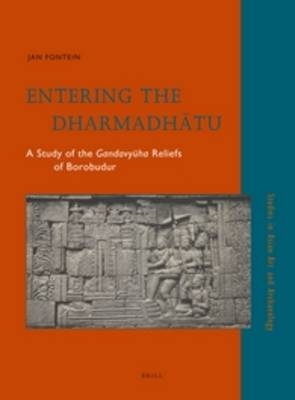
Entering the Dharmadhātu
A Study of the Gandavyūha Reliefs of Borobudur
Seiten
2012
Brill (Verlag)
978-90-04-21122-3 (ISBN)
Brill (Verlag)
978-90-04-21122-3 (ISBN)
New identifications of the 460 bas-reliefs of Borobudur illustrating the Gandavyūha, based upon a comparison with the contents of three early Chinese translations of Sanskrit manuscripts of the text of Central Asian or Indian provenance.
The Gandavyūha, a sacred text of Mahāyāna Buddhism, is an allegorical tale of the pilgrimage of a youth named Sudhana, who visits fifty-three spiritual mentors to receive their instruction in the Conduct of the Bodhisattva. His miraculous journey on the path towards Enlightenment inspired the sculptors of Borobudur (9th century C.E.) to illustrate the tale in 460 bas-reliefs on the higher galleries of this great Javanese monument. During the 1920s N.J. Krom and F.D.K. Bosch identified many of the panels, but most of their findings, written in Dutch, remained unnoticed. Entering the Dharmadhātu compares the complete set of panels with three early Chinese translations of Central Asian and Indian Sanskrit manuscripts of the Gandavyūha. This first identification of the entire series in English concludes with a discussion of the new perspectives on the meaning, symbolism, and architecture of Borobudur that a reading of the Gandavyūha suggests.
The Gandavyūha, a sacred text of Mahāyāna Buddhism, is an allegorical tale of the pilgrimage of a youth named Sudhana, who visits fifty-three spiritual mentors to receive their instruction in the Conduct of the Bodhisattva. His miraculous journey on the path towards Enlightenment inspired the sculptors of Borobudur (9th century C.E.) to illustrate the tale in 460 bas-reliefs on the higher galleries of this great Javanese monument. During the 1920s N.J. Krom and F.D.K. Bosch identified many of the panels, but most of their findings, written in Dutch, remained unnoticed. Entering the Dharmadhātu compares the complete set of panels with three early Chinese translations of Central Asian and Indian Sanskrit manuscripts of the Gandavyūha. This first identification of the entire series in English concludes with a discussion of the new perspectives on the meaning, symbolism, and architecture of Borobudur that a reading of the Gandavyūha suggests.
Jan Fontein (22 May 1927 – 19 May 2017) was a Dutch Asian art scholar and former museum director. From 1945 to 1953 he studied far eastern languages and Indonesian archaeology at Leiden University. Fontein moved to the United States, where he became curator of Asian Art at the Museum of Fine Arts, Boston. Fontein was its director from 1975 to 1987. He was series editor of Brill’s book series Asian Art & Archaeology until his passing.
| Erscheint lt. Verlag | 20.3.2012 |
|---|---|
| Reihe/Serie | Studies in Asian Art and Archaeology ; 26 |
| Verlagsort | Leiden |
| Sprache | englisch |
| Maße | 210 x 270 mm |
| Gewicht | 943 g |
| Themenwelt | Kunst / Musik / Theater ► Kunstgeschichte / Kunststile |
| Kunst / Musik / Theater ► Malerei / Plastik | |
| Geisteswissenschaften ► Religion / Theologie ► Buddhismus | |
| ISBN-10 | 90-04-21122-5 / 9004211225 |
| ISBN-13 | 978-90-04-21122-3 / 9789004211223 |
| Zustand | Neuware |
| Informationen gemäß Produktsicherheitsverordnung (GPSR) | |
| Haben Sie eine Frage zum Produkt? |
Mehr entdecken
aus dem Bereich

aus dem Bereich
Philosophische Betrachtungen
Buch | Softcover (2024)
Aufbau TB (Verlag)
CHF 20,95
das Leben darf leicht sein : 99 Impulse eines Zen-Mönchs
Buch | Hardcover (2025)
Lotos (Verlag)
CHF 29,90


