


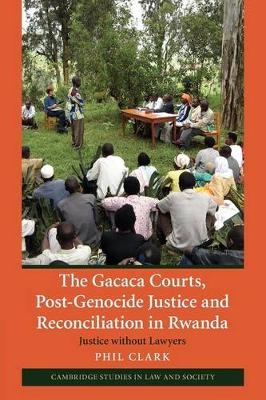
The Gacaca Courts, Post-Genocide Justice and Reconciliation in Rwanda
Justice without Lawyers
Seiten
2011
Cambridge University Press (Verlag)
978-1-107-40410-6 (ISBN)
Cambridge University Press (Verlag)
978-1-107-40410-6 (ISBN)
Since 2001, the Gacaca community courts have been the centrepiece of Rwanda's justice and reconciliation programme. Drawing on six years of fieldwork in Rwanda and nearly five hundred interviews with participants, this book's conclusions provide indispensable insight into post-genocide justice and reconciliation.
Since 2001, the Gacaca community courts have been the centrepiece of Rwanda's justice and reconciliation programme. Nearly every adult Rwandan has participated in the trials, principally by providing eyewitness testimony concerning genocide crimes. Lawyers are banned from any official involvement, an issue that has generated sustained criticism from human rights organisations and international scepticism regarding Gacaca's efficacy. Drawing on more than six years of fieldwork in Rwanda and nearly five hundred interviews with participants in trials, this in-depth ethnographic investigation of a complex transitional justice institution explores the ways in which Rwandans interpret Gacaca. Its conclusions provide indispensable insight into post-genocide justice and reconciliation, as well as the population's views on the future of Rwanda itself.
Since 2001, the Gacaca community courts have been the centrepiece of Rwanda's justice and reconciliation programme. Nearly every adult Rwandan has participated in the trials, principally by providing eyewitness testimony concerning genocide crimes. Lawyers are banned from any official involvement, an issue that has generated sustained criticism from human rights organisations and international scepticism regarding Gacaca's efficacy. Drawing on more than six years of fieldwork in Rwanda and nearly five hundred interviews with participants in trials, this in-depth ethnographic investigation of a complex transitional justice institution explores the ways in which Rwandans interpret Gacaca. Its conclusions provide indispensable insight into post-genocide justice and reconciliation, as well as the population's views on the future of Rwanda itself.
Acknowledgements; List of abbreviations; Map of Rwanda; Introduction; 1. Framing Gacaca: transitional justice themes; 2. Moulding tradition: the history, law and hybridity of Gacaca; 3. Interpreting Gacaca: the rationale for analysing a dynamic socio-legal institution; 4. The Gacaca journey: the rough road to justice and reconciliation; 5. Gacaca's modus operandi: engagement through popular participation; 6. Gacaca's pragmatic objectives; 7. Accuser, liberator or reconciler? Truth through Gacaca; 8. Law, order and restoration: peace and justice through Gacaca; 9. Mending hearts and minds: healing and forgiveness through Gacaca; 10. (Re)fusing social bonds: Gacaca and reconciliation; Conclusion; Glossary; Bibliography; Index.
| Erscheint lt. Verlag | 8.12.2011 |
|---|---|
| Reihe/Serie | Cambridge Studies in Law and Society |
| Zusatzinfo | Worked examples or Exercises |
| Verlagsort | Cambridge |
| Sprache | englisch |
| Maße | 152 x 229 mm |
| Gewicht | 540 g |
| Themenwelt | Geisteswissenschaften ► Geschichte ► Regional- / Ländergeschichte |
| Recht / Steuern ► Allgemeines / Lexika | |
| Recht / Steuern ► EU / Internationales Recht | |
| Recht / Steuern ► Strafrecht ► Strafverfahrensrecht | |
| ISBN-10 | 1-107-40410-X / 110740410X |
| ISBN-13 | 978-1-107-40410-6 / 9781107404106 |
| Zustand | Neuware |
| Informationen gemäß Produktsicherheitsverordnung (GPSR) | |
| Haben Sie eine Frage zum Produkt? |
Mehr entdecken
aus dem Bereich


aus dem Bereich
die Geschichte meiner Urgroßmutter
Buch | Hardcover (2025)
C.H.Beck (Verlag)
CHF 32,15
Träume und Macht : eine Biografie
Buch | Hardcover (2025)
C.H.Beck (Verlag)
CHF 61,60


