


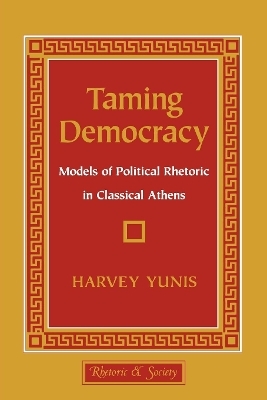
Taming Democracy
Models of Political Rhetoric in Classical Athens
Seiten
1996
Cornell University Press (Verlag)
9780801483585 (ISBN)
Cornell University Press (Verlag)
9780801483585 (ISBN)
How does one speak to a large, diverse mass of ordinary, sovereign citizens and persuade them to render wise decisions? For Thucydides, Plato, and Demosthenes, who observed classical Athenian democracy in action, this was an urgent question. Harvey Yunis looks at how these three—historian, philosopher, politician respectively—explored the...
How does one speak to a large, diverse mass of ordinary, sovereign citizens and persuade them to render wise decisions? For Thucydides, Plato, and Demosthenes, who observed classical Athenian democracy in action, this was an urgent question. Harvey Yunis looks at how these three—historian, philosopher, politician respectively—explored the instructive potential of political rhetoric as a means of "taming democracy," Plato's metaphor for controlling the fractious demos through language. Yunis offers new insights into the ideas of the three thinkers: Thucydides' bipolar model of Periclean versus demagogic rhetoric; Plato's engagement with political rhetoric in the Gorgias, the Phaedrus, and the Laws; and Demosthenes' attempt both to instruct and to persuade his political audience. Yunis illuminates both the concrete historical problem of political deliberation in Athens and the intellectual and literary responses that the problem evoked. Few, if any, other books on classical Athens afford such a combination of perspectives from history, drama, philosophy, and politics. Writing with unusual clarity and cogency, Yunis translates all texts and explains the relevant issues. His book can profitably be read by anyone concerned with the issues at the heart of classical and contemporary democracy.
How does one speak to a large, diverse mass of ordinary, sovereign citizens and persuade them to render wise decisions? For Thucydides, Plato, and Demosthenes, who observed classical Athenian democracy in action, this was an urgent question. Harvey Yunis looks at how these three—historian, philosopher, politician respectively—explored the instructive potential of political rhetoric as a means of "taming democracy," Plato's metaphor for controlling the fractious demos through language. Yunis offers new insights into the ideas of the three thinkers: Thucydides' bipolar model of Periclean versus demagogic rhetoric; Plato's engagement with political rhetoric in the Gorgias, the Phaedrus, and the Laws; and Demosthenes' attempt both to instruct and to persuade his political audience. Yunis illuminates both the concrete historical problem of political deliberation in Athens and the intellectual and literary responses that the problem evoked. Few, if any, other books on classical Athens afford such a combination of perspectives from history, drama, philosophy, and politics. Writing with unusual clarity and cogency, Yunis translates all texts and explains the relevant issues. His book can profitably be read by anyone concerned with the issues at the heart of classical and contemporary democracy.
Harvey Yunis is Associate Professor of Classics at Rice University.
| Erscheint lt. Verlag | 18.1.1996 |
|---|---|
| Reihe/Serie | Rhetoric and Society |
| Verlagsort | Ithaca |
| Sprache | englisch |
| Maße | 152 x 229 mm |
| Gewicht | 907 g |
| Themenwelt | Geisteswissenschaften ► Philosophie ► Philosophie Altertum / Antike |
| Sozialwissenschaften ► Politik / Verwaltung ► Politische Systeme | |
| ISBN-13 | 9780801483585 / 9780801483585 |
| Zustand | Neuware |
| Informationen gemäß Produktsicherheitsverordnung (GPSR) | |
| Haben Sie eine Frage zum Produkt? |
Mehr entdecken
aus dem Bereich


aus dem Bereich
Anleitung zu einer Lektüre Mark Aurels
Buch | Hardcover (2025)
FinanzBuch Verlag
CHF 27,95


