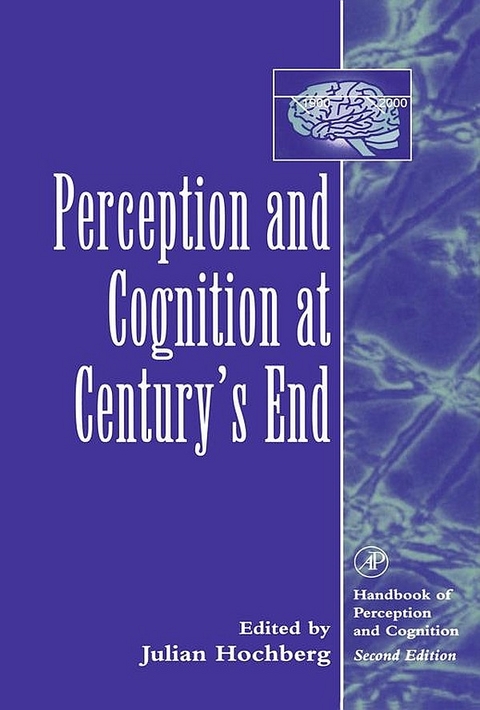
Perception and Cognition at Century's End (eBook)
487 Seiten
Elsevier Science (Verlag)
9780080538600 (ISBN)
Key Features
* Written by prominent active researchers in the field
* Presents broad coverage of perception and cognition
* Considers perception and cognition in the context of the thought of the past half-century
* Contains extensive references; excellent resource
Perception and Cognition at Century's End contains cognitive psychology surveys that are up-to-date and historically based, as well as references to the development of cognitive psychology over the past century. The book can serve as a central or specialized text for a range of psychology courses. - Written by prominent active researchers in the field- Presents broad coverage of perception and cognition- Considers perception and cognition in the context of the thought of the past half-century- Contains extensive references; excellent resource
Front Cover 1
Perception and Cognition at Century’s End 2
Copyright Page 3
Contents 6
Contributors 14
Foreword 16
Preface 18
Part 1: Roo ts and Persisting Issues 22
Chapter 1. A Context for the Second Half of the Century: One View 24
I. Purposes and Substance of This Volume 24
II. An Historical Context 25
III. The First Half of This Century 30
IV. Massive Changes at the Half-Century 38
References 39
Chapter 2. Philosophy, Perception, and Cognitive Science 44
I. Introduction 44
II. Methodology and the Mind–Body Problem 45
III. Computation and Representation 47
IV. Theories of Content 55
V. Perceptual Strategies and Mental Content 60
VI. Conclusion 64
References 64
Chapter 3. Consciousness and Mind as Philosophical Problems and Psychological Issues 66
I. Mind and Consciousness: Central Issues 66
II. What Is a Philosophy of Mind About? 67
III. The Puzzle of Consciousness 68
IV. Philosophical Positions 70
V. Psychologists and Consciousness 72
VI. Views Apart from the Mainstream 73
VII. Mind as Mechanism 74
VIII. Psychological Issues: Functionalism and Empirical Results—What Is the Function of Consciousness? 75
IX. Psychological Functionalism and Consciousness 77
X. Consciousness and Empirical Psychology 78
XI. Yes, Virginia, There Is a Brain: The Mind–Body Distinction 82
XII. Coda 83
References 84
Part 2: The Informed Present : Where We Are and How We Got There 88
Chapter 4. Information from the World around Us 90
I. Framework 1 : Experience in an Unruly World 92
II. Framework 2: Mathematics and Natural Law in a Well-Ordered World 95
III. Framework 3: Biology in an Expedient World 99
IV. Multiple Sources of Inforniation and the Problems They Present 102
V. Information and What It Represents 107
VI. Summary: Working among Three Frameworks 108
References 110
Chapter 5. Illusions at Century’s End 116
I. Why Illusions Are Considered Theoretically Diagnostic 119
II. Theories of Perceptual Representation 120
III. Physiological Theories 125
IV. Functional Theories 131
V. Conclusion 152
References 153
Chpter 6. Pictures and Their Special Status in Perceptual and Cognitive Inquiry 158
I. Pictures and the World 159
II. Pictures, Representation, and Communication 163
III. The Basic Pictorial Elements 172
IV. Summary 183
References 184
Chapter 7. The Internalization of Perceptual Processing Constraints 190
I. Introduction 190
II. The Varieties of Internalization Proposals 191
III. Concluding Remarks 211
References 213
Chapter 8. A Century of Human Information- Processing Theory: Vision, Attention, and Memory 220
I. The Evolution of Psychological Theory 220
II. Visual Perception 225
III. Visual Attention 241
IV. Immediate Memory 257
V. Conclusions 267
References 269
Chapter 9. Gestalt Theory and Its Legacy: Organization in Eye und Brain, in Attention and Mental Representation 274
I. Introduction and Overview 274
II. Starting Over: The Gestaltists’ Reformulation of Psychology and Neurophysiology 277
III. Resetting the Problems and Their Context 291
IV. Perception as Purposive Behavior 300
V. The Gestalt Phenomena and Mental Representation 309
References 313
Chapter 10. Vision Fin de Siecle: A Reductionistic Explanation of Perception for the 21st Century? 328
I. Antecedents 329
II. Visual Receptive Fields 332
III. Barlow’s Neuron Doctrine 334
IV. Psychophysics of Receptive Fields 335
V. A Visual Takeover: Redrawing the Brain 340
VI. Marr’s Inclusive Framework 340
VII. Vision Fin de Siecle 343
VIII. A Reductionistic Explanation for Perception in 21st Century? 348
References 348
Chapter 11. Nature, Nurture, and Development 354
I. Introduction 354
II. Development of Perception of Depth and Distance 355
III. Development of Perception and Categorization of Objects 364
IV. Development of Knowledge of Number 372
V. Looking Ahead 379
References 385
Chapter 12. Language and Action: Current Challenges 394
I. Action 397
II. Language 407
III. Summary and Conclusions 419
References 420
Chapter 13. Concepts and categorization 424
I. Introduction 424
II. Conceptual Functions 425
III. The Empirical Study of Categorization 426
IV. Similarity 427
V. Category Structure 428
VI. Constraints and Challenges for Theories of Categorization 433
VII. Conceptual Functions and Cognition in Context 445
VIII. Conclusions 452
References 453
Chapter 14. Imagery, Visualization, and Thinking 462
I. Introduction 462
II. Visualization 463
III. The Psychology of Reasoning 466
IV. Models and Images 476
V. Conclusions 484
References 486
Index 490
Philosophy, Perception, and Cognitive Science
Mark Rollins
I INTRODUCTION
“The owl of Minerva flies at dusk,” Hegel famously declared, referring to the historical role of philosophy in the development of civilization. But the owl also flies at dawn. The past half century has seen the dawn of cognitive science. And it is generally said that philosophy has somehow figured in it. The aim of this essay is to indicate something of the nature of that role. One useful way to understand the relation of philosophy to cognitive science is to treat the latter as having roots in the former; in particular, in ancient questions about the nature of knowledge and the mind’s relation to the body or brain. However, philosophical interests in these questions have also evolved with the dynamic interaction among disciplines evident in the last 50 years. It is true that, to some extent, philosophy always elaborates a fixed set of positions on a small range of fundamental questions, but the real interest in the field lies in the particular details of those elaborations. What philosophy has gained from cognitive science are new empirical perspectives on its traditional concerns, new ways of posing philosophical questions, and—on a more finegrained level of investigation—new problems. Cognitive science has derived from philosophy broad conceptual frameworks and methodological proposals aimed at integrating empirical results. In recent years these efforts have been based on an ever closer scrutiny of the ideas and concepts used in scientific theories. To understand the current tenor of philosophy and cognitive science, this dynamic must be kept in mind.
A number of persistent issues in philosophy have taken new directions with the rise of cognitive science; for example, the mind—body relation, intentionality, and consciousness. But at the center of these controversies stand questions about the nature and necessity of representation in perception and cognition. I shall focus on those questions.
II METHODOLOGY AND THE MIND-BODY PROBLEM
The three dominant views of the mind-body relation are Functionalism, Identity Theory, and what I shall call Neobehaviorism. According to the Functionalist, mental abilities are essentially causal powers: the capacity to produce a certain output given the right sort of input. These powers cannot be identical to neurological structures or properties because the same causal capacity or function can be implemented by many, very different types of structure or physical property. By contrast, the Identity theorist treats each bona fide type of mental function as identical to a type of physical structure or process in the brain.1 Both Functionalism and Identity theory accept the psychological reality of mental states, in particular, mental representational states. In this they differ from Neobehaviorism, a position implicit in the work of Dennett [1987].2 According to the latter, mental representations (e.g., beliefs) can be construed as functional states of the brain, but such states are only useful fictions. They are posited by cognitive science to make predictions, but they have a status similar to other scientific abstractions, such as center of gravity or equator. They help us conceptualize other real phenomena, but they do not themselves exist in the same sense as the phenomena so conceived. This is, in part, a point about how science works.
In fact, each of these views has consequences for our understanding of cognitive science. For instance, Functionalism implies the “autonomy of psychology.” According to that thesis, psychology can formulate its laws without regard to the neurological substrate on which the function depends. The result is a theory-dualism, because psychological theories of perception and cognition are supposed to be irreducible to biological theories of brain processes and structures.3 By contrast, Identity theory allows for reduction, but that possibility rests on a theory of meaning (for psychological terms) that the Functionalist rejects. Because similar mental functions are multiply realizable in quite different types of brains, any reduction will have to be species-specific. If Identity theory is true, pain or belief or mental representation must mean different things when applied to cats or cockatiels than when used to describe humans.
Recent research on perception has played an important role in the mind-body debates. For example, it is well known that Marr’s (1982) theory of vision exemplifies three levels of explanation, which he argued are required for an adequate account: (a) the computational level, in which the real-world tasks and goals of the visual system are identified; (b) the algorithm level, where the operations required to perform the tasks are specified; and (c) the level of implementation which is, for humans and other animals, the domain of neuroscience. This trilevel theory of explanation is a natural elaboration of the more fundamental distinction between functions and structures on which the Functionalist philosophy of mind rests. Thus the success of Marr’s theory can be taken to show the value of the Functionalism, arguably the most influential theory during the rise of cognitive science since 1950.
However, in recent years, Marr’s way of distinguishing among levels of explanation has been rejected by a number of philosophers and scientists (P. S. Churchland, Ramachandran, & Sejnowski, 1994, p. 248; Kosslyn, 1994, pp. 33-38). They appeal to connectionist computational models on the one hand, and to empirical evidence on the other. Specifically, the reliance on patterns of connectivity in a network to encode information makes the connectionist computational model somewhat more biologically realistic than Marr’s classical type, and the model has other properties that seem brainlike as well.4 Thus, connectionist models blur the distinction between computational function and implementational structure. Add to that the observation that a similar blurring is a common practice in neuroscience, where many more than three levels of description are found anyway, and the result is that Functionalism loses substantial ground.
Neobehaviorism stands ready to take its place. Despite the blurring of structure-function boundaries in the actual practice of cognitive science, the Neobe–haviorist can argue for the legitimacy of an idealized definition of mental functions that is precise and unambiguous, on the grounds that such a description is highly useful. What is crucial is that the functions be decomposable into more and more elementary ones. This ensures that the functions can be performed by a physical device like the brain and underwrites the possibility of a systematic account. The result is a view of levels of explanation that is similar to Marr’s. Indeed, Dennett (1987) has developed his own trilevel model of explanation, in which the bottom and middle levels are essentially Marr’s, whereas the top level—the intentional stance—goes beyond Marr by allowing explanation in terms of beliefs and other prepositional attitudes that are common in our ordinary descriptions of ourselves. To be sure, Dennett doubts that explanation in terms of beliefs and desires can ever rise above the level of rough-and-ready generalizations. Nonetheless, he thinks such generalizations do have a fair amount of predictive value, and on his scale of utility, other psychological constructs fare much worse. For instance, he has frequently criticized the inclusion of mental images and qualia (in anything like their traditional, folk psychological forms) in cognitive theory as misleading and unhelpful (Dennett, 1981, pp. 174-189; 1991, chs. 4, 10, and 12; cf. Rollins, 1989).
However, this instrumentalistic conception of cognitive science has not been widely embraced.5 It makes the acceptability of psychological theory too relativistic, dependent largely on the predominant interpretive practice. Moreover, Neobehavioristic skepticism about images and qualia appears to have been undercut empirically. Although the relevant scientific theories are controversial, both constructs have figured in recent accounts of perception and perceptual awareness. For instance, by employing a variety of techniques to study the visual system in the brain, Stephen Kosslyn (1994) now claims to have shown decisively that perceptual processes sometimes require augmentation by imagery. Further, reductionists who rely on the current generation of connectionist models sometimes claim to have a potentially adequate account of qualia as physiological phenomena (e.g., P. M. Churchland, 1990, pp. 146-149). Moreover, they claim that Functionalists and Neobehaviorists working in the Marr tradition tend to overemphasize languagelike representations and propositional attitudes (P. M. Churchland, 1990).
Thus metaphysical issues about the relation between mind and body have spawned questions about the nature of explanation in cognitive science and about the status of mental representations. Indeed, perhaps the most pressing question that cognitive science must now confront is this: What is the nature of representation in perception and cognition? To answer this question, it is necessary to consider some theories of representational form and content.
III COMPUTATION AND REPRESENTATION
Old debates about the mind-body relation took new turns with the rise of artificial...
| Erscheint lt. Verlag | 22.9.1998 |
|---|---|
| Sprache | englisch |
| Themenwelt | Geisteswissenschaften ► Psychologie ► Allgemeine Psychologie |
| Geisteswissenschaften ► Psychologie ► Biopsychologie / Neurowissenschaften | |
| Geisteswissenschaften ► Psychologie ► Verhaltenstherapie | |
| ISBN-13 | 9780080538600 / 9780080538600 |
| Informationen gemäß Produktsicherheitsverordnung (GPSR) | |
| Haben Sie eine Frage zum Produkt? |
 PDF (Adobe DRM)
Kopierschutz: Adobe-DRM
Adobe-DRM ist ein Kopierschutz, der das eBook vor Mißbrauch schützen soll. Dabei wird das eBook bereits beim Download auf Ihre persönliche Adobe-ID autorisiert. Lesen können Sie das eBook dann nur auf den Geräten, welche ebenfalls auf Ihre Adobe-ID registriert sind.
Details zum Adobe-DRM
Dateiformat: PDF (Portable Document Format)
Mit einem festen Seitenlayout eignet sich die PDF besonders für Fachbücher mit Spalten, Tabellen und Abbildungen. Eine PDF kann auf fast allen Geräten angezeigt werden, ist aber für kleine Displays (Smartphone, eReader) nur eingeschränkt geeignet.
Systemvoraussetzungen:
PC/Mac: Mit einem PC oder Mac können Sie dieses eBook lesen. Sie benötigen eine
eReader: Dieses eBook kann mit (fast) allen eBook-Readern gelesen werden. Mit dem amazon-Kindle ist es aber nicht kompatibel.
Smartphone/Tablet: Egal ob Apple oder Android, dieses eBook können Sie lesen. Sie benötigen eine
Geräteliste und zusätzliche Hinweise
Buying eBooks from abroad
For tax law reasons we can sell eBooks just within Germany and Switzerland. Regrettably we cannot fulfill eBook-orders from other countries.
aus dem Bereich