


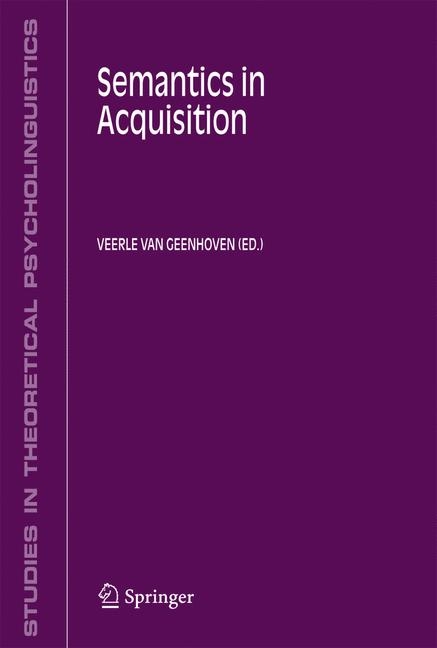
Semantics in Acquisition (eBook)
VIII, 355 Seiten
Springer Netherland (Verlag)
9781402044854 (ISBN)
This volume contains writings focusing on semantic phenomena and their interpretation in the analysis of the language of a learner. The variety of phenomena that are addressed is substantial: temporal aspect and tense, specificity, quantification, scope, finiteness, focus structure, and focus particles. These phenomena are investigated is many languages. The volume creates a theoretical as well as an empirical bridge between semantic research on the one hand and psycholinguistic acquisition studies on the other.
Veerle Van Geenhoven is a formal semanticist with a primary interest in crosslinguistic research. She received a 'Dr.phil.' degree in linguistics from the Eberhard-Karls-Universität Tübingen, Germany, in 1996, and a university lecturing qualification (Habilitation) from the Johann-Wolfgang-Goethe-Universität Frankfurt, Germany, in 2005. She held positions at the University of Stuttgart, the Max Planck Institute for Psycholinguistics in Nijmegen, the University of Bielefeld, UC Santa Cruz, and the Radboud University in Nijjmegen. In the last years, her research has been made possible by a fellowship of the Royal Netherlands Academy of Arts and Sciences.
A good deal of work in language acquisition has been devoted to children's interpretation of sentences that contain the universal quantifier, e. g. , every in English. It has been observed in several experimental studies and across several languages that some school-age children experience difficulty in interpreting such sentences (e. g. , Inhelder & Piaget, 1964; Roeper & de Villiers, 1991; Philip, 1995). Non-adult responses from children have been found in various conditions, including the circumstance exemplified in the picture in Figure 1, where three boys are each riding an elephant and a fourth elephant (referred to as the 'extra-object') is not being ridden. Some children who are shown such a picture sometimes respond No to the question in (1) relative to this picture: (1) Is every boy riding an elephant? Figure 1. The Extra-Object Condition To justify their negative answer to the question in (1), children often point to the extra object, i. e. , the elephant that is not being ridden. This reply has been called the symmetrical response or the exhaustive pairing response since children who give this kind of response seem to interpret the question to be about the symmetry (i. e. , one-to-one relation) between the set of entities denoted by the subject noun (the boys) and the set denoted by the object noun (the elephants).
Veerle Van Geenhoven is a formal semanticist with a primary interest in crosslinguistic research. She received a 'Dr.phil.' degree in linguistics from the Eberhard-Karls-Universität Tübingen, Germany, in 1996, and a university lecturing qualification (Habilitation) from the Johann-Wolfgang-Goethe-Universität Frankfurt, Germany, in 2005. She held positions at the University of Stuttgart, the Max Planck Institute for Psycholinguistics in Nijmegen, the University of Bielefeld, UC Santa Cruz, and the Radboud University in Nijjmegen. In the last years, her research has been made possible by a fellowship of the Royal Netherlands Academy of Arts and Sciences.
Acquisition and Interpretation: A Brief Introduction / VEERLE VAN GEENHOVEN Part I: THE DEVELOPMENT OF THE SYNTAX-SEMANTICS INTERFACE Mismatches of Form and Interpretation / GREG CARLSON Watching Noun Phrases Emerge: Seeking Compositionality / TOM ROEPER Cross-Linguistic Acquisition of Complement Tense / AYUMI MATSUO PART II: ACQUIRING UNIVERSAL QUANTIFICATION Everybody Knows / LUISA MERONI, ANDREA GUALMINI AND STEPHEN CRAIN The Effect of Context on Children's Interpretations of Universally Quantified Sentences / KENNETH F. DROZD AND ERIK VAN LOOSBROEK Structure and Meaning in the Acquisition of Scope / JULIEN MUSOLINO PART III: TIME IN THE LANGUAGE OF A LEARNER Time for Children: An Integrated Stage Model of Aspect and Tense / VEERLE VAN GEENHOVEN State Change and Temporal Reference in Inuktitut Child Language / MARY SWIFT Temporal Adverbials and Early Tense and Aspect Markers in the Acquisition of Dutch / MARIANNE STARREN PART IV: FINITENESS AND ITS DEVELOPMENT On Finiteness / WOLFGANG KLEIN Functions of Finiteness in Child Language / PETRA GRETSCH PART V: FOCUS PARTICLES IN CHILD LANGUAGE Additive Particles and Scope Marking in Child German / ULRIKE NEDERSTIGT (Un)Stressed Ook in Child Dutch / WENDA BERGSMA Subject Index
| Erscheint lt. Verlag | 15.7.2006 |
|---|---|
| Reihe/Serie | Studies in Theoretical Psycholinguistics | Studies in Theoretical Psycholinguistics |
| Zusatzinfo | VIII, 358 p. |
| Verlagsort | Dordrecht |
| Sprache | englisch |
| Themenwelt | Geisteswissenschaften ► Sprach- / Literaturwissenschaft ► Sprachwissenschaft |
| Schlagworte | acquisition • Language acquisition • Psycholinguist • Semantic • semantic research • Semantics • Syntax • Temporal aspect • Tense |
| ISBN-13 | 9781402044854 / 9781402044854 |
| Informationen gemäß Produktsicherheitsverordnung (GPSR) | |
| Haben Sie eine Frage zum Produkt? |
 PDF (Wasserzeichen)
DRM: Digitales Wasserzeichen
Dieses eBook enthält ein digitales Wasserzeichen und ist damit für Sie personalisiert. Bei einer missbräuchlichen Weitergabe des eBooks an Dritte ist eine Rückverfolgung an die Quelle möglich.
Dateiformat: PDF (Portable Document Format)
Mit einem festen Seitenlayout eignet sich die PDF besonders für Fachbücher mit Spalten, Tabellen und Abbildungen. Eine PDF kann auf fast allen Geräten angezeigt werden, ist aber für kleine Displays (Smartphone, eReader) nur eingeschränkt geeignet.
Systemvoraussetzungen:
PC/Mac: Mit einem PC oder Mac können Sie dieses eBook lesen. Sie benötigen dafür einen PDF-Viewer - z.B. den Adobe Reader oder Adobe Digital Editions.
eReader: Dieses eBook kann mit (fast) allen eBook-Readern gelesen werden. Mit dem amazon-Kindle ist es aber nicht kompatibel.
Smartphone/Tablet: Egal ob Apple oder Android, dieses eBook können Sie lesen. Sie benötigen dafür einen PDF-Viewer - z.B. die kostenlose Adobe Digital Editions-App.
Buying eBooks from abroad
For tax law reasons we can sell eBooks just within Germany and Switzerland. Regrettably we cannot fulfill eBook-orders from other countries.
aus dem Bereich


