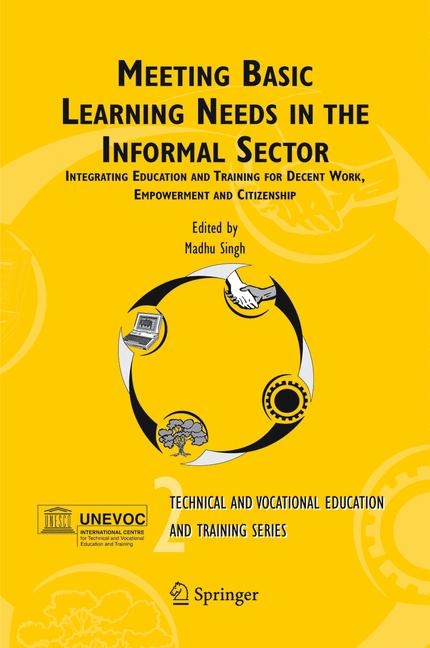
Meeting Basic Learning Needs in the Informal Sector (eBook)
XV, 250 Seiten
Springer Netherland (Verlag)
9781402034275 (ISBN)
In advancing the vision of adult learning articulated at the International Conference on Adult Education (CONFINTEA V) held in Hamburg in 1997, the UNESCO Institute for Education has been conducting studies on the different areas and dimensions of 'Adult Learning and the Changing World of Work'. One question that has been central to this area is: What constitutes adult learning for those who traditionally secure their survival in the informal economy, as well as for those school leavers and dropouts who are forced to work in this sector? In answering this question, the informal sector or popular economy may be defined in various ways, but there is an increasing recognition that it is a phenomenon that has come to stay and that government policies aimed at economic and social development, including national education and training policies and programmes, should target those who work in this sector. In particular, basic education and continuing education and training are being seen as key to empowering people and as crucial to strategies for reducing poverty. Moreover, there is a growing awareness that education is a human right of fundamental siginificance to promoting decent work and humane living conditions. It is in view of such considerations that UIE and the ILO planned to conduct studies in South Asia (Nepal, Bangladesh, India) to develop an understanding of the quality provision of education and skills development in and for the informal sector.
Contents Book Series Scope Introduction by the Series Editors Preface Acknowledgements Acronyms Introduction -Madhu Singh Section 1: Cross-Cutting Themes:Schooling and Basic Skills: Training Programmes and Challenges
in the Informal Sector: Latin America-Enrique Pieck Gochicoa.-Informal Learning and the Role of Social Movements -Bernd Overwien.-The Informal Sector: Non-Formal Education Settings for Working Children -Laila IskandarEgypt.-Institutional Support Structures and Modes of Skills Transmission-V. V. Krishna.-Gender and the Informal Economy in Latin America: New Challenges
and Possible Answers for Labour Training Policies -Sara Silveira and Anaclara Matosas.-Trade Unions and Adult Learning for Women Construction Workers in the Informal Sector -Christine Nathan.-Section 2: Country Studies :Skills Formation for the Informal Sector in Bangladesh:
A Strategic Framework-Rashed Al Mahmud Titumir.-Training and Skills Development for Decent Work in the Informal Sector: Case Studies from South India-Amit Mitra.-Education, Training and Skills Formation for Decent Work in the Informal Sector: Case Studies from Northern India-V. V. Krishna.-Educational Reform for Linking Skills Development -with Employment in Nepal-Poorna K. Adhikary.-Training in Modest Housing Construction for Those Who Need it Most: An Example from Nicaragua -Peter Gerasch and Arturo Durán.-Index of Names .-Index of Subjects .-Contributors .
| Erscheint lt. Verlag | 28.9.2005 |
|---|---|
| Reihe/Serie | Technical and Vocational Education and Training: Issues, Concerns and Prospects | Technical and Vocational Education and Training: Issues, Concerns and Prospects |
| Zusatzinfo | XV, 250 p. |
| Verlagsort | Dordrecht |
| Sprache | englisch |
| Themenwelt | Geisteswissenschaften |
| Sozialwissenschaften ► Pädagogik ► Berufspädagogik | |
| Sozialwissenschaften ► Pädagogik ► Erwachsenenbildung | |
| Sozialwissenschaften ► Politik / Verwaltung | |
| Schlagworte | Education • Gender • Lifelong Learning • Strategy • Training • Women |
| ISBN-13 | 9781402034275 / 9781402034275 |
| Informationen gemäß Produktsicherheitsverordnung (GPSR) | |
| Haben Sie eine Frage zum Produkt? |
 PDF (Wasserzeichen)
DRM: Digitales Wasserzeichen
Dieses eBook enthält ein digitales Wasserzeichen und ist damit für Sie personalisiert. Bei einer missbräuchlichen Weitergabe des eBooks an Dritte ist eine Rückverfolgung an die Quelle möglich.
Dateiformat: PDF (Portable Document Format)
Mit einem festen Seitenlayout eignet sich die PDF besonders für Fachbücher mit Spalten, Tabellen und Abbildungen. Eine PDF kann auf fast allen Geräten angezeigt werden, ist aber für kleine Displays (Smartphone, eReader) nur eingeschränkt geeignet.
Systemvoraussetzungen:
PC/Mac: Mit einem PC oder Mac können Sie dieses eBook lesen. Sie benötigen dafür einen PDF-Viewer - z.B. den Adobe Reader oder Adobe Digital Editions.
eReader: Dieses eBook kann mit (fast) allen eBook-Readern gelesen werden. Mit dem amazon-Kindle ist es aber nicht kompatibel.
Smartphone/Tablet: Egal ob Apple oder Android, dieses eBook können Sie lesen. Sie benötigen dafür einen PDF-Viewer - z.B. die kostenlose Adobe Digital Editions-App.
Buying eBooks from abroad
For tax law reasons we can sell eBooks just within Germany and Switzerland. Regrettably we cannot fulfill eBook-orders from other countries.
aus dem Bereich