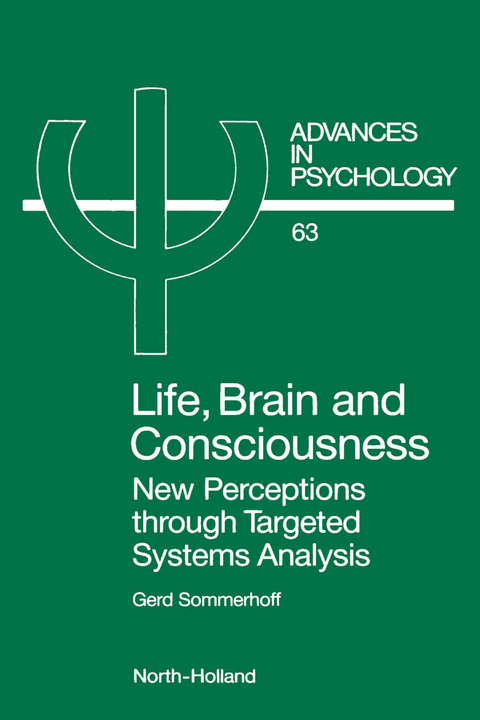
Life, Brain and Consciousness (eBook)
352 Seiten
Elsevier Science (Verlag)
978-0-08-086717-5 (ISBN)
The relation between mind and brain can never be understood by science until the nature of consciousness and self-consciousness is clearly perceived as specific system-properties. In this volume the author tackles this problem in a rigorous analysis which begins with the general dynamics of living systems and leads the reader step-by-step towards firm conclusions about the physical processes of consciousness and the main categories of mental events. Finally the author moves from the cognitive to the affective, and proceeds to interpret a number of uniquely human sensibilities in the light of the general biological perspective he has established.
Front Cover 1
Life, Brain and Consciousness: New Perceptions through Targeted Systems Analysis 4
Copyright Page 5
CONTENTS 6
PREFACE 10
CHAPTER 1. - INTRODUCTION AND OVERVIEW 16
1.1 - Science and the nature of consciousness 16
1.2 - The importance of the problem for science 18
1.3 - The state of the art 19
1.4 - 'Conscious', 'consciousness' and 'internal representations' 24
1.5 - Further aspects of consciousness 29
1.6 - The three basic categories of internal representations 32
1.7 - The application of systems theory 37
1.8 - The neural correlates of mental events 40
1.9 - Deeper levels of consciousness 45
Part I: LIFE 50
CHAPTER 2. - ORDER AND LIFE 52
Introduction and summary 52
2.1 - The directiveness of vital activities 53
2.2 - Dynamic versus structural order 54
2.3 - The range and importance of teleological concepts 57
2.4 - Past misconceptions 59
CHAPTER 3. - THE DEFINITION OF TELEOLOGICAL CONCEPTS IN NON-TELEOLOGICAL TERMS 62
Summary 62
3.1 - General characteristics of directive activities 62
3.2 - Their common pattern of causal relationships 66
3.3- Further comments 73
3.4 - Applications of the concept of directive correlation 78
Part II: BRAIN AND CONSCIOUSNESS 84
CHAPTER 4. - CONSCIOUSNESS AND SELF-CONSCIOUSNESS 86
Summary 86
4.1 - The psychologist's dilemma 87
4.2 - The meaning of consciousness 90
4.3 - Internal representations of the outside world 93
4.4 - The functional definition of 'internal representation' 97
4.5 - Three main categories of internal representations 101
4.6 - Selecting a technical definition of consciousness 105
CHAPTER 5. - THE PHYSICAL STRUCTURE OF THE INTERNAL REPRESENTATIONS 110
Summary 110
5.1 - General structural considerations 112
5.2 - The Conditional Expectancy Hypothesis 114
5.3 - Categories and ascending orders of expectancies 119
5.4 - Empirical evidence and additional arguments 125
5.5 - The learning changes involved 136
5.6 - Further comments on visual perception 142
5.7- Contrasts with other theories of perception 146
Chapter 6. - THE NEURAL CORRELATES OF THE INTERNAL REPRESENTATIONS 154
Summary 154
6.1 - Recapitulation 155
6.2 - The neural correlates of states of readiness 156
6.3 - The neural correlates of states of expectancy 164
6.4 - Intentions and their execution 166
6.5 - The seat of consciousness and the effect of lesions 174
6.6 - Conflicting beliefs in brain research 183
CHAPTER 7. - SELF-AWARENESS, IMAGINATION AND MEMORY 186
Recapitulation and summary 186
7.1 - Self-awareness 187
7.2 - Properties of the imagination 192
7.3 - The neural correlates of the imagination 195
7.4 - Aspects of memory 200
7.5 - Episodic memory recall 205
CHAPTER 8. - LANGUAGE AND RATIONAL THOUGHT 214
Introduction and summary 214
8.1 - Classes and the internal representation of classes 218
8.2 - Logical relationships between classes 219
8.3 - The brain's struggle with nameless entities 222
8.4 - What the sentence structure communicates 225
8.5 - Mental images and the propositional form 229
8.6 - The foundations of rational thought 231
CHAPTER 9. - MIND AND MATTER 234
Summary 234
9.1 - Categories of mental events 234
9.2 - The bridge between mind and matter 236
9.3 - The unity of the self in split-brain subjects 237
9.4 - The freedom of the will 239
9.5 - Knowledge and belief 241
9.6 - Artificial Intelligence 243
9.7 - Contrasts with the approach of academic philosophy 249
Part III: CULTURE 256
CHAPTER 10. - DEEPER LEVELS OF CONSCIOUSNESS (1) 258
Introduction to Part III and summary 258
10.1 - A crucial departure from the biological norm 263
10.2 - The roots of the human psyche 266
10.3 - Frustration, conflict and anxiety 270
CHAPTER 11. - DEEPER LEVELS OF CONSCIOUSNESS (2) 274
11.1 - The sense of beauty 274
11.2- The moral sense 281
11.3 -A distinctive step in the evolution of life 288
11.4 - The religious dimension 291
11.5 - Concluding remarks 297
Part IV: APPENDICES 300
Appendix A: Further applications of the concept of directive correlation 302
Appendix B: Some basic concepts of set theory 306
Appendix C Some basic concepts of formal logic 314
Appendix D: Generative and transformational grammars 320
Appendix E: Some basic concepts of information theory 326
Appendix F: Physical systems and causal relationships 330
BIBLIOGRAPHY 334
INDEX 344
| Erscheint lt. Verlag | 18.12.1989 |
|---|---|
| Sprache | englisch |
| Themenwelt | Geisteswissenschaften ► Psychologie ► Allgemeine Psychologie |
| Geisteswissenschaften ► Psychologie ► Verhaltenstherapie | |
| Medizin / Pharmazie ► Medizinische Fachgebiete ► Neurologie | |
| ISBN-10 | 0-08-086717-0 / 0080867170 |
| ISBN-13 | 978-0-08-086717-5 / 9780080867175 |
| Informationen gemäß Produktsicherheitsverordnung (GPSR) | |
| Haben Sie eine Frage zum Produkt? |
 PDF (Adobe DRM)
Kopierschutz: Adobe-DRM
Adobe-DRM ist ein Kopierschutz, der das eBook vor Mißbrauch schützen soll. Dabei wird das eBook bereits beim Download auf Ihre persönliche Adobe-ID autorisiert. Lesen können Sie das eBook dann nur auf den Geräten, welche ebenfalls auf Ihre Adobe-ID registriert sind.
Details zum Adobe-DRM
Dateiformat: PDF (Portable Document Format)
Mit einem festen Seitenlayout eignet sich die PDF besonders für Fachbücher mit Spalten, Tabellen und Abbildungen. Eine PDF kann auf fast allen Geräten angezeigt werden, ist aber für kleine Displays (Smartphone, eReader) nur eingeschränkt geeignet.
Systemvoraussetzungen:
PC/Mac: Mit einem PC oder Mac können Sie dieses eBook lesen. Sie benötigen eine
eReader: Dieses eBook kann mit (fast) allen eBook-Readern gelesen werden. Mit dem amazon-Kindle ist es aber nicht kompatibel.
Smartphone/Tablet: Egal ob Apple oder Android, dieses eBook können Sie lesen. Sie benötigen eine
Geräteliste und zusätzliche Hinweise
Buying eBooks from abroad
For tax law reasons we can sell eBooks just within Germany and Switzerland. Regrettably we cannot fulfill eBook-orders from other countries.
aus dem Bereich