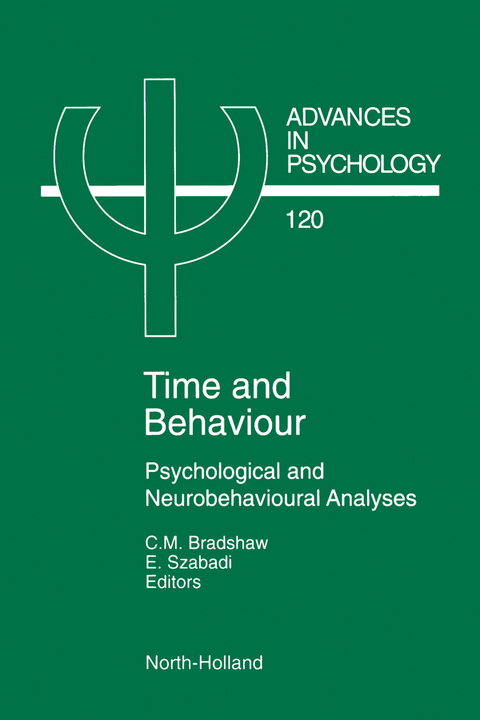
Time and Behaviour (eBook)
575 Seiten
Elsevier Science (Verlag)
9780080543017 (ISBN)
The last decade has seen a burgeoning of interest in the quantitative analysis of timing behaviour, and progress during the last five or six years has been particularly impressive, with the publication of several major new theoretical contributions.
There has also been considerable progress in behavioural methodology during the past decade. In the area of reinforcement schedules, for example, the venerable interresponse&ndash,time schedule, fixed&ndash,interval peak procedure and interval bisection task have been complemented by a 'second generation' of incisive instruments for analyzing timing behaviour.
Another area of recent development is the analysis of the neurobiological substrate of timing behaviour. Several research groups are currently studying the involvement of various central neurotransmitter systems in the timing behaviour, and the ability of centrally acting drugs and discrete brain lesions to alter timing processes.
Yet another recent development in timing research is the growing dialogue between two fields that have grown up separately, although, superficially at least, they seem to have much in common: the experimental analysis of 'interval timing', traditionally the province of experimental psychology, and behavioural chronobiology. The last few years have seen a growing interest in the comparative properties of the internal 'clocks' that regulate biobehavioural rhythms with time bases in the circadian range or longer, and those that are entailed in timing of intervals in the range of seconds or minutes.
All these areas of research, and others, are represented in the chapters that make up this volume. This book will help to promote further interactions among researchers who hail from disparate disciplines, but who share a common interest in the temporal properties of behaviour.
That time is both a dimension of behaviour and a ubiquitous controlling variable in the lives of all living things has been well recognized for many years.The last decade has seen a burgeoning of interest in the quantitative analysis of timing behaviour, and progress during the last five or six years has been particularly impressive, with the publication of several major new theoretical contributions.There has also been considerable progress in behavioural methodology during the past decade. In the area of reinforcement schedules, for example, the venerable interresponse-time schedule, fixed-interval peak procedure and interval bisection task have been complemented by a 'second generation' of incisive instruments for analyzing timing behaviour.Another area of recent development is the analysis of the neurobiological substrate of timing behaviour. Several research groups are currently studying the involvement of various central neurotransmitter systems in the timing behaviour, and the ability of centrally acting drugs and discrete brain lesions to alter timing processes. Yet another recent development in timing research is the growing dialogue between two fields that have grown up separately, although, superficially at least, they seem to have much in common: the experimental analysis of 'interval timing', traditionally the province of experimental psychology, and behavioural chronobiology. The last few years have seen a growing interest in the comparative properties of the internal 'clocks' that regulate biobehavioural rhythms with time bases in the circadian range or longer, and those that are entailed in timing of intervals in the range of seconds or minutes.All these areas of research, and others, are represented in the chapters that make up this volume. This book will help to promote further interactions among researchers who hail from disparate disciplines, but who share a common interest in the temporal properties of behaviour.
Cover 1
Contents 6
Preface 8
Contributors 10
Chapter 1. Dynamic models of rapid temporal control in animals 14
Chapter 2. Timing and temporal search 54
Chapter 3. Time's causes 92
Chapter 4. Application of a mode-control model of temporal integration to counting and timing behaviour 146
Chapter 5. Does a common mechanism account for timing and counting phenomena in the pigeon? 198
Chapter 6. Pigeons' coding of event duration in delayed matching-to-sample 230
Chapter 7. Ordinal, phase, and interval timing 278
Chapter 8. Cooperation, conflict and compromise between circadian and interval clocks in pigeons 342
Chapter 9. Factors influencing long-term time estimation in humans 398
Chapter 10. How time flies: Functional and neural mechanisms of interval timing 422
Chapter 11. On the human neuropsychology of timing of simple repetitive movements 472
Chapter 12. 5-hydroxytryptamine and interval timing 530
Index 584
| Erscheint lt. Verlag | 18.6.1997 |
|---|---|
| Sprache | englisch |
| Themenwelt | Geisteswissenschaften ► Psychologie ► Allgemeine Psychologie |
| Geisteswissenschaften ► Psychologie ► Biopsychologie / Neurowissenschaften | |
| Geisteswissenschaften ► Psychologie ► Verhaltenstherapie | |
| Medizin / Pharmazie ► Medizinische Fachgebiete ► Neurologie | |
| ISBN-13 | 9780080543017 / 9780080543017 |
| Informationen gemäß Produktsicherheitsverordnung (GPSR) | |
| Haben Sie eine Frage zum Produkt? |
 PDF (Adobe DRM)
Kopierschutz: Adobe-DRM
Adobe-DRM ist ein Kopierschutz, der das eBook vor Mißbrauch schützen soll. Dabei wird das eBook bereits beim Download auf Ihre persönliche Adobe-ID autorisiert. Lesen können Sie das eBook dann nur auf den Geräten, welche ebenfalls auf Ihre Adobe-ID registriert sind.
Details zum Adobe-DRM
Dateiformat: PDF (Portable Document Format)
Mit einem festen Seitenlayout eignet sich die PDF besonders für Fachbücher mit Spalten, Tabellen und Abbildungen. Eine PDF kann auf fast allen Geräten angezeigt werden, ist aber für kleine Displays (Smartphone, eReader) nur eingeschränkt geeignet.
Systemvoraussetzungen:
PC/Mac: Mit einem PC oder Mac können Sie dieses eBook lesen. Sie benötigen eine
eReader: Dieses eBook kann mit (fast) allen eBook-Readern gelesen werden. Mit dem amazon-Kindle ist es aber nicht kompatibel.
Smartphone/Tablet: Egal ob Apple oder Android, dieses eBook können Sie lesen. Sie benötigen eine
Geräteliste und zusätzliche Hinweise
Buying eBooks from abroad
For tax law reasons we can sell eBooks just within Germany and Switzerland. Regrettably we cannot fulfill eBook-orders from other countries.
aus dem Bereich