Psychology of Learning and Motivation (eBook)
410 Seiten
Elsevier Science (Verlag)
9780080554044 (ISBN)
* An intergrative view of memory, metamemory, judgment and decision-making, and individual differences
* Relevant to both applied concerns and basic research
* Articles written by expert contributors
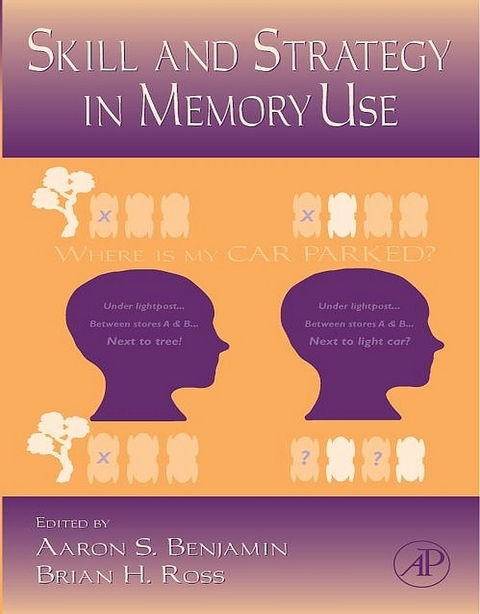
The view of memory use as skilled performance embraces the interactive nature of memory and higher order cognition. In considering the contexts in which memory is used, this book helps to answer such questions as:- If asked where I live, how do I decide on a street address or city name?- What influences my selection in a criminal lineup besides actual memory of the perpetrator?- Why do expert golfers better remember courses they've played than amateur golfers?Chapters in this volume discuss strategies people use in responding to memory queries- whether and how to access memory and how to translate retrieved products into responses. Coverage includes memory for ongoing events and memory for prospective events-how we remember to do future intended actions. Individual differences in memory skill is explored across people and situations, with special consideration given to the elderly population and how strategies at encoding and retrieval can offset what would otherwise be declining memory. - An intergrative view of memory, metamemory, judgment and decision-making, and individual differences- Relevant to both applied concerns and basic research- Articles written by expert contributors
Front Cover 1
Skill and Strategy in Memory Use 4
Copyright Page 5
Contents 6
Contributors 10
Preface 12
Chapter 1: The Strategic Regulation Of Memory Accuracy And Informativeness 16
I. Introduction 16
A. Everyday Versus Laboratory Approaches to Memory 17
B. Competing Goals of Memory Reporting: Accuracy Versus Informativeness 20
II. The Strategic Control of Memory Reporting: A Metacognitive Framework 21
A. The Basic Model: Control of Report Option 23
B. Empirical Evidence 27
C. QAP Methodology 33
D. QAP or Type-2 SDT? 42
III. Applications of the Framework 44
A. The Recall-Recognition Paradox 45
B. Children's Eyewitness Testimony 46
C. Memory Impairment in Old Age 48
D. Clinical Memory Impairment 50
E. Encoding Specificity and Memory Cueing 51
F. Psychometric Testing 52
IV. Expanding the Framework: Control of Memory Grain Size 54
A. Accuracy-Informativeness Trade-Off 55
B. Satisficing Versus Utility-Maximizing Models of Grain Control 56
C. Empirical Evidence 57
D. Control of Grain Size in Episodic Memory Reporting Over Time 60
V. Toward an Integrated Model of Grain Size and Report Option 63
A. An Integrated Satisficing Model 63
B. To Coarsen or Withhold? 65
C. The Need for an Informativeness Criterion 66
VI. Conclusion 68
Acknowledgments 68
References 68
Chapter 2: Response Bias in Recognition Memory 76
I. Introduction 76
II. Measuring Response Bias 78
A. Measuring Response Bias in a Single Condition 78
B. Comparing Bias Among Conditions with Equal Sensitivity 80
C. Comparing Bias Among Conditions with Unequal Sensitivity 81
III. Explaining Response Bias 82
A. Seeking Invariants Within the Data 82
B. Divining Subject Strategy 83
IV. Between-Group Criterion Differences 87
V. Between-List Criterion Differences 87
VI. Within-Test Criterion Shifts 89
A. Evidence Against Shifts: Strength Manipulations 89
B. Evidence for Shifts: Processing and Stimulus Manipulations 91
VII. An Interim Summary 93
VIII. Distribution Shifts Masquerading as Criterion Shifts 94
A. Study-Test Delay 95
B. Context Effects 95
C. Identifying the Change 96
IX. Designs with Multiple Responses 96
A. The Remember-Know Paradigm 97
B. Confidence Ratings 99
X. Conclusions and Recommendations 103
A. Choose the Right Sensitivity Measure 103
B. Choose the Right Response-Bias Measure 103
C. Apply an Explicit Model to the Data 104
D. Consider the Use of Feedback and/or a Forced-Choice Design 104
E. Use Ratings and Plot ROCs 105
Acknowledgment 105
References 105
Chapter 3: What Constitutes a Model of Item-Based Memory Decisions? 110
I. Introduction 110
A. What Are Item-Based Memory Decisions? 110
B. One Dimensional Signal Detection Theory: A Simple Decision Model 111
II. The Characteristics and Neural Substrates of Item-Based Memory Decisions 115
A. How Labile Is the Recognition Criterion During Testing? 115
B. Is the Relationship Between Confidence and Accuracy Monotonic? 128
C. Is the Recognition Criterion Informed by Individual Skill? 141
D. Context Versus Item Memory Judgments and PFC 147
III. Conclusion—What Constitutes a Model of Item-Based Memory Decisions? 153
Acknowledgments 155
References 155
Chapter 4: Prospective Memory and Metamemory: The Skilled Use of Basic Attentional and Memory Processes 160
I. Introduction 160
II. What Is Different About Prospective Memory? 161
III. Is There a Specialized Prospective Memory System? 162
IV. Using Basic Memory and Attentional Processes in the Service of Prospective Memory 163
A. Use of Controlled (or Directed) Recognition Processes 164
B. Spontaneous Recognition Processes 166
C. Spontaneous, Reflexive Associative Memory Processes 167
V. The Multiprocess Theory: Contextual Factors Determining the Utility of Each Process 169
VI. Metamemory and Prospective Memory 170
A. Sensitivity to the Extent to Which the Ongoing Task Encourages Focal Processing of the Target Cue 171
B. Importance of the Prospective Memory Task 175
C. Delaying Execution of Retrieved Intentions 176
D. Sensitivity to Costs of Monitoring 179
VII. Summary and Future Directions 180
References 184
Chapter 5: Memory is More than just Remembering: Strategic Control of Encoding, Accessing Memory, and Making Decisions 190
I. Introduction 190
II. Interacting with Memory 192
III. Strategic Decisions About Encoding 193
A. What Gets Encoded? 194
B. How Does Information Get Encoded? 196
C. Learning About Encoding 200
D. Control of Encoding as a Means of Control over Memory 203
IV. Strategic Decisions About Memory Access 204
A. Means of Accessing Memory Traces 205
B. Decisions About How to Access Memory 207
C. Learning About Memory Access 214
D. Strategic Memory Access as a Cognitive Skill 216
V. Postaccess Decision Processes 217
A. Suppression of Output 217
B. Output Grain 219
C. Criterion Placement and Adjustment in Recognition 219
D. Learning About How to Make Memory Decisions 222
E. Postaccess Decision Processes as a Means of Control Over Memory 224
VI. Conclusions 224
References 227
Chapter 6: The Adaptive and Strategic Use of Memory By Older Adults: Evaluative Processing and Value-Directed Remembering 240
I. Overview 240
II. A Selective Review of the Research on Memory and Lifespan Development 241
A. Life Span Theories of Cognitive Aging 241
B. Motivated Cognition and Goals of Older Adults 244
III. Strategic Control and Value as Memory Modifiers for Older Adults 246
A. Value as a Memory Modifier for Older Adults 246
B. Selectivity, Value, and the Use of Memory by Older Adults 249
C. Evaluative Processing as Skilled Cognition in Old Age? 254
D. Value, Motivation, and Emotional Priority for Older Adults 256
IV. Model, Review and New View of Value, Memory, and Aging 257
A. A Model of Evaluative Processing and Value-Directed Remembering 257
B. General Slowing, Metacognition, and Evaluative Processing 260
C. Associative Memory Impairments and Value 261
D. Recollection, Familiarity, and Value 262
E. False Memory and Flexible Remembering 264
F. Proper Names as Low Value Information? 265
G. Memory, Value, and Grain Size at Retrieval 267
V. Implications of Value on Memory and Aging 269
A. Brain Mechanisms, Value, Memory, and Aging 269
B. Expertise as Adaptive Control and Skilled Cognition in Old Age Revisited 271
C. Individual Differences Among Older Adults: The Control and Use of Value Assignment 272
D. Value-Directed Remembering and Implications for Training 274
VI. Summary and Conclusions 275
Acknowledgments 277
References 278
Chapter 7: Experience is a Double-Edged Sword: A Computational Model of The Encoding/Retrieval Trade-Off With Familiarity 286
I. Introduction 286
II. When and Why Experience Adversely Affects Memory Retrieval 288
A. The Fan Effect 288
B. The SAC Memory Model: The Role of Experience in Recognition Memory 292
C. The SAC Model of Word Recognition and the Word Frequency Mirror Effect 296
D. Converging Evidence for SAC Explanation Using Other Types of Stimuli 301
E. Summary of How Experience Hurts Retrieval 305
III. When and Why Experience Facilitates Memory Encoding 306
A. Augmentation of SAC: How WM and Prior Experience Interact to Affect Ease of Encoding 309
B. Illustrations of Model Fits with the New Encoding Assumptions 312
C. The Consequences of Minimal "Lifelong" Experience on Encoding 315
D. Extremely Low-Frequency Stimuli: Experience Enables Unitization (Chunking) 316
IV. General Discussion 318
A. Explaining Related Phenomena with Our Model 319
V. Summary and Conclusions 320
Acknowledgments 321
References 321
Chapter 8: Toward an Understanding of Individual Differences in Episodic Memory: Modeling the Dynamics Of Recognition Memory 328
I. A Possible Relationship Between the Speed-Accuracy Trade-Off and Individual Differences in Associative Recognition 328
II. Traditional Testing Procedures 333
III. Classical Models of Associative Recognition 334
IV. Modeling the Accuracy and Latency of Associative Recognition 338
A. Encoding of Associative Information 339
B. Familiarity-Based Retrieval 339
C. Decision 341
D. Familiarity-Based Performance 342
E. Recollection 348
F. Dual-Process Decision Strategies 350
V. Conclusions 360
Acknowledgments 361
References 361
Chapter 9: Memory as A Fully Integrated Aspect of Skilled and Expert Performance 366
I. Introduction 366
II. Outline of the Chapter 368
A. Historical Background to the Traditional Approach Searching for Basic Abilities 369
B. The Powerful Effects of Some Types of Practice 372
C. Toward a Scientific Study of High Levels of Skill and Expert Performance 374
D. Capturing Reproducibly Superior Performance Under Standardized Conditions 375
E. Applying the Expert-Performance Approach to Identify the Mediating Mechanisms 376
F. The Representative Rehearsed Performance and Its Relation to Memory Performance 381
G. Expert Performance in Domains with Less Predictable Situations and Its Relation to Memory Performance 383
H. Expert Performance Involving Calculation and Its Relation to Memory Performance 385
III. Summary 387
IV. Conclusion 388
Acknowledgment 390
References 390
Index 396
Contents of Recent Volumes 406
| Erscheint lt. Verlag | 3.10.2007 |
|---|---|
| Mitarbeit |
Herausgeber (Serie): Brian H. Ross |
| Sprache | englisch |
| Themenwelt | Geisteswissenschaften ► Psychologie ► Allgemeine Psychologie |
| Geisteswissenschaften ► Psychologie ► Biopsychologie / Neurowissenschaften | |
| Geisteswissenschaften ► Psychologie ► Verhaltenstherapie | |
| ISBN-13 | 9780080554044 / 9780080554044 |
| Informationen gemäß Produktsicherheitsverordnung (GPSR) | |
| Haben Sie eine Frage zum Produkt? |
 EPUB (Adobe DRM)
Kopierschutz: Adobe-DRM
Adobe-DRM ist ein Kopierschutz, der das eBook vor Mißbrauch schützen soll. Dabei wird das eBook bereits beim Download auf Ihre persönliche Adobe-ID autorisiert. Lesen können Sie das eBook dann nur auf den Geräten, welche ebenfalls auf Ihre Adobe-ID registriert sind.
Details zum Adobe-DRM
Dateiformat: EPUB (Electronic Publication)
EPUB ist ein offener Standard für eBooks und eignet sich besonders zur Darstellung von Belletristik und Sachbüchern. Der Fließtext wird dynamisch an die Display- und Schriftgröße angepasst. Auch für mobile Lesegeräte ist EPUB daher gut geeignet.
Systemvoraussetzungen:
PC/Mac: Mit einem PC oder Mac können Sie dieses eBook lesen. Sie benötigen eine
eReader: Dieses eBook kann mit (fast) allen eBook-Readern gelesen werden. Mit dem amazon-Kindle ist es aber nicht kompatibel.
Smartphone/Tablet: Egal ob Apple oder Android, dieses eBook können Sie lesen. Sie benötigen eine
Geräteliste und zusätzliche Hinweise
Buying eBooks from abroad
For tax law reasons we can sell eBooks just within Germany and Switzerland. Regrettably we cannot fulfill eBook-orders from other countries.
aus dem Bereich