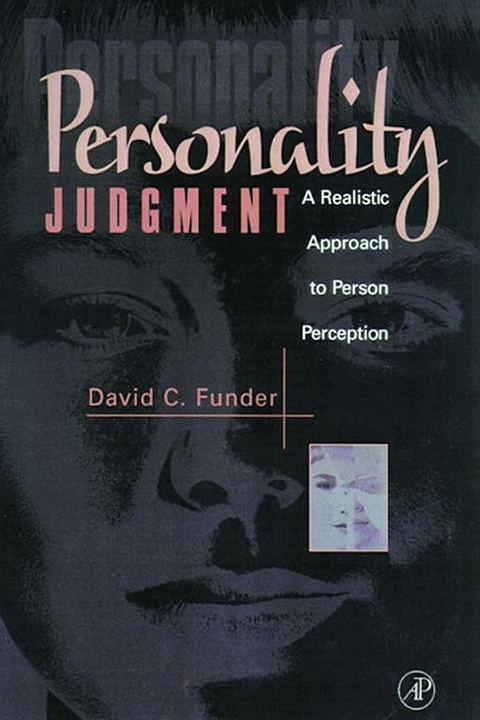
Personality Judgment (eBook)
238 Seiten
Elsevier Science (Verlag)
978-0-08-049206-3 (ISBN)
Accuracy in judging personality is important in clinical assessment, applied settings, and everyday life. Personality judgments are important in assessing job candidates, choosing friends, and determining who we can trust and rely on in our personal lives. Thus, the accuracy of those judgments is important to both individuals and organizations. In examining personality judgment, Personality Judgment takes a sweeping look at the field's history, assumptions, and current research findings. The book explores the construct of traits within the person-situation debate, defends the human judge in the face of the fundamental attribution error, and discusses research on four categories of moderators in judgment: the good judge, the judgeable target, the trait being judged, and the information on which the judgment is based. Spanning two decades of accuracy research, this book makes clear not only how personality judgment has come to its current standing but also where it may move in the future. - Covers 20 years worth of historical, current and future trends in personality judgment- Includes discussions of debatable issues related to accuracy and error. The author is well known for his recently developed theoy of the process by which one person may render an accurate judgment of the personality traits of another
Front Cover 1
Personality Judgment A Realistic Approach to Person Perception 6
Copyright Page 7
Contents 10
Preface 14
Acknowledgments 16
Chapter 1. Approaching Accuracy 18
Curiosity and Its Fulfillment 19
What Is Accuracy? 20
Chapter Organization 21
The Importance of Accuracy 21
Three Propositions 28
Social and Personality Psychology: Separation and Integration 30
Renewed Research on Accuracy 40
The Agenda of Accuracy Research and Plan for the Book 42
Chapter 2. The Very Existence of Personality 44
Does Personality Exist? 44
The Situational Onslaught 45
The Response 49
Do Personality Traits Explain Anything? 69
Personality Reafirmed 71
Chapter 3. Error and Accuracy in the Study of Personality Judgment 74
Evolution of Research on Accuracy and Error 75
Accuracy in Human Social Judgment 90
Toward a Rapprochement between Error and Accuracy 95
Chapter 4. Methodological and Philosophical Considerations 98
The Lessons of Cronbach 98
The Criterion Problem 100
Interjudge Agreement 106
Behavioral Prediction 123
General Issues of Design and Analysis 128
Conclusion 132
Chapter 5. The Process of Accurate Personality Judgment 134
The Realistic Accuracy Model 134
The Structure of RAM 137
Implications of the Realistic Accuracy Model 140
The Four Steps to Accurate Personality Judgment 142
Multiple Cues and Multiple Traits 151
The Goals of RAM 152
Chapter 6. Moderators of Accuracy 154
The Good Judge 155
The Good Target 163
The Good Trait 169
Good Information 172
Interactions among Moderators 179
Conclusion 185
Chapter 7. Self-Knowledge 186
Self-Perception versus Other-Perception 186
Application of RAM to Self-Judgment 194
Conclusion 203
Chapter 8. Prospects for Improving Accuracy 204
Relevance 205
Availability 207
Detection 208
Utilization 209
The Judge’s Situation 223
References 226
Index 248
Approaching Accuracy
This is a book about accuracy in personality judgment. It presents theory and research concerning the circumstances under which and processes by which one person might make an accurate appraisal of the psychological characteristics of another person, or even of oneself.
Accuracy is a practical topic. Its improvement would have clear advantages for organizations, for clinical psychology, and for the lives of individuals. With accurate personality judgment, organizations would become more likely to hire the right people and place them in appropriate positions. Clinical psychologists would make more accurate judgments of their clients and so serve them better. Moreover, a tendency to misinterpret the interpersonal world is an important part of some psychological disorders. If we knew more about accurate interpersonal judgment, this knowledge might help people to correct the kinds of misjudgments that can cause problems. Most important of all, if individuals made more accurate judgments of personality they might do better at choosing friends, avoiding people who cannot be trusted, and understanding their interpersonal worlds (Nowicki & Mitchell, 1998). This last-named advantage—improving interpersonal understanding—is the worthiest justification for doing research on accuracy and the most powerful reason why people find the topic interesting.
CURIOSITY AND ITS FULFILLMENT
When George Miller (1969) urged researchers to “give psychology away” to the wider public, the gifts he described were the ways in which psychological knowledge might be used to create more useful instruments for aircraft cockpits, allow more accurate selection of qualified employees, and ensure racial harmony, world peace, and increased sales of soap. Psychology can—to a greater or lesser degree— do all of these things, and these accomplishments help to justify its existence. Moreover, it certainly can be useful to predict what another person will do, or even to know what another person is thinking, and our interest in these matters is heightened when we feel a need to control what is going on (Swann, Stephenson, & Pittman, 1981).
But its practical accomplishments are not the primary reason that psychology exists, and our everyday interest about other people goes beyond pragmatic considerations. People are intrinsically interested in each other. How else can we explain the vast amount of otherwise pointless gossip that occupies so much of our time, gossip that consists largely of highly speculative judgments about why some other person is doing what he or she is doing, what he or she is thinking, and what he or she is likely to do next. How else can we explain the frequency of sidewalk cafes, confessional television programs, and telescopes in the windows of high-rise apartment complexes, all of which provide the opportunity to watch other people who, with any luck, you need never encounter nor be directly affected by in any other way. And how else, indeed, can we explain the existence of the highly paid occupation of “celebrity,” the function of which seems to be to give everybody on earth a few individuals in common that they can all gossip about?
Psychology arose to institutionalize, formalize, and satisfy the intrinsic curiosity people have about each other and about themselves. To paraphrase a comment by Sal Maddi (1996), if all of psychology were abolished tomorrow and all memory of its existence erased, before very long it would have to be reinvented, because some questions simply will not go away. If the reader of this book is a psychologist or graduate student in psychology, chances are that a burning interest in one or more of these questions is the reason the reader got into the field in the first place (Funder, 1998).
The fundamental questions people have about each other have two foci. The job of a local television news reporter is to satisfy the curiosity, sometimes morbid, of his or her viewers. When interviewing the person who just survived a plane crash or whose house has burned to the ground, the reporter invariably asks, “How did it feel? What were you thinking?” And when interviewing the surviving postal workers after one of their coworkers has gone on yet another murderous rampage, the reporter inevitably asks, “What kind of person was he? What was he like?”
In other words, included among the fundamental questions that underlie psychological curiosity are the ones that ask what people are thinking and feeling, and what they are like. The first concerns what Ickes (1993) has called “empathic accuracy,” defined as the ability to describe another person’s thoughts and feelings (see also Ickes, 1997). The second question concerns judgments of personality, of traits such as extraversion, honesty, sociability, and happiness. The two topics are relevant to each other. What one is thinking and feeling surely offers a clue as to the kind of person that he or she is. And different kinds of people no doubt think and feel differently, even in the same situation. The two topics are therefore not completely separable, and it will become apparent as we go along that the research findings concerning one of these topics is highly relevant to (and generally consistent with) the findings from the other (Colvin, Vogt, & Ickes, 1997). But this book is primarily about the latter topic. This is a book about how people make judgments of what each other is like, the degree to which these judgments achieve accuracy, and the factors that make accuracy in personality judgment more and less likely.
WHAT IS ACCURACY?
Accuracy is a topic that has only recently come back into acceptance, if not fashion, in research psychology (Funder & West, 1993). For the better part of four decades (1950–1990) psychologists were prone either to ignore accuracy or to redefine it out of existence. The reasons for this state of affairs range from the daunting methodological issues that confront the study of accuracy to the infiltration of deconstructionist philosophies into social psychology. The infiltration of these philosophies has had the subtle but unmistakable effect of causing many psychologists to be uncomfortable with the idea of assuming, defining, or even discussing the nature of social reality.
So at the outset it should be said that when this book talks about accuracy, the term is used advisedly yet in the most disingenuous possible way. Herein, accuracy refers not to any sophisticated reconstructionist, deconstructionist, or convenient operational definition of this very loaded word. Rather, it refers to the relation between what is perceived and what is.
This definition raises a large number of issues. The most central as well as the most daunting is the criterion issue, which concerns how reality—especially, psychological reality—can ever be known so that judgments can be compared with it to assess their accuracy. Other issues, only slightly less central and slightly less daunting, include the nature of personality, the quality of human judgment, and a host of methodological complications that arise in the study of personality and person perception.
These are all worthy issues. They deserve to be addressed directly. The topic of accuracy is too important to be ignored, sidestepped, or operationally redefined out of existence. The goal of this book, therefore, is to confront this topic, and these issues, as directly as possible.
CHAPTER ORGANIZATION
The remainder of this introductory chapter is in four parts. The first discusses in detail the reasons why the topic of accuracy in personality judgment is so important. These reasons are practical, theoretical, and even philosophical. The second part introduces the basic orienting assumptions of the particular approach to accuracy that will be taken in this book. Three seemingly simple but sometimes controversial assumptions entail an approach to accuracy that trespasses across the otherwise welldefended, traditional border between social and personality psychology. The third part of this chapter outlines some of the differences (and sometimes antagonisms) between social and personality psychology, and proposes a rapprochement. The need for the reintegration of personality and social psychology is a direct implication of the present approach to accuracy research, and is a persistent theme throughout this book. The fourth part of this chapter describes the historical roots of the Realistic Accuracy Model and outlines its research agenda and the overall plan of the remainder of the book.
THE IMPORTANCE OF ACCURACY
The accuracy of personality judgment touches on many areas of life. It is important for reasons that are practical, theoretical, and intrinsic.
Practical Considerations
Accuracy in personality judgment has important practical implications for people living their daily lives as well as for psychologists attempting to do work that has a positive effect on individuals and society.
Daily Life
A moment’s reflection will confirm that personality judgment is an important part of daily existence. Conversations about what other people are like fill our waking hours, and our impressions of others’ personality attributes drive decisions about who to trust, befriend, hire, fire, date, and marry. This process is formalized in the “letter of recommendation,” a common vehicle for one person to describe his or her...
| Erscheint lt. Verlag | 16.8.1999 |
|---|---|
| Sprache | englisch |
| Themenwelt | Geisteswissenschaften ► Geschichte |
| Geisteswissenschaften ► Psychologie ► Allgemeine Psychologie | |
| Geisteswissenschaften ► Psychologie ► Psychoanalyse / Tiefenpsychologie | |
| Geisteswissenschaften ► Psychologie ► Sozialpsychologie | |
| Geisteswissenschaften ► Psychologie ► Verhaltenstherapie | |
| ISBN-10 | 0-08-049206-1 / 0080492061 |
| ISBN-13 | 978-0-08-049206-3 / 9780080492063 |
| Informationen gemäß Produktsicherheitsverordnung (GPSR) | |
| Haben Sie eine Frage zum Produkt? |
 PDF (Adobe DRM)
Kopierschutz: Adobe-DRM
Adobe-DRM ist ein Kopierschutz, der das eBook vor Mißbrauch schützen soll. Dabei wird das eBook bereits beim Download auf Ihre persönliche Adobe-ID autorisiert. Lesen können Sie das eBook dann nur auf den Geräten, welche ebenfalls auf Ihre Adobe-ID registriert sind.
Details zum Adobe-DRM
Dateiformat: PDF (Portable Document Format)
Mit einem festen Seitenlayout eignet sich die PDF besonders für Fachbücher mit Spalten, Tabellen und Abbildungen. Eine PDF kann auf fast allen Geräten angezeigt werden, ist aber für kleine Displays (Smartphone, eReader) nur eingeschränkt geeignet.
Systemvoraussetzungen:
PC/Mac: Mit einem PC oder Mac können Sie dieses eBook lesen. Sie benötigen eine
eReader: Dieses eBook kann mit (fast) allen eBook-Readern gelesen werden. Mit dem amazon-Kindle ist es aber nicht kompatibel.
Smartphone/Tablet: Egal ob Apple oder Android, dieses eBook können Sie lesen. Sie benötigen eine
Geräteliste und zusätzliche Hinweise
Buying eBooks from abroad
For tax law reasons we can sell eBooks just within Germany and Switzerland. Regrettably we cannot fulfill eBook-orders from other countries.
aus dem Bereich