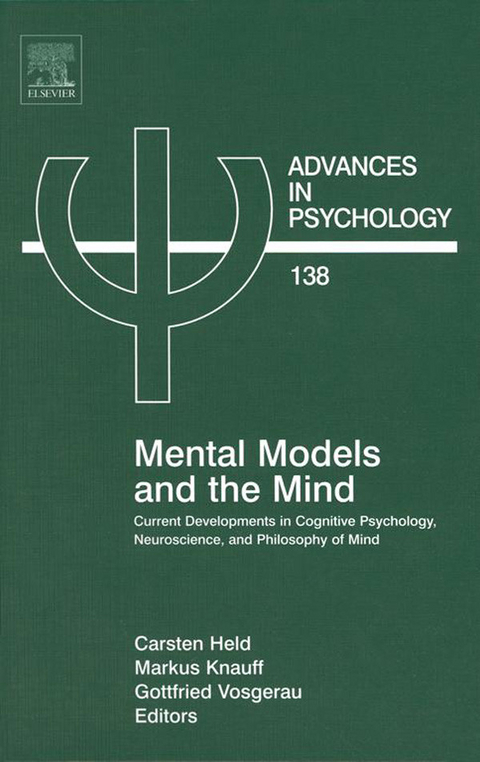
Mental Models and the Mind (eBook)
286 Seiten
Elsevier Science (Verlag)
9780080459011 (ISBN)
*Examines the theory of mental models from the perspectives of cognitive psychology, cognitive neuroscience and philosophy of the mind
*Introduces new empirical methods, experimental results, and interdisciplinary yet complementary approaches
*Serves as a reference book and an overview of current research
"e;Cognitive psychology,"e; "e;cognitive neuroscience,"e; and "e;philosophy of mind"e; are names for three very different scientific fields, but they label aspects of the same scientific goal: to understand the nature of mental phenomena. Today, the three disciplines strongly overlap under the roof of the cognitive sciences. The book's purpose is to present views from the different disciplines on one of the central theories in cognitive science: the theory of mental models. Cognitive psychologists report their research on the representation and processing of mental models in human memory. Cognitive neuroscientists demonstrate how the brain processes visual and spatial mental models and which neural processes underlie visual and spatial thinking. Philosophers report their ideas about the role of mental models in relation to perception, emotion, representation, and intentionality. The single articles have different and mutually complementing goals: to introduce new empirical methods and approaches, to report new experimental results, and to locate competing approaches for their interpretation in the cross-disciplinary debate. The book is strongly interdisciplinary in character. It is especially addressed to researchers in any field related to mental models theory as both a reference book and an overview of present research on the topic in other disciplines. However, it is also an ideal reader for a specialized graduate course. - Examines the theory of mental models from the perspectives of cognitive psychology, cognitive neuroscience and philosophy of the mind- Introduces new empirical methods, experimental results, and interdisciplinary yet complementary approaches- Serves as a reference book and an overview of current research
Cover 1
Contents 6
Preface 8
Contributors 10
General Introduction 12
Part I: Cognitive Psychology 30
Introduction 32
Mental Models, Sentential Reasoning, and Illusory Inferences 27 34
Interaction of Knowledge and Working Memory in Reasoning About Relations 60
Mental Models in Learning Situations 92
Part II: Cognitive Neuroscience 116
Introduction 118
Resolving Valid Multiple Model Inferences Activates a Left Hemisphere Network 120
A Neuro-Cognitive Theory of Relational Reasoning with Mental Models and Visual Images 134
Part III: Perception, Emotion, and Language 160
Introduction 162
Pictures, Perception, and Mental Models 164
Emotion, Decision, and Mental Models 180
Language Processing: Construction of Mental Models or More? 196
Part IV: Philosophy of Mind 212
Introduction 214
Visual Imagery, Mental Models, and Reasoning 218
Mental Models as Objectual Representations 244
The Perceptual Nature of Mental Models 255 G. Vosgerau 262
Index 284
Mental Models, Sentential Reasoning, and Illusory Inferences
P.N. Johnson-Laird1 phil@princeton.edu Department of Psychology, Princeton University
1 This research was supported by a grant from the National Science Foundation (BCS-0076287) to study strategies in reasoning. For their helpful advice, I thank Ruth Byrne, Vittorio Girotto, Geoff Goodwin, Uri Hasson, Karl Christoph Klauer, Louis Lee, Markus Knauff, Walter Schroyens, André Vandierendonck, Clare Walsh, and Yingrui Yang.
Abstract
This chapter describes how individuals reason with sentential connectives, such as “if,” “or,” and “and.” They do not have a “truth functional” semantics for these connectives, but rather they construct models of the possibilities compatible with sentences in which the connectives occur. Human working memory has a limited processing capacity, and so individuals aim to construct only a single model at a time, and to represent only those clauses in the premises that hold in each possibility. One unexpected consequence of the theory emerged from its computer implementation. Certain inferences should yield systematic fallacies if reasoners use mental models. The chapter explains this prediction and reports some studies corroborating the occurrence of these “illusory” inferences. No one has yet devised an account of them on the basis of another theory.
Suppose that you are carrying out a test of system and you know that if the test is to continue then the reactivity of the system must not have reached the critical level. You then observe that the reactivity has reached the critical level. What should you do? It seems obvious that you should stop the test. The engineers in charge at Chernobyl were in this position, but they continued the test (see Medvedev 1990). Why they continued is puzzling, because the test was not only dangerous, but pointless. It led to the disaster. One possibility is that the engineers failed to make a valid inference of the form:
If A then not B.
B.
Therefore, not A.
where A stands for “the test is to continue” and B stands for “the reactivity has reached the critical level.”
For several years, I have given groups of engineering students a similar problem with an abstract content, such as:
If there is a triangle on the board then there is a circle on the board.
There isn’t a circle on the board.
What, if anything, follows?
Typically, more than half of them respond that nothing follows from these premises. In fact, the premises yield the conclusion:
There is not a triangle on the board.
This conclusion is valid: it must be true given that the premises are true.
But, the inference is quite difficult to make. The engineers are not reluctant to make inferences, because with premises of this sort:
If there is a triangle on the board then there is a circle on the board.
There is a triangle on the board.
nearly all of them draw the valid conclusion:
There is a circle on the board.
People do make mistakes, and the difference in difficulty between the two previous inferences is one of the most robust effects in the psychology of reasoning (see, e.g. Evans et al. 1993). Yet, reasoners are not always wrong. Psychologists therefore need to explain both their logical ability and the cause of their mistakes.
My aim in this chapter is to describe the mental mechanisms underlying a major sort of reasoning, so-called “sentential reasoning”, which is based on negation and sentential connectives, such as “if,” “or,” and “and.” The account is a development from the theory of mental models (Johnson-Laird 1983, Johnson-Laird & Byrne 1991). The theory postulates that the mind constructs models of the world that it uses to reason. It constructs them from perception (Marr 1982), imagination (Metzler & Shepard 1982), knowledge (Gentner & Stevens 1983), and the comprehension of discourse (Stevenson 1993, Polk & Newell 1995, Oakhill & Garnham 1996, Garnham 2001). A crucial distinction between models and other sorts of proposed mental representation is that the structure of models corresponds to the structure of what they represent: individuals are represented by individual tokens, properties by properties of these tokens, and relations by relations among these tokens (see, e.g. Johnson-Laird 1983).
In reasoning, a key step is to establish a conclusion; its strength depends on whether any models of the premises refute it (Johnson-Laird & Byrne 1991). The theory therefore provides a unified account of reasoning about what is necessary, probable, or possible. A conclusion is necessary if it holds in all the models of the premises, it is probable if it holds in most models of the premises (Johnson-Laird et al. 1999), and it is possible if it holds in at least one model of the premises (Bell & Johnson-Laird 1998).
The model theory, as I refer to it, is based on a core principle that concerns the interpretation of connectives, and that gives rise to systematic fallacies. These fallacies can be so compelling that they have an illusory quality: it is hard to avoid succumbing to them even when you are on guard against them. You will understand the principle more easily if I outline elementary logic. Hence, the chapter begins with such an account. It then describes the interpretation of connectives in natural language, and illustrates the limitations of human working memory. These limitations lead to the fundamental principle of the model theory: Mental models are parsimonious. The chapter formulates the mechanisms that implement this principle in the construction of mental models, which it contrasts with the reasoning of superhuman entities with unlimited working memories. It reports some illustrative results of recent studies of the illusory inferences. These results corroborate the theory.
1 Logic and truth-functional connectives
Logic treats sentences as expressing propositions; in everyday life, however, the proposition that a sentence expresses almost always depends on its context. “I can hear you now”—an utterance all too common these days—expresses different propositions depending on who says it, to whom it is addressed, and the time and circumstances of the utterance. To keep matters simple, I will use sentences that depend as little as possible on their context, and, where feasible, I will adopt the fiction that sentences are propositions.
Logic is the science of valid inferences. It is not concerned with how people make such inferences. Logicians have formulated many different calculi for formalized languages. They can set up a calculus in two distinct ways (see, e.g. Jeffrey 1981). The first way is formal, concerning patterns of symbols, but not their interpretation. The sentential calculus concerns sentential connectives in their logical senses—a notion that I will explain soon. Its formal specification depends on rules of inference, such as:
A or B, but not both.
not-B
Therefore, A.
The variables, A and B, can have as values any declarative sentences whatsoever.
The second way to characterize a calculus is semantic. Consider an atomic sentence, i.e., one that contains neither negations nor connectives:
There is a circle on the board.
Let’s suppose that it is false. A compound sentence is made from atoms by combining them with negation or sentential connectives. Here is a negative compound:
There is not a circle on the board.
This assertion is true because, as I just told you, the atom that it contains is false. Suppose that you also know another compound assertion, which is a disjunction of two atoms:
There is a triangle on the board or there is a circle, or both.
This disjunction is inclusive, because it allows that both atoms could be true. Hence, its meaning is compatible with three possibilities:
There is a triangle on the board and there is not a circle.
There is not a triangle on the board and there is a circle.
There is a triangle on the board and there is a circle.
You already know that there is not a circle, and so you can eliminate all but the first possibility. It follows that that there is a triangle. The formal rule above also allows you to make this inference, but here you have made it on a semantic basis. Hence, in principle, human reasoning could be based on formal procedures or semantic procedures, or both.
The meaning of the preceding disjunction can be laid out in the form of a truth table, which specifies the truth value of the disjunction for each of the four possible contingencies—the three possibilities in which it is true, and the remaining possibility in which it is false. Table 1 presents this truth table. Each row in the table shows a possible combination of the truth values of the two atoms, and the resulting truth value of their...
| Erscheint lt. Verlag | 11.1.2006 |
|---|---|
| Sprache | englisch |
| Themenwelt | Geisteswissenschaften ► Psychologie ► Allgemeine Psychologie |
| Geisteswissenschaften ► Psychologie ► Verhaltenstherapie | |
| ISBN-13 | 9780080459011 / 9780080459011 |
| Informationen gemäß Produktsicherheitsverordnung (GPSR) | |
| Haben Sie eine Frage zum Produkt? |
 EPUB (Adobe DRM)
Kopierschutz: Adobe-DRM
Adobe-DRM ist ein Kopierschutz, der das eBook vor Mißbrauch schützen soll. Dabei wird das eBook bereits beim Download auf Ihre persönliche Adobe-ID autorisiert. Lesen können Sie das eBook dann nur auf den Geräten, welche ebenfalls auf Ihre Adobe-ID registriert sind.
Details zum Adobe-DRM
Dateiformat: EPUB (Electronic Publication)
EPUB ist ein offener Standard für eBooks und eignet sich besonders zur Darstellung von Belletristik und Sachbüchern. Der Fließtext wird dynamisch an die Display- und Schriftgröße angepasst. Auch für mobile Lesegeräte ist EPUB daher gut geeignet.
Systemvoraussetzungen:
PC/Mac: Mit einem PC oder Mac können Sie dieses eBook lesen. Sie benötigen eine
eReader: Dieses eBook kann mit (fast) allen eBook-Readern gelesen werden. Mit dem amazon-Kindle ist es aber nicht kompatibel.
Smartphone/Tablet: Egal ob Apple oder Android, dieses eBook können Sie lesen. Sie benötigen eine
Geräteliste und zusätzliche Hinweise
Buying eBooks from abroad
For tax law reasons we can sell eBooks just within Germany and Switzerland. Regrettably we cannot fulfill eBook-orders from other countries.
aus dem Bereich