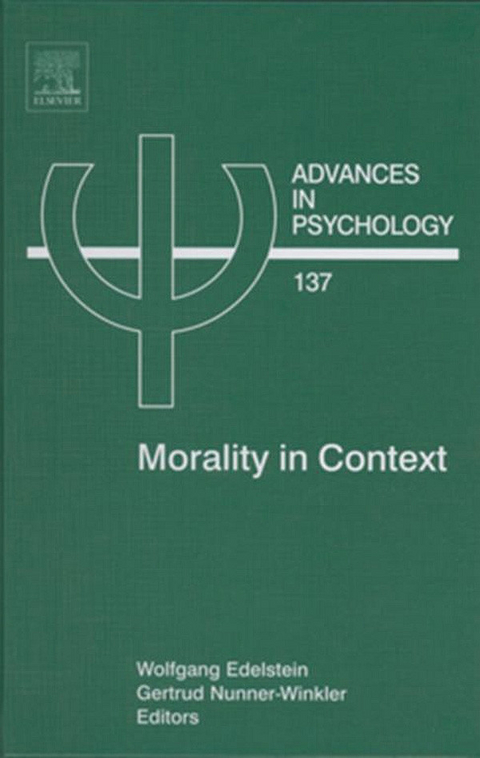
Morality in Context (eBook)
418 Seiten
Elsevier Science (Verlag)
9780080456973 (ISBN)
As these changes are accounted for and analyzed in the social sciences, new perspectives emerge that give rise to new ways of framing issues and problems. These problems are best addressed by way of cooperation between philosophers and social scientists. As Habermas (1990) has pointed out in a much cited paper, philosophers depend on social science to fill in the data they require to answer the questions raised by philosophy in its placeholder function. The reverse also holds true: Social science needs the conceptual clarifications that philosophy can provide. With respect to morality, such mutual interchanges are of particular importance the contributions to this book show convincingly.
Morality in context is a timely topic. A debate between philosophers and social scientists is a good way to approach it. Why is there such a booming interest in morality and why does it focus on context? One starting point is the change in the sociostructural and sociocultural conditions of modern societies. This involves change in the empirical conditions of moral action and in the social demand on morality. As these changes are accounted for and analyzed in the social sciences, new perspectives emerge that give rise to new ways of framing issues and problems. These problems are best addressed by way of cooperation between philosophers and social scientists. As Habermas (1990) has pointed out in a much cited paper, philosophers depend on social science to fill in the data they require to answer the questions raised by philosophy in its "e;placeholder"e; function. The reverse also holds true: Social science needs the conceptual clarifications that philosophy can provide. With respect to morality, such mutual interchanges are of particular importance the contributions to this book show convincingly.
front cover 1
copyright 5
table of contents 6
front matter 8
List of Contributors 8
Introduction 10
body 34
Constitutive Aspects of Morality (Philosophical Issues 34
The Meaning of Moral Ought 36
Between Aristotle and Kant—Sketch of a Morality of Recognition 50
Contexts of Recognition—Comments on Axel Honneth's Moral Perspective Beyond Aristotle and Kant 66
Emotions and the Origins of Morality 70
What Should Count as Moral Behavior? The Nature of "Early Morality" in Children's Development 128
Discourse in Context 152
Moral Intimacy and Moral Judgment—Tailoring General Theories to Personal Contexts 172
Moral Resilience—The Unhappy Moralist 212
Do Concepts Matter? The Impact of a Justice Framing on Responses to a Moral Dilemma—A Research Note 234
The Discontents and Contents in Cultural Practices—It Depends on Where You Sit 254
Changes in Moral Understanding—An Intergenerational Comparison 282
Is Community Compatible with Autonomy? Cultural Ideals Versus Empirical Realities 302
Is Community Compatible with Autonomy? Some Comments to Joan Miller's Research on Differing Moralities in India and the United States 322
Reasoning About Moral Obligations and Interpersonal Responsibilities in Different Cultural Contexts 326
Partiality and Identity—Psychological Research on Preferential Behavior Toward Group Members 350
Culture, Context, and the Psychological Sources of Human Rights Concepts 374
To Forgive and Forget 404
| Erscheint lt. Verlag | 25.7.2005 |
|---|---|
| Sprache | englisch |
| Themenwelt | Geisteswissenschaften ► Philosophie ► Allgemeines / Lexika |
| Geisteswissenschaften ► Philosophie ► Ethik | |
| Geisteswissenschaften ► Psychologie ► Allgemeine Psychologie | |
| Geisteswissenschaften ► Psychologie ► Entwicklungspsychologie | |
| Geisteswissenschaften ► Psychologie ► Psychoanalyse / Tiefenpsychologie | |
| Geisteswissenschaften ► Psychologie ► Sozialpsychologie | |
| Geisteswissenschaften ► Psychologie ► Verhaltenstherapie | |
| ISBN-13 | 9780080456973 / 9780080456973 |
| Informationen gemäß Produktsicherheitsverordnung (GPSR) | |
| Haben Sie eine Frage zum Produkt? |
 PDF (Adobe DRM)
Kopierschutz: Adobe-DRM
Adobe-DRM ist ein Kopierschutz, der das eBook vor Mißbrauch schützen soll. Dabei wird das eBook bereits beim Download auf Ihre persönliche Adobe-ID autorisiert. Lesen können Sie das eBook dann nur auf den Geräten, welche ebenfalls auf Ihre Adobe-ID registriert sind.
Details zum Adobe-DRM
Dateiformat: PDF (Portable Document Format)
Mit einem festen Seitenlayout eignet sich die PDF besonders für Fachbücher mit Spalten, Tabellen und Abbildungen. Eine PDF kann auf fast allen Geräten angezeigt werden, ist aber für kleine Displays (Smartphone, eReader) nur eingeschränkt geeignet.
Systemvoraussetzungen:
PC/Mac: Mit einem PC oder Mac können Sie dieses eBook lesen. Sie benötigen eine
eReader: Dieses eBook kann mit (fast) allen eBook-Readern gelesen werden. Mit dem amazon-Kindle ist es aber nicht kompatibel.
Smartphone/Tablet: Egal ob Apple oder Android, dieses eBook können Sie lesen. Sie benötigen eine
Geräteliste und zusätzliche Hinweise
Buying eBooks from abroad
For tax law reasons we can sell eBooks just within Germany and Switzerland. Regrettably we cannot fulfill eBook-orders from other countries.
aus dem Bereich