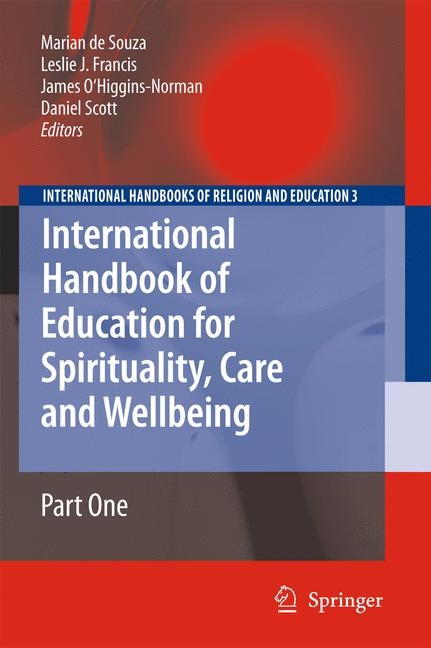
International Handbook of Education for Spirituality, Care and Wellbeing (eBook)
1238 Seiten
Springer Netherland (Verlag)
9781402090189 (ISBN)
Acknowledging and understanding spiritual formation is vital in contemporary education. This book explores the dynamic relationship between education and wellbeing. It examines the theory underpinning the practice of education in different societies where spirituality and care are believed to be at the heart of all educational experiences. The book recognizes that, regardless of the context or type of educational experience, education is a caring activity in which the development of the whole person - body, mind and spirit - is a central aim for teachers and educators in both formal and informal learning.
The chapters in this handbook present and discuss topics that focus on spirituality as an integral part of human experience and, consequently, essential to educational programs which aim to address personal and communal identity, foster resilience, empathy and compassion, and promote meaning and connectedness.
Acknowledging and understanding spiritual formation is vital in contemporary education. This book explores the dynamic relationship between education and wellbeing. It examines the theory underpinning the practice of education in different societies where spirituality and care are believed to be at the heart of all educational experiences. The book recognizes that, regardless of the context or type of educational experience, education is a caring activity in which the development of the whole person - body, mind and spirit - is a central aim for teachers and educators in both formal and informal learning. The chapters in this handbook present and discuss topics that focus on spirituality as an integral part of human experience and, consequently, essential to educational programs which aim to address personal and communal identity, foster resilience, empathy and compassion, and promote meaning and connectedness.
Aims & Scope
Contents 5
Author Biographies 13
General Introduction 28
References 32
Part I The Psychology of Religion and Spirituality: Implications for Education andWellbeing – An Introduction 33
References 39
Chapter 1 Ways of Studying the Psychology of Religion and Spirituality 40
Method 1: Personal Documents and Questionnaires 41
Method 2: Survey Research 42
Method 3: Scales, Measurement, and Correlation 44
Method 4: Clinical Psychoanalysis and Object Relations 44
Interlude: The Question of the Experiment as Privileged Method 45
Method 5: The Experimental Paradigm as an Unachievable Ideal 47
Method 6: Quasi-Experimental Studies 47
Method 7: Neurophysiological Measures 49
Method 8: Ethnography, Participant Observation and Field Research 50
Method 9: Phenomenological Research 51
Method 10: Confessional Research 51
Summary and Conclusion 52
References 53
Chapter 2 Measuring Religiousness and Spirituality: Issues, Existing Measures, and the Implications for Education andWellbeing 57
General Issues Related to Measurement 58
Theoretical Considerations 59
Psychometric Considerations 59
Sample Representativeness and Cultural Sensitivity 60
Review of Measures 61
Measures of Dispositional Religiousness 62
Measures of Functional Religiousness 65
Alternatives to Self-Report 67
Implicit Measurement 68
Other Alternative Forms of Measurement 69
Guidance in Choosing a Measure 69
Conclusion 70
Note 70
References 70
Chapter 3 Examining Religious and Spiritual Development During Childhood and Adolescence 75
A New Day for Religious and Spiritual Development 76
Defining Spiritual Development is Difficult 76
Cognitive Approaches to Spiritual Development 78
A Social-Ecology Approach to Children’s Spirituality 81
AdolescentWellbeing 84
Moving Beyond Stage Theory 85
Conclusion 87
References 87
Chapter 4 Understanding and Assessing Spiritual Health 92
Brief Introduction 92
Nature of Spirituality 93
Spirituality Is Innate 93
Spirituality Is Emotive 93
Spirituality and Religion 94
Spirituality Is Subjective 94
Spirituality Is Dynamic 95
Understanding Spirituality 95
Dimensions of Health 96
Spiritual Health andWellbeing 96
A Model of Spiritual Health 97
Assessing Spiritual Health andWellbeing 99
Instruments for Assessing SH/WB Spiritual Health in Four Domains Index (SH4DI) 101
Spiritual Health and Life-Orientation Measure (SHALOM) 101
Feeling Good, Living Life 103
Quality of Life Influences Survey 103
Reflections on Research in SWB for Pastoral Care in Schools 104
Vignettes from Development of Instruments 105
Year 9 Surrogate Mum Ò Improved Maths and General Wellbeing 105
Hollow Leader Ò Family Fac ade 105
Whole School Environmental Education Program 106
General Comments on My SWB Research Four Domains 106
Spiritual Dissonance 107
Conclusion 107
References 108
Chapter 5 The Contribution of Religiousness and Spirituality to SubjectiveWellbeing and Satisfaction with Life 112
Introduction 112
Defining and Measuring Spirituality and Religiousness 114
Key Issues in Demonstrating Spirituality and Religiosity as Robust Predictors of Life Satisfaction Issue 1: Spirituality and Religiosity as Robust Constructs 116
Issue 2: The Relational Fertility of Spiritual and Religious Constructs 118
Issue 3: Incremental Validity of Spirituality and Religiosity 120
Theoretical Yield 123
The Psychological Value of Numinous Constructs 124
Conclusion 124
References 125
Chapter 6 Culture, Religion and Spirituality in Relation to Psychiatric Illness 129
Definitions 129
The Somatisation Hypothesis 131
Afro-Caribbean Schizophrenia? 134
Jewish OCD (Obsessive-Compulsive Disorder): Do Religions Which Encourage Scrupulosity as a Feature of Spirituality Foster OCD? 136
Gender Differences in the Prevalence of Depression 138
Conclusions and Implications for Education andWellbeing 141
References 142
Chapter 7 Psychological Type Theory and Religious and Spiritual Experiences 146
An Individual Differences Approach 146
Introducing Psychological Type 148
Measuring Psychological Type 150
Profiling Religious Professionals 153
Profiling Church Congregations 157
Different Expressions of Religious and Spiritual Experiences 159
Applications 161
Note 162
References 162
Chapter 8 Understanding the Attitudinal Dimensions of Religion and Spirituality 167
Introduction 167
Dimensions of Religion 168
The Attitudinal Dimension 169
Research Across Linguistic Divides 170
Research Across Religious Traditions 171
Religion and Mental Health 173
Religion andWellbeing 176
Broader Research Field 177
Conclusion 179
References 179
Chapter 9 Social, Religious and Spiritual Capitals: A Psychological Perspective 188
Introduction 188
Mapping the “Capitals” Theoretical Terrain Social, Religious and Spiritual CapitalsÛ An Increased Foregrounding Social Capital 189
We Now Move to Some Key Definitions of the Terms in Question Spiritual Capital 191
Religious Capital (Including Religious Spiritual Capital) 192
Definitions of Spiritual and Religious Capitals ( as Used in This Chapter) 192
Psychological Perspectives on Social, Religious and Spiritual Capitals 193
A Threefold Structure of Psychological Response 193
Service, Hospitality, Self-Emptying 195
Vocation 196
Choosing the Narrower Road 197
Being Channels of Grace 199
Theology, Psychology and Languages of Capital 199
The Micro, Bonding, Personal Level of Psychological Integration 201
The Meso, Bridging, Interpersonal Level of Psychological Integration 202
The Macro, Linking, Structural Level of Psychological Integration 202
Drawing Together the Threads 203
Conclusion 204
Notes 205
References 205
Chapter 10 Mystical, Religious, and Spiritual Experiences 207
Religion and Spirituality 208
Deconversion 209
Cultural Implications for Religion, Spirituality, and PsychologicalWellbeing 210
Conversion 212
Religious Experience and Human Nature 213
Glossolalia 214
Prayer and Meditation 215
Mysticism 218
Conclusion 221
References 222
Chapter 11 The Spiritual Dimension of Coping: Theoretical and Practical Considerations 226
Introduction 226
The Meaning of Spirituality 227
The Story of Cindy 228
A Theoretical Model for Understanding and Evaluating Spirituality 230
The Spiritual Dimension of Coping 233
Spiritual Trauma 234
Conservational Spiritual Coping 235
Spiritual Struggles 237
Transformational Spiritual Coping 239
The Practical Implications of Spiritual Coping 240
Helping People Access Spiritual Coping Resources 240
Helping People Address Spiritual Struggles 242
Conclusions 243
References 243
Chapter 12 The Psychology of Faith Development 248
Introduction 248
What Is Faith? 249
Aspects of Faith 251
When is Faith? 252
Criticisms 254
Relevance and Implications 258
References 260
Chapter 13 The Psychology of Prayer: A Review of Empirical Research 263
Introduction 263
The Subjective Effects of Prayer 265
The Objective Effects of Prayer 269
The Content of Ordinary Prayer 274
Conclusion 277
References 278
Part II The Role of Spirituality in Human Development and Identity: An Introduction 284
The Structure of the Part 286
References 289
Chapter 14 Spirituality and Mental Health: The Mystery of Healing 290
The Changing Nature of Health 290
Wisdom and Medicine 292
Spirituality as a Life-Enhancing Factor 294
Client-Led Recovery of the Spiritual 294
Spirituality and Suffering 295
The Mystery that Heals 297
Wave and Particle 298
Deep Security in the Other 299
The Balance of Particle andWave 300
Negative Capability, Wholeness and Healing 302
The Art of Spirituality in a Clinical Setting 304
References 304
Chapter 15 The Dynamics of Spiritual Development 306
Introduction 306
Limitations of Previous Developmental Theories 307
Dynamic Systems Theory 308
A Dynamic System Approach to Development 309
System Parameters 309
Agency 309
Attractors 310
Spiritual Development Through a Dynamic Systems Lens 310
Spirits and Integrative Dynamic Systems 311
Applying the Dynamic Systems Theory Lens 312
Principles of Spiritual Development Indicated by a DST Approach 313
Phases and Phase Transitions in Spiritual Development PrenatalÛ the Symbiotic Phase 315
Phase Transition at Birth 315
InfancyÛthe Trust Period 315
Transition to Pre-critical Linguistic Symbolisation 316
Pre-critical SymbolicÛthe Period of Beliefs 317
Transition to Discernment 318
Dependent Critical SymbolicÛthe Period of Discernment 318
Transition to Exploration 320
Independent ConstrainedÛthe Period of Exploration 320
The Transition to Maturity 321
Spiritual Maturity 321
Summary 322
Conclusion 322
References 323
Chapter 16 Does Positive Psychology Have a Soul for Adolescence? 325
Towards the Spiritual Path 325
Spirituality or Spiritualities: A Babel of Languages 327
What Is Positive Psychology? – From a Similar Lens to a Sharper Focus 329
Resilience from the Perspective of Positive Psychology 331
Positive Psychology and Spirituality: Brother Sun, Sister Moon 335
A Dialogue for the Future 337
References 339
Chapter 17 Voices of Global Youth on Spirituality and Spiritual Development: Preliminary Findings from a Grounded Theory Study 342
Introduction 343
Methods 344
Sample 344
Selecting Grounded Theory 345
Data Analysis 346
Step One: Conducting Line-by-Line Coding 347
Step Two: Producing Focused Codes 347
Step Three: Generating Consolidated Categories or Themes 348
Step Four: Establishing Emergent Theoretical Constructs 349
Emergent Theoretical Constructs 352
Capacity for Spirituality Is Natural 352
Being Actively Spiritual Is a Choice 353
Active Spirituality Shapes a Purposeful Orientation to Life 353
Spiritual Development Is Not Dependent Upon Age but Is Affected by Other Dimensions of Human Development 353
Spiritual Development Is Mediated by the Dynamics of Interpersonal Relationships and Social Contexts 354
Spirituality Is Seen as Different from, and More Expansive than, Religion and Religious Observance 354
Spirituality Is Commonly Experienced as a Source of Protection and/ or Comfort Especially During Troubling Times 355
Spirituality Is Rooted in a Special Connection 355
Youth Are Open to Having Conversation About Spirituality 356
Contribution to Emergent Field of Adolescent Spiritual Development 356
Limitations and Implications for Further Research 358
Summary 359
Notes 360
References 360
Chapter 18 Moment to Moment Spirituality in Early Childhood Education 362
Introduction 362
The Child Who Is this Spiritual Being? 364
The Mindful Teacher 365
Allowing: Nurturing the Spiritual Moments 367
Moment to Moment Sounds of Spirit Connecting with Language, Voice, and Song 367
Singing Spirits 369
The Classroom Environment 370
Play: Vital Food for the Spirit 374
Moment to Moment Spirituality in the Kindergarten Little Moments, Many Times 375
References 376
Chapter 19 Children’s Spiritual Intelligence 377
Journey of Grief and Enlightenment 378
Children’s InnerWorlds 378
Definition of Spiritual Intelligence 379
The Cost of Oppressing Spiritual Intelligence 380
The Spiritual Tree of Life 381
Bibliography 391
Chapter 20 In Search of the Spiritual: Adolescent Transitions as Portals to the Spirit Self 393
Opportunity for Deep Growth Introduction 393
Description of Spirituality 394
Opportunities in Development 395
On Adolescent Development Introduction 396
Adolescence as a Spiritual Portal 396
Holistic View of Adolescence Meaning Making 399
Build It and They Will Grow 400
Five Dimensions of the Self 400
A Context for Educating Youth 404
Adolescent Spiritual Self How Does an Adolescent Make Sense of Spirituality? 405
Conclusion and Openings 406
Bibliography 407
Chapter 21 Reflection for Spiritual Development in Adolescents 409
Introduction 409
Spirituality and Spiritual Development 410
The Concept and Nature of Reflection 411
Reflection for Religiously Tethered Spiritual Development 414
Benefits for Adolescents 414
Religion and Indoctrination 417
Reflection for Religiously Untethered Spiritual Development 419
Benefits for Adolescents 420
Promoting Spiritual Reflection in School 421
Conclusion 422
References 423
Chapter 22 Developing Contemplative Capacities in Childhood and Adolescence: A Rationale and Overview 426
Introduction 426
Definitions and Practices 428
Benefits of Developing Contemplative Capacities 429
What is Contemplative Development? 431
The Act of Looking at or Attending Intently with Presence, Attention, Sensitivity, or Ï MindfulnessÓ 432
Intuitive Knowing 434
Mystical Knowing, Meditation on Spiritual, or Religious Ideas 436
The Act of the Mind When Considering IntentlyÛ Deep Thought, Insight, Pondering, Reasoning, Study, Reflection, Self- Reflection 439
Conclusion 441
References 441
Chapter 23 The Contribution of Spirituality to “Becoming a Self” in Child and Youth Services 444
A Comparison of Educational Practices 445
The Educational Psychology of Growth and Development 447
Organization of Time 447
Goals and the Methods and Mechanisms of Growth 450
Values and Sources of Data 451
Vocation as a Foundation for Spirituality in Informal Education 451
OneÌs Station as the Site of a Vocation 452
Stations as Humanly Organized 453
Calling: Divine, Social, and Individual Imperatives 453
The Authentic Self 454
Discerning the Transcendent 456
Discernment of Discernment 458
Vocation in a Youth Program 458
Spirituality as an Educational Ideology 460
References 461
Chapter 24 Coming of Age as a Spiritual Task in Adolescence 463
Introduction 463
Spiritual Development: Several Clarifications 465
Coming of Age as Cultural Model 467
Adolescent Experience: The Spiritual as Lived Experience 470
The Markers of Passage 471
Notes 477
References 477
Chapter 25 Youthful Peak Experiences in Cross-Cultural Perspective: Implications for Educators and Counselors 478
Introduction 478
Modern Psychology and Youthful Spirituality 479
Exploring the Peaks of Childhood 481
Cross-Cultural Research in Progress 484
Canada 484
Mexico 486
Norway 487
Singapore 489
Venezuela 490
Discussion 491
Cross-Cultural Considerations 491
Educational Implications 494
Some Thoughts on Future Research 495
References 496
Chapter 26 Peak Experiences Explored Through Literature 499
Introduction 499
Connection, Healing, and Restoration 500
Challenges: The Untamed NaturalWorld 505
A Relationship of Care 511
Concluding Thoughts 513
Note 513
References 513
Chapter 27 Developing Spiritual Identity: Retrospective Accounts From Muslim, Jewish, and Christian Exemplars 515
Introduction 515
Naturalistic Study of Spiritual Identity 517
Life Narrative Coding 521
Grounded Theory Coding 524
Theme 1: Relational Consciousness 525
Theme 2: Vocational Identity 525
Theme 3: Stewardship 526
Theme 4: Tradition 527
Theme 5: Divine as Omnipotent 528
Spiritual Identity Revisited 529
References 530
| Erscheint lt. Verlag | 13.10.2009 |
|---|---|
| Reihe/Serie | International Handbooks of Religion and Education | International Handbooks of Religion and Education |
| Zusatzinfo | XXXVIII, 1238 p. |
| Verlagsort | Dordrecht |
| Sprache | englisch |
| Themenwelt | Geisteswissenschaften ► Psychologie ► Pädagogische Psychologie |
| Geisteswissenschaften ► Religion / Theologie ► Christentum | |
| Sozialwissenschaften ► Pädagogik ► Vorschulpädagogik | |
| Sozialwissenschaften ► Politik / Verwaltung | |
| Sozialwissenschaften ► Soziologie ► Spezielle Soziologien | |
| Schlagworte | Biografie • care and wellbeing • Education • Identity • Learning and Instruction • Religion • religion/religiosity • Spirituality |
| ISBN-13 | 9781402090189 / 9781402090189 |
| Informationen gemäß Produktsicherheitsverordnung (GPSR) | |
| Haben Sie eine Frage zum Produkt? |
 PDF (Wasserzeichen)
Größe: 7,9 MB
DRM: Digitales Wasserzeichen
Dieses eBook enthält ein digitales Wasserzeichen und ist damit für Sie personalisiert. Bei einer missbräuchlichen Weitergabe des eBooks an Dritte ist eine Rückverfolgung an die Quelle möglich.
Dateiformat: PDF (Portable Document Format)
Mit einem festen Seitenlayout eignet sich die PDF besonders für Fachbücher mit Spalten, Tabellen und Abbildungen. Eine PDF kann auf fast allen Geräten angezeigt werden, ist aber für kleine Displays (Smartphone, eReader) nur eingeschränkt geeignet.
Systemvoraussetzungen:
PC/Mac: Mit einem PC oder Mac können Sie dieses eBook lesen. Sie benötigen dafür einen PDF-Viewer - z.B. den Adobe Reader oder Adobe Digital Editions.
eReader: Dieses eBook kann mit (fast) allen eBook-Readern gelesen werden. Mit dem amazon-Kindle ist es aber nicht kompatibel.
Smartphone/Tablet: Egal ob Apple oder Android, dieses eBook können Sie lesen. Sie benötigen dafür einen PDF-Viewer - z.B. die kostenlose Adobe Digital Editions-App.
Zusätzliches Feature: Online Lesen
Dieses eBook können Sie zusätzlich zum Download auch online im Webbrowser lesen.
Buying eBooks from abroad
For tax law reasons we can sell eBooks just within Germany and Switzerland. Regrettably we cannot fulfill eBook-orders from other countries.
aus dem Bereich