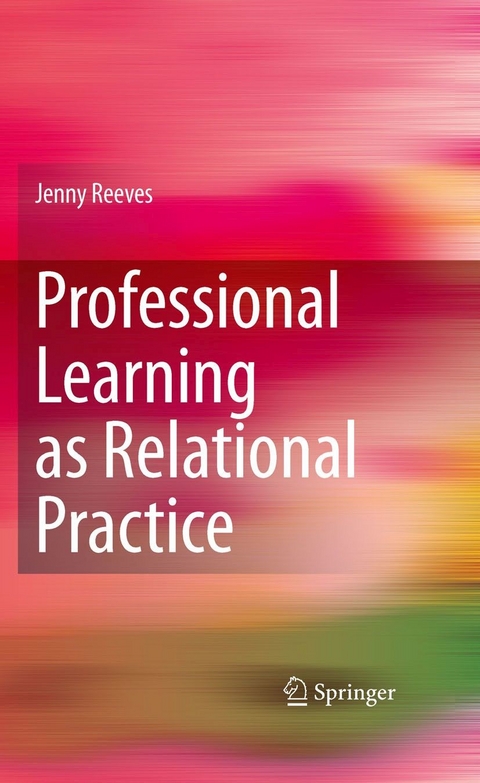
Professional Learning as Relational Practice (eBook)
XII, 205 Seiten
Springer Netherland (Verlag)
978-90-481-8739-3 (ISBN)
Given the emphasis on transforming professional work through the adoption of enquiry-based and trans-disciplinary approaches to service development, there is an urgent need for those involved in professional education to develop a robust understanding of how changes in practice occur. A more inclusive approach to the analysis of the processes involved across the varied and interrelated contexts in which they occur is thus very timely.
In this book, Jenny Reeves sets out to explore the gap between the experience of professional learning as an interactive, dynamic and socially contextualised process, and descriptions that are often individualistic, overly linear and largely context-free. She makes the claim that this disjuncture is the outcome of modes of enquiry that concentrate on limited selections of the available data.
Adopting a relational approach to describing practice-based professional development, including graphical means for exploring the spaces produced by the activity, provides a very different picture. It creates a basis for representing the complex movements, relationships and interactions between people and things that occur during professional learning. It also provides a productive approach to describing the exchange and creation of professional knowledge across different contexts over time.
By building a picture of the ephemeral spaces and connections that educating activities produce, mapping relational space allows those engaged in professional education to think rather differently about how professional learning and changes in knowledge and practice may be understood, supported and developed.
Given the emphasis on transforming professional work through the adoption of enquiry-based and trans-disciplinary approaches to service development, there is an urgent need for those involved in professional education to develop a robust understanding of how changes in practice occur. A more inclusive approach to the analysis of the processes involved across the varied and interrelated contexts in which they occur is thus very timely.In this book, Jenny Reeves sets out to explore the gap between the experience of professional learning as an interactive, dynamic and socially contextualised process, and descriptions that are often individualistic, overly linear and largely context-free. She makes the claim that this disjuncture is the outcome of modes of enquiry that concentrate on limited selections of the available data.Adopting a relational approach to describing practice-based professional development, including graphical means for exploring the spaces produced by the activity, provides a very different picture. It creates a basis for representing the complex movements, relationships and interactions between people and things that occur during professional learning. It also provides a productive approach to describing the exchange and creation of professional knowledge across different contexts over time.By building a picture of the ephemeral spaces and connections that educating activities produce, mapping relational space allows those engaged in professional education to think rather differently about how professional learning and changes in knowledge and practice may be understood, supported and developed.
Preface 6
Contents 8
1 Adopting a New Approach to Professional Learning 13
Introduction 13
Looking at Professional Learning from a Relational Perspective 13
Delineating Educating Systems 16
The Plan of the Book 18
Part I: Mapping the Relational Spaces of Educating 19
Part II: Exploring Professional Learning as Relational Practice 20
Part III: Tracking Knowledge Creation and Exchange 21
Part I Mapping the Relational Spaces of Educating 23
Introduction to Part I 23
2 Describing Educating Systems 24
Introduction Please confirm whether the head levels have been identified correctly. 24
What Is the Scottish Qualification for Headship? 24
The Parameters of Educating Systems 28
Developing a Descriptive Framework 30
Five Criteria 30
Mediated Learning 31
Situated Learning 33
Activity Theory 34
Actor Network Theory 35
Mapping Techniques 36
Spatiality 37
Relationality 38
Sense Making 39
Discussion 41
Conclusion 43
3 The Field of Educating: Tracking Relations and Relays 45
Introduction 45
Educating as a Field of Activity 45
A Typology for Educating Systems 47
An Order of Discourse 51
Making Sense of Organisational Learning 53
Surfacing Pedagogies, Relays and Discursive Struggle 60
Representing Relays and Networks: Building a Relational Map 60
Pedagogic Strategy 63
Discursive Struggle 66
Conclusion 67
4 Making Learning Spaces Visible 69
Introduction 69
Relational Space 70
Forms of Spatiality 70
Assembling the Tool Set for Durational Mapping 72
Event Analysis 72
Participation: People 74
Activity Sets 75
Participation: Artefacts 76
Artefactual Arrays 76
Spaces and Flows 76
The Spatial Patterning of Interaction on the SQH Programme 79
Mapping the System as Time and Space 79
The Durational Representation of the SQH 79
Summary 86
Applications of Mapping Relational Space 86
Using Mapping for Investigation and Design 86
Effects of Hybridity in Educating Systems 90
Hybridity and Spatial Interference 90
Characteristics of Third Space 92
Conclusion 93
Summary Part I 94
Part II Professional Learning as Relational Practice 95
Introduction to Part II 95
5 Changing Self: Interactions of Space and Identity 96
Introduction 96
Practice-Based Learning 96
Professional Practice 97
Implications for Professional Learning 98
Learning During Practice-Based Programmes 100
Accounts of Practice 101
Tracking Discursive Change in Reflective Commentaries 102
Annette 103
Discursive Changes 103
Situational Factors 105
Jean 107
Discursive Changes 107
Situational Factors 108
The Dynamics of the Learning Process 109
In-Built Contingency 109
Enacted Social Space 111
Imagined Social Space 113
Outcomes of Interaction: The Creation of Third Space 114
Conclusion 117
6 Pedagogy: Creating a Hub in a Field of Relays 119
Introduction 119
Pedagogy and Purpose 119
A Psychological Approach 120
A Sociological Perspective 122
Agency and Intentionality 124
Pedagogy on the Chartered Teacher Programme: Section 1 The Intentions of Educators 125
Relay 1: Shaping the Learner -- Being Postgraduate 127
Relay 2: Shaping the Learner -- Being a Chartered Teacher 128
The Tutors' Views 129
Standard Operating Procedures: The Programme Handbook and the Module Descriptors 131
Relay 3: Disciplinary Governance 132
The Module Workbook and the Readings 132
Summary 132
Pedagogy on the Chartered Teacher Programme: Section 2 The Actions of Educators 133
Collaborative Learning 136
Reflective Practice 137
Summary 139
Pedagogic Practices Relaying Agency 139
Creating the Activity Set 140
Mixing Theoretical and Practical Knowledge 141
Creating and Rebundling Connections 142
Conclusion 143
7 Constructing Knowledge and Agency 146
Introduction 146
Teacher Professionalism and Chartered Teachers 147
Contradictory Conceptions of Professionalism 147
Intertextuality 150
The Construction of Reflective Reports 151
Using Sources External to the School Community 154
Example 1 154
Using Sources Internal to the School Community 155
Example 2 155
Example 3 156
Example 4 156
Rhetorical Devices and the Making of War Machines 157
Re-contextualising and Creating Knowledge 158
Processes 158
Displaying Expertise 159
'Proven' Experience 160
Shaped Experience 160
The Power to Influence Others 162
Theorisation 162
Work Process Knowledge 163
Affiliation 163
Conclusion 164
Summary Part II 165
Part III Tracking Knowledge Creation and Exchange 169
8 Knowledge Creation: The Reflexivity of Hybrid Systems 170
Introduction 170
Knowledge and Activity 170
Reflexivity and Reflection 173
Knowledge Creation and the CT Programme 175
The Outcomes 178
Stage 1: Multiplicity -- Performing the CT Programme as a Networked System 179
Internal Relations 179
External Relations 180
Stage 2: The System in Action -- Knowledge Exchange and Creation 182
(a) Trajectory 1 Practice (K2 Teachers) to Theory (K1 Cohort) 182
(b) Trajectory 1 Practice (K2 Teachers) to Practice (K2 Tutors) 183
(c) Trajectory 2 Practice (K2 Tutors) to Theory (K1 Teachers) 183
(d) Trajectory 3 Practice (K2 Teachers & Tutors) to Theory (K1 Disciplinary)
Characteristics of a Hybrid System 184
Knowledge Exchange and Creation 185
Forms of Forgetting 186
Network Effects 187
Conclusion 189
9 Conclusion 192
Describing Educating as Relational Practice 192
Substantive Issues in Professional Learning 194
Implications 197
References 201
Author Index 211
Subject Index 215
"Chapter 3 The Field of Educating: Tracking Relations and Relays (p. 33-34)
Introduction
This chapter is about the first stage of mapping networked activity systems, relational mapping, which is a means of representing the relations, transmission points and relays that run between and across educating systems. I want to begin to develop the tool set for mapping by setting the operation of local educating systems within the wider context of educating as a field of activity.
There are therefore two main objectives of the chapter: first, to provide some delineation of the types of systems involved in educating activity and second, to begin the process of building representations of the operation of networked systems within this particular field. The chapter begins by exploring some of the general features of educating and the relationship this activity has to various discourses that are characteristic of educational contexts.
In so doing, it identifies four broad categories of educating systems that use socialising, schooling and developmental and contagious pedagogic strategies to shape the behaviour of learners. The first two strategies are characterised as assimilative, since learners are taken into the space of their educators, whilst the two latter strategies are characterised as invasive, in that the educators move into the learners’ territory. The case study that forms the background for extending this discussion is about the introduction of an organisational learning strategy into a local authority’s education service.
The account begins the analytical task by looking at how two particular local educating systems sought to establish frameworks for sense making that would alter the practice of teachers in schools and how these systems were materially connected to one another in contestation over practice. The case illustrates the conceptual and political work that was involved in attempting to shape practice through the use of an invasive, developmental strategy on the part of the local authority’s senior management team.
Last, the discursive analysis of the case study data is used to derive a horizontal section through this local network or a relational map–a map that shows some of the key discursive relays and relations between the activity systems that were germane to the progress of educating at this particular location. The relational map is based on the use of a number of conventions that will be built upon and refined in the next chapter as a way of mapping educating activity over time."
| Erscheint lt. Verlag | 7.4.2010 |
|---|---|
| Zusatzinfo | XII, 205 p. |
| Verlagsort | Dordrecht |
| Sprache | englisch |
| Themenwelt | Geisteswissenschaften |
| Sozialwissenschaften ► Pädagogik ► Berufspädagogik | |
| Sozialwissenschaften ► Pädagogik ► Erwachsenenbildung | |
| Sozialwissenschaften ► Politik / Verwaltung | |
| Schlagworte | changing professional practice • complex interrelations • educating service development • Education • knowledge exchange and creation • learning • networked learning systems • practice-based learning • Professiona • professional development • professional education • professional knowledge |
| ISBN-10 | 90-481-8739-7 / 9048187397 |
| ISBN-13 | 978-90-481-8739-3 / 9789048187393 |
| Informationen gemäß Produktsicherheitsverordnung (GPSR) | |
| Haben Sie eine Frage zum Produkt? |
 PDF (Wasserzeichen)
DRM: Digitales Wasserzeichen
Dieses eBook enthält ein digitales Wasserzeichen und ist damit für Sie personalisiert. Bei einer missbräuchlichen Weitergabe des eBooks an Dritte ist eine Rückverfolgung an die Quelle möglich.
Dateiformat: PDF (Portable Document Format)
Mit einem festen Seitenlayout eignet sich die PDF besonders für Fachbücher mit Spalten, Tabellen und Abbildungen. Eine PDF kann auf fast allen Geräten angezeigt werden, ist aber für kleine Displays (Smartphone, eReader) nur eingeschränkt geeignet.
Systemvoraussetzungen:
PC/Mac: Mit einem PC oder Mac können Sie dieses eBook lesen. Sie benötigen dafür einen PDF-Viewer - z.B. den Adobe Reader oder Adobe Digital Editions.
eReader: Dieses eBook kann mit (fast) allen eBook-Readern gelesen werden. Mit dem amazon-Kindle ist es aber nicht kompatibel.
Smartphone/Tablet: Egal ob Apple oder Android, dieses eBook können Sie lesen. Sie benötigen dafür einen PDF-Viewer - z.B. die kostenlose Adobe Digital Editions-App.
Buying eBooks from abroad
For tax law reasons we can sell eBooks just within Germany and Switzerland. Regrettably we cannot fulfill eBook-orders from other countries.
aus dem Bereich