


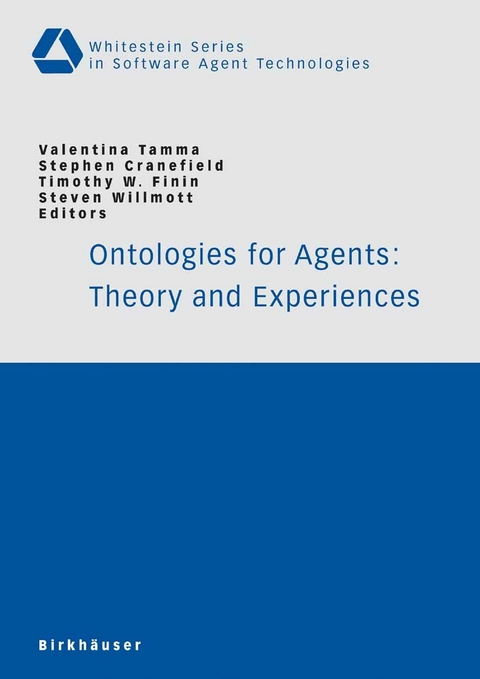
Ontologies for Agents: Theory and Experiences (eBook)
X, 345 Seiten
Springer Basel (Verlag)
9783764373610 (ISBN)
The volume aims at providing a comprehensive review of the diverse efforts covering the gap existing between the two main perspectives on the topic of ontologies for multi-agent systems, namely: How ontologies should be modelled and represented in order to be effectively used in agent systems, and on the other hand, what kind of capabilities should be exhibited by an agent in order to make use of ontological knowledge and to perform efficient reasoning with it. The volume collects the most significant papers of the AAMAS 2002 and AAMAS 2003 workshop on ontologies for agent systems, and the EKAW 2002 workshop on ontologies for multi-agent systems.
Contents 6
Foreword 8
Ontologies for Interaction Protocols 12
1. Introduction 12
2. Example: the FIPA Request Interaction Protocol 14
3. A Coloured Petri Net approach 16
4. Modelling Internal Agent Operations 20
4.1. The Static Approach 21
4.2. The Dynamic Approach 22
5. AUML Revisited 23
6. Conclusion 24
References 25
On the Impact of Ontological Commitment 29
1. Introduction 29
2. Ontological Commitment 31
2.1. Conflict: Definer, Application, User 31
2.2. Conflict: Commitment, Evolution 32
3. Setting: The EDEN Application 33
4. Impedance Mismatch and its Consequences 34
5. Ontology Development Issues 39
5.1. Design and Representation 39
5.2. Evolution and Versioning 40
6. Compositional Ontologies 41
6.1. Subset 42
6.2. Compose 44
6.3. Extend 45
6.4. An Example 46
7. Implementation Issues 46
7.1. Internal Representation 47
7.2. External Representation 48
8. Conclusions 49
References 51
Agent to Agent Talk: Nobody There? Supporting Agents Linguistic Communication 53
1. Introduction 54
2. How many ways can we misunderstand? 56
2.1. It’s Greek to me: the role of language in agent communication 57
2.2. Mapping, merging and messing up with knowledge: different approaches to reconcile heterogeneity 58
2.3. One for all and all for one: on the ambiguity among terms and concepts 60
2.4. A rose is a rose is a rose: symbols and meaning 61
3. Agent ontologies 62
3.1. Ontological similarity evaluation 63
3.1.1. Conceptual similarity among planes O(S) and O(H). 64
3.1.2. Lexical similarity among planes V (S) and V (H). 66
3.1.3. Lexical expressivity. 67
3.1.4. Lexical-Semantic coherence. 68
4. Toward a linguistic agent society: a language-aware architecture 69
4.1. Agent Taxonomy 70
4.1.1. The Resource agents. 71
4.1.2. The Mediator Agent. 72
4.1.3. The Translator Agent. 73
4.1.4. The Coordinator agent. 73
4.2. Adaptive agent communication 75
4.2.1. Processing agent connections. 75
4.2.2. Processing agent requests. 76
5. Conclusions 78
References 80
Ontology Translation by Ontology Merging and Automated Reasoning 83
1. Introduction 83
2. Our Approach 85
2.1. Uniform Internal Representation 85
2.2. Ontology Merging and Bridging Axioms 86
2.3. Automated Reasoning 91
3. Application: OntoMerge 93
4. Recent Work 96
4.1. Backward Chaining 96
4.2. Semiautomatic Tools for Ontology Merging 96
5. Related work 99
6. Conclusions 101
References 102
Collaborative Understanding of Distributed Ontologies in a Multiagent Framework: Experiments on Operational Issues 105
1. Introduction 105
2. Framework 107
2.1. Ontological Components 107
2.2. Operational Components 108
2.2.1. Query Processing. 109
2.2.2. Action Planning. 110
2.2.3. Query Composition. 110
2.3. Agent Communication Language 110
3. Methodology and Design 111
4. Implementation 113
5. Discussion of Results 114
5.1. Experimental Setup 114
5.2. Parameters Collected 116
5.3. Results 118
5.3.1. Level-0 Analysis. 118
5.3.2. Other Level Analysis. 125
6. Conclusions 128
References 129
Reconciling Implicit and Evolving Ontologies for Semantic Interoperability 131
1. Introduction 131
2. Current projects toward a semantic web 132
3. Reconciling implicit ontologies 134
4. Practical reconciliation 135
4.1. CASA 135
4.2. AReXS 138
4.3. Modifications to the AReXS algorithm 147
5. Multi-agent systems: applied semantic interoperability 148
6. Conclusions and Future Directions 150
Acknowledgements 151
References 152
Query Processing in Ontology-Based Peer-to-Peer Systems 155
1. Introduction 155
1.1. Semantic Web and Peer-to-Peer 155
1.2. The Need for New Approaches 157
1.2.1. Dropping the global schema. 157
1.2.2. Good enough answers. 158
2. Ontology-Based Peer-to-peer Systems 159
2.1. Ontological Knowledge 160
2.2. Inter-Ontology Mappings 161
2.3. Semantics and Logical Consequence 162
2.4. Ontology-Based Queries 163
3. Query Processing 164
3.1. Approximating Class Descriptions 164
3.2. Queries as Classes 166
3.3. Quality of Approximation 167
4. Query Relaxation 168
4.1. Variable Elimination 169
4.2. Guided Elimination 171
5. Examples from a case study 171
5.1. Concept approximations 172
5.2. Query relaxation 173
6. Conclusions 174
References 176
Message Content Ontologies 178
1. Introduction 178
2. Message Content Ontology Framework 179
2.1. Agent Communication Meta Ontology 181
2.2. Reference Model 181
2.2.1. Conversation Domain Ontology. 182
2.2.2. Performative Ontology. 183
2.2.3. Protocol Ontology. 185
2.2.4. Agent Role Ontology. 187
2.3. Message Content Ontology 187
2.4. Message Content Ontology Creation 189
2.4.1. Identification of Conversation Specific Concepts. 189
2.4.2. Speci.cation of Conversation Specific Concepts. 190
2.5. Message Content Ontology Application 192
3. Operationalization of Ontology-based Communication 194
3.1. Minimal Agent communication ontology 195
3.2. Defining Message Content Ontologies 197
3.3. Mapping from Ontology Design to Java Beans 199
3.4. Message Content Ontology Application 199
4. Legal Advisor 200
4.1. Architecture 200
4.1.1. Law Expert Agent. 200
4.1.2. Law Services Broker. 202
4.1.3. Personal Law Assistant. 202
4.2. Message Content Ontology Design 202
4.3. Simple Scenario 203
4.4. Evaluation 204
5. Discussion 205
References 207
Incorporating Complex Mathematical Relations in Web-Portable Domain Ontologies 210
1. Introduction 210
2. The EHEP Experimental Analysis 212
2.1. Event Selection Variables in the EHEP Domain Ontology 212
2.2. Constant and Function EHEP Event Selection Variables 214
3. The Principles of Our Approach 216
4. Explicating the Mathematical Relations In the EHEP Domain Ontology 218
4.1. Representing Quantity 218
4.2. Representing Units of Measurement 222
4.3. Quantity and Data Type 224
4.3.1. Basic Data Type. 225
4.3.2. Composite Data Type. 226
4.4. Structuring Mathematical Concept as Compound Quantity 229
4.4.1. Result of Compound Quantity. 231
4.4.2. Intension of Compound Quantity. 231
4.4.3. Parameter of Compound Quantity. 231
5. Encoding the Arithmetic-Logic Expression of Compound Quantities 236
6. Future Work 236
7. Conclusion 238
References 238
Acknowledgment 240
The SOUPA Ontology for Pervasive Computing 241
1. Introduction 241
2. Problems in the Existing Pervasive Computing Systems 242
3. The SOUPA Ontology 243
3.1. The Web Ontology Language OWL 245
3.2. Related Ontologies 245
3.3. SOUPA Core 246
3.4. SOUPA Extension 254
4. The Context Broker Architecture 255
5. CoBrA Applications 257
5.1. The EasyMeeting System 257
5.2. CoBrA Demo Toolkit 259
6. Future Work 262
7. Conclusions 263
References 263
A UML Ontology and Derived Content Language for a Travel Booking Scenario 267
1. Introduction 267
2. Overview of our approach 268
3. A travel booking ontology in UML 271
4. The ontology-specific content language 274
5. Using the generated content language 275
6. Comparison with JADE 278
6.1. Ontologies vs. content languages 279
6.2. Concept names vs. function symbols 280
6.3. Terms vs. IREs 281
6.4. Strongly vs. weakly typed descriptor classes 281
6.5. Content language codecs 281
6.6. Generating action description classes 281
7. Conclusion 281
References 282
Some Experiences with the Use of Ontologies in Deliberative Agents 285
1. Introduction 285
2. Outline Problem 286
2.1. Issues from the challenge problem 286
3. Overview of the Nuin Platform 288
3.1. Nuinscript scripting knowledge representation language 289
3.2. Nuinscript plan language 290
4. Solution Examples using Nuin 291
4.1. Preamble: use of ontologies 291
4.2. Initial client to agent communication 293
4.2.1. Representation of user goals. 295
4.3. Interactions with suppliers 297
4.4. Reconciling vocabularies 299
4.5. Critiquing and ranking solutions 300
5. Evaluation and conclusions 303
References 304
Location-Mediated Agent Coordination in Ubiquitous Computing 307
1. Introduction 307
2. Coordination Gaps in Ubiquitous Computing 308
2.1. Intention Gaps between Services, Devices and Humans 308
2.2. Representation Gaps between Services, Devices and Humans 309
3. Location-Mediated Agent Coordination 309
3.1. Bridging Intention Gaps between Services, Devices and Humans 311
3.2. Bridging Representation Gaps between Services, Devices and Humans 311
4. Implementation 323
5. Related Work 326
6. Future Work 326
7. Conclusion 327
References 327
Acknowledgment 329
An Ontology for Agent-Based Monitoring of Fulfillment Processes 330
1. Problem 330
2. Supply Chain Monitoring 332
2.1. Supply Chain Model 332
2.2. Agent-Based Concept 333
3. Ontology 336
3.1. Methodological Approach 336
3.2. Tracking Data 337
3.3. Concepts 338
3.4. Supply Chain Scenario 342
4. Implementation 343
5. Ontology-Based Agent Communication 344
6. Prototype Systems 347
7. Conclusion 350
References 350
Acknowledgment 352
Reconciling Implicit and Evolving Ontologies for Semantic Interoperability (p. 121-122)
Kendall Lister, Maia Hristozova and Leon Sterling
Abstract. This paper addresses current approaches to the goal of semantic interoperability on the web and presents new research directions. We critically discuss the existing approaches, including RDF, SHOE, PROMPT and Chimaera, and identify the most e.ective elements of each. In our opinion, the ability of these primarily closed solutions to succeed on a global web scale is limited. In general, a unilateral solution to the problem on a global level seems unlikely in the foreseeable future. We review and contrast our own research experiments AReXS and CASA and suggest that as yet unaddressed issues should be considered, such as reconciling implicit ontologies and evolving ontologies and task-oriented analysis. We also consider the role of semantic interoperation in multi-agent systems and describe strategies for achieving this via the ROADMAP methodology, with emphasis on building and assuring knowledge models.
Keywords. Ontology translation/mapping, Ontology maintenance/evolution, Data standardisation.
1. Introduction
The much talked about goal of building a new Internet that is comprehensible to machines as well as humans is generally considered to involve enhancing content and information sources with semantic markings and explicit ontologies. A number of approaches to this goal have been proposed, and these generally involve a new representation for semantically enriched data. Something that seems to be often overlooked, however, is that a single solution is unlikely to be usefully applicable to the entire world wide web. It is obvious that business needs are generally quite di.erent to the needs of individuals, and that even within the business community di.erent areas will require solutions of varying sophistication, accuracy and scale. The widespread success of the world wide web and its underlying technologies, HTML and HTTP, has been due in no small part to their simplicity and ease of adoption. By providing a simple architecture that anyone could learn and use with minimal overhead, content .ourished on the web. Other information technologies that arguably provided more e.ective methods for locating and retrieving data failed to take o. in the same exponential way that the web did.
Where the web infrastructure itself doesn’t even contain the most rudimentary searching and resource location features, Gopher, WAIS and a large number of proprietary online databases that predated the world wide web all provided automated indexing, searching, hypertextuality and other information management capabilities. But despite their apparent advantages, all of these technologies were overtaken by the web. In fact, in many cases proprietary databases and indexes have had their interfaces replaced with web-based solutions, to the point that the actual technology is largely hidden. It is more than a coincidence that where the world wide web succeeded and grew to become a de facto standard, the more complex alternatives faltered and missed out on popular adoption.
Similarly, we consider that the next generation of semantically-capable global information infrastructure will necessarily be relatively simple in order to achieve the same scale of acceptance. That is not to say that sophisticated technologies have no place - on the contrary, they will be vital for the areas of industry that require them, and their advances will no doubt drive other research e.orts even further. Also, the intelligent agents that roam this infrastructure will themselves be very sophisticated. However, there remains a fundamental role for simple, .exible and adaptive technologies that do not demand strict adherence to formal standards and protocols and the development and publishing costs that follow. By leaving the majority of the intelligence for semantic comprehension in the interpreting applications rather than the medium itself, we will develop technologies that can operate in any information environment, not just those that are sophisticated and semantically enhanced. There is no suggestion that semantically rich environments are not useful and desirable, but it is not practical to expect the entirety, or even the majority, of the information landscape of the future to be uniformly structured, as current research seems to imagine.
2. Current projects toward a semantic web
Discussions of the problems of semantic operability on the web have a tendency to become discussions of the problem of managing and integrating ontologies. The reasons for this are not obscure: ontologies are widely regarded as a critical element of the next generation of data integration solutions, and the world wide web is a heterogeneous environment in which foreign data (and therefore ontologies) are regularly juxtaposed. What is less clear is how such data can be combined. A number of new technologies have been proposed that extend or replace existing web technologies, prominent among these are RDF, SHOE, PROMPT and Chimaera.
| Erscheint lt. Verlag | 30.3.2006 |
|---|---|
| Reihe/Serie | Whitestein Series in Software Agent Technologies and Autonomic Computing | Whitestein Series in Software Agent Technologies and Autonomic Computing |
| Zusatzinfo | X, 345 p. |
| Verlagsort | Basel |
| Sprache | englisch |
| Themenwelt | Geisteswissenschaften ► Philosophie |
| Mathematik / Informatik ► Informatik ► Programmiersprachen / -werkzeuge | |
| Mathematik / Informatik ► Informatik ► Software Entwicklung | |
| Technik | |
| Schlagworte | Agent Technology • automated reasoning • Modeling • multi-agent system • Ontology • Processing • ubiquitous computing • unified modeling language (UML) |
| ISBN-13 | 9783764373610 / 9783764373610 |
| Informationen gemäß Produktsicherheitsverordnung (GPSR) | |
| Haben Sie eine Frage zum Produkt? |
 PDF (Wasserzeichen)
DRM: Digitales Wasserzeichen
Dieses eBook enthält ein digitales Wasserzeichen und ist damit für Sie personalisiert. Bei einer missbräuchlichen Weitergabe des eBooks an Dritte ist eine Rückverfolgung an die Quelle möglich.
Dateiformat: PDF (Portable Document Format)
Mit einem festen Seitenlayout eignet sich die PDF besonders für Fachbücher mit Spalten, Tabellen und Abbildungen. Eine PDF kann auf fast allen Geräten angezeigt werden, ist aber für kleine Displays (Smartphone, eReader) nur eingeschränkt geeignet.
Systemvoraussetzungen:
PC/Mac: Mit einem PC oder Mac können Sie dieses eBook lesen. Sie benötigen dafür einen PDF-Viewer - z.B. den Adobe Reader oder Adobe Digital Editions.
eReader: Dieses eBook kann mit (fast) allen eBook-Readern gelesen werden. Mit dem amazon-Kindle ist es aber nicht kompatibel.
Smartphone/Tablet: Egal ob Apple oder Android, dieses eBook können Sie lesen. Sie benötigen dafür einen PDF-Viewer - z.B. die kostenlose Adobe Digital Editions-App.
Buying eBooks from abroad
For tax law reasons we can sell eBooks just within Germany and Switzerland. Regrettably we cannot fulfill eBook-orders from other countries.
aus dem Bereich


