


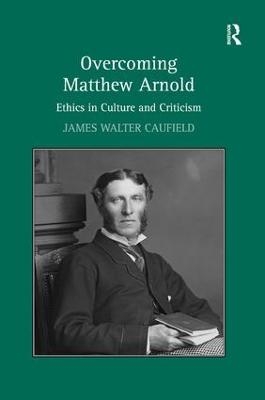
Overcoming Matthew Arnold
Ethics in Culture and Criticism
Seiten
2012
Routledge (Verlag)
9781409426516 (ISBN)
Routledge (Verlag)
9781409426516 (ISBN)
Opening the way for a reexamination of Matthew Arnold's contributions to ethical criticism, this title emphasizes the central role of philosophical pessimism in Arnold's master tropes of culture and conduct. It uses Arnold's ethics as a lens through which to view key literary and cultural movements of the past 150 years.
Opening the way for a reexamination of Matthew Arnold's unique contributions to ethical criticism, James Walter Caufield emphasizes the central role of philosophical pessimism in Arnold's master tropes of "culture" and "conduct." Caufield uses Arnold's ethics as a lens through which to view key literary and cultural movements of the past 150 years, demonstrating that Arnoldian conduct is grounded in a Victorian ethic of "renouncement," a form of altruism that wholly informs both Arnold's poetry and prose and sets him apart from the many nineteenth-century public moralists. Arnold's thought is situated within a cultural and philosophical context that shows the continuing relevance of "renouncement" to much contemporary ethical reflection, from the political kenosis of Giorgio Agamben and the pensiero debole of Gianni Vattimo, to the ethical criticism of Wayne C. Booth and Martha Nussbaum. In refocusing attention on Arnold's place within the broad history of critical and social thought, Caufield returns the poet and critic to his proper place as a founding father of modern cultural criticism.
Opening the way for a reexamination of Matthew Arnold's unique contributions to ethical criticism, James Walter Caufield emphasizes the central role of philosophical pessimism in Arnold's master tropes of "culture" and "conduct." Caufield uses Arnold's ethics as a lens through which to view key literary and cultural movements of the past 150 years, demonstrating that Arnoldian conduct is grounded in a Victorian ethic of "renouncement," a form of altruism that wholly informs both Arnold's poetry and prose and sets him apart from the many nineteenth-century public moralists. Arnold's thought is situated within a cultural and philosophical context that shows the continuing relevance of "renouncement" to much contemporary ethical reflection, from the political kenosis of Giorgio Agamben and the pensiero debole of Gianni Vattimo, to the ethical criticism of Wayne C. Booth and Martha Nussbaum. In refocusing attention on Arnold's place within the broad history of critical and social thought, Caufield returns the poet and critic to his proper place as a founding father of modern cultural criticism.
James Walter Caufield is an extension lecturer at the University of California, Los Angeles, USA.
Chapter 1 Culture and Conduct; Chapter 2 The Buried Life; Chapter 3 Poetry is the Reality; Chapter 4 Culture Hates Hatred; Chapter 5 To the Wise, Foolish; to the World, Weak; Chapter 6 Less than Joy and More than Resignation;
| Verlagsort | London |
|---|---|
| Sprache | englisch |
| Maße | 156 x 234 mm |
| Gewicht | 566 g |
| Themenwelt | Geisteswissenschaften ► Geschichte |
| Geisteswissenschaften ► Philosophie ► Ethik | |
| Geisteswissenschaften ► Philosophie ► Philosophie der Neuzeit | |
| Geisteswissenschaften ► Sprach- / Literaturwissenschaft ► Anglistik / Amerikanistik | |
| Geisteswissenschaften ► Sprach- / Literaturwissenschaft ► Literaturgeschichte | |
| Geisteswissenschaften ► Sprach- / Literaturwissenschaft ► Literaturwissenschaft | |
| ISBN-13 | 9781409426516 / 9781409426516 |
| Zustand | Neuware |
| Informationen gemäß Produktsicherheitsverordnung (GPSR) | |
| Haben Sie eine Frage zum Produkt? |
Mehr entdecken
aus dem Bereich


aus dem Bereich
Buch | Hardcover (2025)
Suhrkamp (Verlag)
CHF 32,15


