


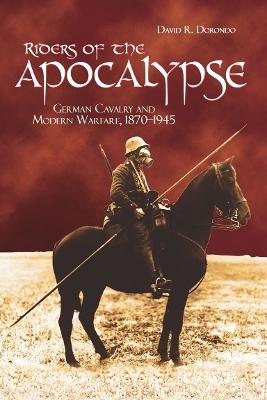
Riders of the Apocalypse
German Cavalry and Modern Warfare, 1870–1945
Seiten
2012
Naval Institute Press (Verlag)
978-1-61251-086-6 (ISBN)
Naval Institute Press (Verlag)
978-1-61251-086-6 (ISBN)
- Titel z.Zt. nicht lieferbar
- Versandkostenfrei
- Auch auf Rechnung
- Artikel merken
Despite the enduring popular image of the blitzkrieg of World War II, the German Army always depended on horses and could not have waged war without them. While the Army’s reliance on draft horses to pull artillery, supply wagons, and field kitchens is now generally acknowledged, David Dorondo’s Riders of the Apocalypse examines the history of the German cavalry. Though concentrating on the period between 1939 and 1945, the book places that history firmly within the larger context of the mounted arm’s development from the Franco-Prussian War of 1870 to the Third Reich’s surrender.
Driven by both internal and external constraints to retain mounted forces after 1918, the German Army effectively did nothing to reduce, much less eliminate, the preponderance of non-mechanised formations during its breakneck expansion under the Nazis after 1933. Instead, politicised command decisions, technical insufficiency, industrial bottlenecks, and, finally, wartime attrition meant that Army leaders were compelled to rely on a steadily growing number of combat horsemen throughout World War II. These horsemen were best represented by the 1st Cavalry Brigade which saw combat in Poland, the Netherlands, France, Russia, and Hungary. Their service, however, came to be cruelly dishonoured by the horsemen of the 8th Waffen-SS Cavalry Division, a unit whose troopers spent more time killing civilians than fighting enemy soldiers.
About the Author
David R. Dorondo holds the degree of D.Phil. from the University of Oxford. He is professor of modern German and European military history at Western Carolina University.
Driven by both internal and external constraints to retain mounted forces after 1918, the German Army effectively did nothing to reduce, much less eliminate, the preponderance of non-mechanised formations during its breakneck expansion under the Nazis after 1933. Instead, politicised command decisions, technical insufficiency, industrial bottlenecks, and, finally, wartime attrition meant that Army leaders were compelled to rely on a steadily growing number of combat horsemen throughout World War II. These horsemen were best represented by the 1st Cavalry Brigade which saw combat in Poland, the Netherlands, France, Russia, and Hungary. Their service, however, came to be cruelly dishonoured by the horsemen of the 8th Waffen-SS Cavalry Division, a unit whose troopers spent more time killing civilians than fighting enemy soldiers.
About the Author
David R. Dorondo holds the degree of D.Phil. from the University of Oxford. He is professor of modern German and European military history at Western Carolina University.
David R. Dorondo holds the degree of D.Phil. from the University of Oxford. He is professor of modern German and European military history at Western Carolina University.
| Erscheint lt. Verlag | 28.6.2012 |
|---|---|
| Zusatzinfo | 15 photos |
| Verlagsort | Annopolis |
| Sprache | englisch |
| Maße | 152 x 230 mm |
| Themenwelt | Sachbuch/Ratgeber ► Natur / Technik ► Tiere / Tierhaltung |
| Geschichte ► Allgemeine Geschichte ► Neuzeit (bis 1918) | |
| Geschichte ► Teilgebiete der Geschichte ► Militärgeschichte | |
| Sozialwissenschaften ► Politik / Verwaltung | |
| ISBN-10 | 1-61251-086-8 / 1612510868 |
| ISBN-13 | 978-1-61251-086-6 / 9781612510866 |
| Zustand | Neuware |
| Informationen gemäß Produktsicherheitsverordnung (GPSR) | |
| Haben Sie eine Frage zum Produkt? |
Mehr entdecken
aus dem Bereich


aus dem Bereich
Geschichte einer wilden Handlung
Buch | Hardcover (2024)
C.H.Beck (Verlag)
CHF 47,60


