


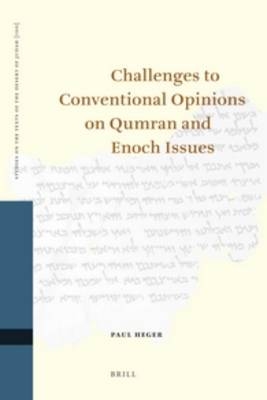
Challenges to Conventional Opinions on Qumran and Enoch Issues
Seiten
2011
Brill (Verlag)
978-90-04-21722-5 (ISBN)
Brill (Verlag)
978-90-04-21722-5 (ISBN)
- Keine Verlagsinformationen verfügbar
- Artikel merken
The study disputes allegations of dualism and determinism in the Dead Sea Scrolls and the substitution of Enoch’s prophecies for the Mosaic Torah, which are incompatible with the biblical doctrines that dominated Jewish society in the late Second Temple period.
Some literary expressions in the Dead Sea Scrolls led scholars to allege that their authors professed a dualistic and deterministic worldview of Zoroastrian origin and that the omission of Moses and Sinai from the Enoch writings evinces that a segment in Jewish society marginalized the Torah, adopting Enoch’s prophecies as its ethical guideline. This study challenges these allegations as utterly conflicting with essential biblical doctrines and the unequivocal beliefs and expectations of Qumran’s Torah-centered society, arguing that scholars’ allegations are erroneously based on interpreting ancient texts with a modern mindset and influenced by the interpreter’s personal cultural background. The study interprets the relevant texts in a manner compatible with the presumed doctrines of ancient Jewish authors and readers.
Some literary expressions in the Dead Sea Scrolls led scholars to allege that their authors professed a dualistic and deterministic worldview of Zoroastrian origin and that the omission of Moses and Sinai from the Enoch writings evinces that a segment in Jewish society marginalized the Torah, adopting Enoch’s prophecies as its ethical guideline. This study challenges these allegations as utterly conflicting with essential biblical doctrines and the unequivocal beliefs and expectations of Qumran’s Torah-centered society, arguing that scholars’ allegations are erroneously based on interpreting ancient texts with a modern mindset and influenced by the interpreter’s personal cultural background. The study interprets the relevant texts in a manner compatible with the presumed doctrines of ancient Jewish authors and readers.
Paul Heger, PhD (Toronto, 1996), is the author of Development of the Incense Cult in Israel (1997), Three Biblical Altar Laws (1999), and Pluralistic Halakhah (2003) (de Gruyter), Cult as the Catalyst for Division (2007, Brill), and numerous journal articles.
1.Introduction
2.Rabbinic And Qumran Interpretation Systems
3.The Attribution Of Modern Concepts To Authors And Readers Of Ancient Texts
4.Enoch: Complementary or Alternative to Mosaic Torah?
5.Jubilees and the Mosaic Torah
6.Another Look at Dualism in Qumran Writings
7.Against a Theory of Dual Determinism in 1QS and 1QHa
8.Epilogue
| Reihe/Serie | Studies on the Texts of the Desert of Judah ; 100 |
|---|---|
| Verlagsort | Leiden |
| Sprache | englisch |
| Maße | 160 x 240 mm |
| Gewicht | 886 g |
| Themenwelt | Sonstiges ► Geschenkbücher |
| Religion / Theologie ► Christentum ► Kirchengeschichte | |
| Geisteswissenschaften ► Religion / Theologie ► Judentum | |
| ISBN-10 | 90-04-21722-3 / 9004217223 |
| ISBN-13 | 978-90-04-21722-5 / 9789004217225 |
| Zustand | Neuware |
| Informationen gemäß Produktsicherheitsverordnung (GPSR) | |
| Haben Sie eine Frage zum Produkt? |
Mehr entdecken
aus dem Bereich

aus dem Bereich
eine andere Geschichte der Papststadt
Buch | Softcover (2024)
C.H.Beck (Verlag)
CHF 25,20
die Macht des Dunklen in unserer Zeit und wie wir ihr entgegentreten
Buch | Hardcover (2025)
Verlag Herder
CHF 27,90


