


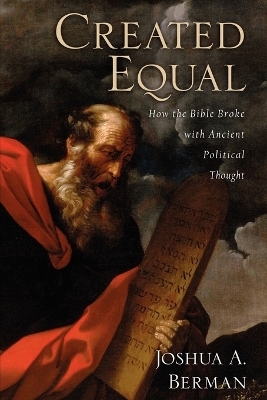
Created Equal
How the Bible Broke with Ancient Political Thought
Seiten
2011
Oxford University Press Inc (Verlag)
978-0-19-983240-8 (ISBN)
Oxford University Press Inc (Verlag)
978-0-19-983240-8 (ISBN)
In Created Equal, Joshua Berman engages the text of the Hebrew Bible from a novel perspective--as a document of social and political thought. He proposes that the Pentateuch can be read as the earliest prescription on record for the establishment of an egalitarian polity.
In Created Equal, Joshua Berman engages the text of the Hebrew Bible from a novel perspective, considering it as a document of social and political thought. He proposes that the Pentateuch can be read as the earliest prescription on record for the establishment of an egalitarian polity. What emerges is the blueprint for a society that would stand in stark contrast to the surrounding cultures of the ancient Near East -- Egypt, Mesopotamia, Ugarit, and the Hittite Empire - in which the hierarchical structure of the polity was centered on the figure of the king and his retinue. Berman shows that an egalitarian ideal is articulated in comprehensive fashion in the Pentateuch and is expressed in its theology, politics, economics, use of technologies of communication, and in its narrative literature. Throughout, he invokes parallels from the modern period as heuristic devices to illuminate ancient developments. Thus, for example, the constitutional principles in the Book of Deuteronomy are examined in the light of those espoused by Montesquieu, and the rise of the novel in 18th-century England serves to illuminate the advent of new modes of storytelling in biblical narrative.
In Created Equal, Joshua Berman engages the text of the Hebrew Bible from a novel perspective, considering it as a document of social and political thought. He proposes that the Pentateuch can be read as the earliest prescription on record for the establishment of an egalitarian polity. What emerges is the blueprint for a society that would stand in stark contrast to the surrounding cultures of the ancient Near East -- Egypt, Mesopotamia, Ugarit, and the Hittite Empire - in which the hierarchical structure of the polity was centered on the figure of the king and his retinue. Berman shows that an egalitarian ideal is articulated in comprehensive fashion in the Pentateuch and is expressed in its theology, politics, economics, use of technologies of communication, and in its narrative literature. Throughout, he invokes parallels from the modern period as heuristic devices to illuminate ancient developments. Thus, for example, the constitutional principles in the Book of Deuteronomy are examined in the light of those espoused by Montesquieu, and the rise of the novel in 18th-century England serves to illuminate the advent of new modes of storytelling in biblical narrative.
Joshua A. Berman is Professor of Bible at Bar-Ilan University in Israel and an Associate Fellow at the Shalem Center in Jerusalem.
List of Abbreviations ; Introduction ; Chapter One: Egalitarian Theology: The Commoner's Upgrade from King's Servant to Servant King ; Chapter Two: Egalitarian Politics: Constitution, Class, and the Book of Deuteronomy ; Chapter Three: Egalitarianism and Assets: God the Economist ; Chapter Four: Egalitarian Technology: Alphabet, Text, and Class ; Chapter Five: Egalitarianism and the Evolution of Narrative: The Rescue of Moses (Exodus 2:1-10) and the Sargon Legend Compared ; Conclusion: Egalitarianisms Ancient and Modern ; Notes ; Select Bibliography ; Index of Scriptural References ; Subject Index
| Erscheint lt. Verlag | 24.11.2011 |
|---|---|
| Verlagsort | New York |
| Sprache | englisch |
| Maße | 156 x 234 mm |
| Gewicht | 372 g |
| Themenwelt | Geisteswissenschaften ► Religion / Theologie ► Judentum |
| Sozialwissenschaften ► Soziologie | |
| ISBN-10 | 0-19-983240-4 / 0199832404 |
| ISBN-13 | 978-0-19-983240-8 / 9780199832408 |
| Zustand | Neuware |
| Informationen gemäß Produktsicherheitsverordnung (GPSR) | |
| Haben Sie eine Frage zum Produkt? |
Mehr entdecken
aus dem Bereich



aus dem Bereich


