


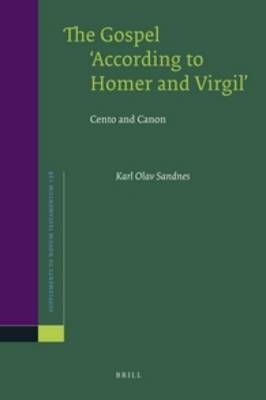
The Gospel 'According to Homer and Virgil'
Cento and Canon
Seiten
2011
Brill (Verlag)
978-90-04-18718-4 (ISBN)
Brill (Verlag)
978-90-04-18718-4 (ISBN)
This study investigates the phenomenon of Christian centos, i.e. attempts at rewriting the Gospel stories in both the style and vocabulary of either Homer (Greek) or Virgil (Latin). Out of the classical epics an entirely new text emerged.
In the fourth century C.E. some Christians paraphrased the stories about Jesus' life in the style of classical epics. Imitating the genre of centos, they stitched together lines taken either from Homer (Greek) or Virgil (Latin). They thus created new texts out of the classical epics, while they still remained fully within the confines of their style and vocabulary. It is the aim of this study to put these attempts into a historical and rhetorical context. Why did some Christians rewrite the Gospel stories in this way, and what came out of this? On the basis of these Christian centos, it is natural to address the view held by some scholars, namely that New Testaments narratives are imitations of the epics.
In the fourth century C.E. some Christians paraphrased the stories about Jesus' life in the style of classical epics. Imitating the genre of centos, they stitched together lines taken either from Homer (Greek) or Virgil (Latin). They thus created new texts out of the classical epics, while they still remained fully within the confines of their style and vocabulary. It is the aim of this study to put these attempts into a historical and rhetorical context. Why did some Christians rewrite the Gospel stories in this way, and what came out of this? On the basis of these Christian centos, it is natural to address the view held by some scholars, namely that New Testaments narratives are imitations of the epics.
Karl Olav Sandnes, Dr. theol. (1988), University of Oslo, is Professor in New Testament at MF Norwegian School of Theology, Oslo, Norway. He has published on the Graeco-Roman background of the New Testament, including The Challenge of Homer. School, Pagan Poets and early Christianity (2009).
1Introduction: The Context of the Study
2The Rhetorical Context of Biblical Epics
3Why Imitate Classical Texts?
4What is a Cento?
5Faltonia Betitia Proba: The Gospel “According to Virgil”
6Eudocia Athenais: The Gospel “According to Homer”
7Summary
| Erscheint lt. Verlag | 14.2.2011 |
|---|---|
| Reihe/Serie | Novum Testamentum, Supplements ; 138 |
| Verlagsort | Leiden |
| Sprache | englisch |
| Maße | 155 x 235 mm |
| Gewicht | 613 g |
| Themenwelt | Sonstiges ► Geschenkbücher |
| Religion / Theologie ► Christentum ► Kirchengeschichte | |
| Geisteswissenschaften ► Sprach- / Literaturwissenschaft ► Anglistik / Amerikanistik | |
| ISBN-10 | 90-04-18718-9 / 9004187189 |
| ISBN-13 | 978-90-04-18718-4 / 9789004187184 |
| Zustand | Neuware |
| Informationen gemäß Produktsicherheitsverordnung (GPSR) | |
| Haben Sie eine Frage zum Produkt? |
Mehr entdecken
aus dem Bereich

aus dem Bereich
eine andere Geschichte der Papststadt
Buch | Softcover (2024)
C.H.Beck (Verlag)
CHF 25,20
die Macht des Dunklen in unserer Zeit und wie wir ihr entgegentreten
Buch | Hardcover (2025)
Verlag Herder
CHF 27,90


