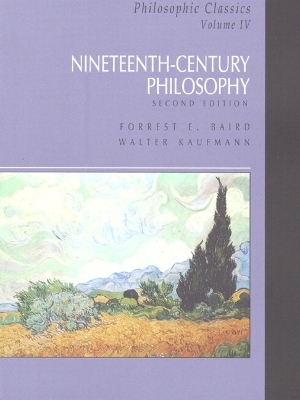
Philosophic Classics, Volume IV
Routledge (Verlag)
978-0-13-021533-8 (ISBN)
- Titel erscheint in neuer Auflage
- Artikel merken
For courses in 19th-century Philosophy or Contemporary Philosophy.
Designed to be accessible to today's students, this anthology of readings in contemporary Western philosophy focuses on Nineteenth-century philosophers who represent a variety of different responses to the issue of the day—i.e., whether or not there was a knowable, nonhuman rational order upon which thinking persons could willfully choose to act. Striking a balance between major and minor figures, the anthology features the best available translations of texts—complete works or complete selections of works—which are both central to each philosopher's thought and are widely accepted as part of the “canon.” The selections are readable and accessible, while still being faithful to the original. Introductions to each philosopher, an abundance of drawings, diagrams, photographs, and a timeline keep students focused throughout.
Jeremy Bentham.
Introduction to the Principles of Morals and Legislation (Chapters 1-4).
Johann Gottlieb Fichte.
On the Foundation of Our Belief in a Divine Government of the Universe. The Vocation of Man (Book III).
G.W.F. Hegel.
Phenomenology of Spirit (“Independence and Dependence of Self-Consciousness: Relations of Master and Servant”). Encyclopaedia (Introduction). Who Thinks Abstractly? Reason in History: A General Introduction to the Philosophy of History (Chapters 1-3). Lectures on the History of Philosophy (“History of Philosophy: The Final Result”).
Arthur Schopenhauer.
The World as Will and Idea (“On the Primacy of the Will in Self-Consciousness”).
Auguste Comte.
Course in Positive Philosophy (“The Nature and Importance of the Positive Philosophy”).
Ludwig Feuerbach.
The Essence of Christianity (“The Essential Nature of Man”).
John Stuart Mill.
Utilitarianism. On Liberty. The Subjection of Women (Selections from Chapter 1).
Soren Kierkegaard.
Fear and Trembling (“Teleological Suspension of the Ethical”).Concluding Unscientific Postscript (“Possible and Actual Theses by Lessing” and “Subjective Truth, Inwardness; Truth is Subjectivity”). Two Ages (“The Present Age”).
Karl Marx.
Economic and Philosophical Manuscripts of 1844(“Alienated Labour,” “Communism and Private Property,” and “Critique of Hegel's Dialectic and General Philosophy”). Manifesto of the Communist Party (Chapters 1, 2, & 4). The German Ideology (“Ideology in General, German Ideology in Particular”). A Contribution to the Critique of Political Economy (Preface and Introduction).
Charles Sanders Peirce.
The Fixation of Belief. How to Make Our Ideas Clear.
William James.
The Moral Philosopher and the Moral Life. The Will to Believe. Pragmatism (“Philosophical Temperaments,” “What Pragmatism Means,” and “The One and the Many”).
Friedrich Nietzsche.
The Birth of Tragedy (Chapters 1-3, 15, 25). The Genealogy of Morals (“<171>Good and Evil, <171>Good and Bad ”). Thus Spoke Zarathustra (Part I, Chapters 1-3). Twilight of the Idols (Selections). The Will to Power (§1067). The Anti-Christ (First Book, Chapters 2-7, 62).
| Erscheint lt. Verlag | 24.1.2000 |
|---|---|
| Verlagsort | New York |
| Sprache | englisch |
| Maße | 235 x 165 mm |
| Gewicht | 665 g |
| Themenwelt | Geisteswissenschaften ► Philosophie ► Geschichte der Philosophie |
| Geisteswissenschaften ► Philosophie ► Philosophie der Neuzeit | |
| ISBN-10 | 0-13-021533-3 / 0130215333 |
| ISBN-13 | 978-0-13-021533-8 / 9780130215338 |
| Zustand | Neuware |
| Informationen gemäß Produktsicherheitsverordnung (GPSR) | |
| Haben Sie eine Frage zum Produkt? |
aus dem Bereich