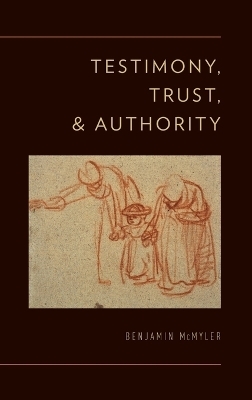
Testimony, Trust, and Authority
Oxford University Press Inc (Verlag)
978-0-19-979433-1 (ISBN)
Much of what we know is acquired by taking things on the word of other people whom we trust and treat as authorities concerning what to believe. But what exactly is it to take someone's word for something? What is it to treat another as an authority concerning what to believe, and what is it to then trust this person for the truth? In Testimony, Trust, and Authority, Benjamin McMyler argues that philosophers have failed to appreciate the nature and significance of our epistemic dependence on the word of others. What others tell us is the case-their testimony, as philosophers use the term-provides us with a reason for belief that is fundamentally unlike the kind of reason for belief provided by other kinds of impersonal evidence. Unlike a footprint in the snow or a bloody knife left at the scene of a crime, a speaker's testimony provides an audience with what McMyler calls a second-personal reason for belief, a reason for belief that serves to parcel out epistemic responsibility for the belief interpersonally between speaker and audience.
Testimony, Trust, and Authority is the most developed articulation and defense of an interpersonal theory of the epistemology of testimony yet to appear. It explains how this position relates to the historical development of philosophical questions about testimony, draws out what is at stake between this position and other competing positions in the contemporary epistemological literature on testimony, highlights and clarifies what is so controversial about this position, and shows how this position connects to broader philosophical issues concerning trust, the second person, and the role of authority in both theoretical and practical rationality. It will be of interest not only to specialists in epistemology but to anyone interested in the nature and significance of human sociality.
Benjamin McMyler is Assistant Professor of Philosophy, Texas A&M University
Acknowledgments ; Introduction ; 1 Testimony as a Philosophical Problem ; 1.1 Testimony, Knowledge, and Understanding ; 1.2 From Human Faith to Inductive Evidence ; 1.3 On Miracles: Hume Versus Port Royal ; 1.4 Inference, Perception, and Sociality: Hume Versus Reid ; 2 Knowing at Second Hand ; 2.1 What is Testimonial Knowledge? ; 2.2 Secondhandness and the Epistemic Right of Deferral ; 2.3 The Epistemological Problem of Testimony Revisited ; 2.4 An Argument from Secondhandness ; 2.5 Skepticism About Knowing at Second Hand ; 3 Three Models of Epistemic Dependence ; 3.1 The Evidential Model ; 3.2 The Inheritance Model ; 3.3 The Second-Personal Model ; 3.4 Moran on Assurance ; 3.5 Intermediate Cases and the Return of Epistemic Autonomy ; 4 Trusting a Person ; 4.1 The Grammar of Trust ; 4.2 Second-Personal Attitudes ; 4.3 Trust as Second-Personal ; 4.4 Trust as Cognitive ; 5 Authority, Autonomy, and Second-Personal Reasons ; 5.1 Second and Third-Personal Reasons ; 5.2 Second-Personal Reasons for
| Erscheint lt. Verlag | 15.12.2011 |
|---|---|
| Verlagsort | New York |
| Sprache | englisch |
| Maße | 239 x 160 mm |
| Gewicht | 417 g |
| Themenwelt | Geisteswissenschaften ► Philosophie ► Erkenntnistheorie / Wissenschaftstheorie |
| ISBN-10 | 0-19-979433-2 / 0199794332 |
| ISBN-13 | 978-0-19-979433-1 / 9780199794331 |
| Zustand | Neuware |
| Informationen gemäß Produktsicherheitsverordnung (GPSR) | |
| Haben Sie eine Frage zum Produkt? |
aus dem Bereich