


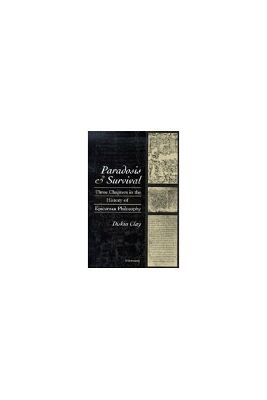
Paradosis and Survival
Three Chapters in the History of Epicurean Philosophy
Seiten
1998
The University of Michigan Press (Verlag)
978-0-472-10896-1 (ISBN)
The University of Michigan Press (Verlag)
978-0-472-10896-1 (ISBN)
The progression of Epicurean doctrine and rhetoric
Paradosis and Survival presents Diskin Clay's fifteen essays devoted to recovering the three main phases of Epicureanism in antiquity: the origin in the first generation of the school in Athens; its spread to Italy in the first century b.c.e.; and its movement to Lycia in the second century c.e. Clay recognizes the subtle intertwining of philosophy and lifestyle, and he makes use of papyri and inscriptions as well as familiar philosophical texts to illuminate both.
The first series of essays concentrates on the mechanisms Epicurus devised to assure the survival of the philosophy beyond its Athenian roots. Clay presents social history on an equal footing with doctrine, and offers for the first time evidence for hero cults among philosophers who believed that the soul died with the body. The second set of essays concentrates Epicureanism in the age of Cicero, Philodemus, and Lucretius. In the four essays on De Rerum Natura, Lucretius is viewed not as a transparency through which we can view the Greek of Epicurus, but a Roman philosopher in control of both doctrine and rhetoric. The book concludes with the study of the philosophy in Oenoanda, Lycia, in which the author brilliantly situates post-1968 discoveries from Oenoanda and the Villa de Papiri in Herculaneum in the context of the second-century mountain city.
This study of Epicureanism as a social movement will be of interest to students of ancient philosophy and the philosophy of early modern Europe, when Epicureanism was revived. In addition, scholars of the New Testament will find parallels to the rise and spread of Christianity.
Diskin Clay is the R. J. R. Nabisco Distinguished Professor of Classical Studies, Duke University.
Paradosis and Survival presents Diskin Clay's fifteen essays devoted to recovering the three main phases of Epicureanism in antiquity: the origin in the first generation of the school in Athens; its spread to Italy in the first century b.c.e.; and its movement to Lycia in the second century c.e. Clay recognizes the subtle intertwining of philosophy and lifestyle, and he makes use of papyri and inscriptions as well as familiar philosophical texts to illuminate both.
The first series of essays concentrates on the mechanisms Epicurus devised to assure the survival of the philosophy beyond its Athenian roots. Clay presents social history on an equal footing with doctrine, and offers for the first time evidence for hero cults among philosophers who believed that the soul died with the body. The second set of essays concentrates Epicureanism in the age of Cicero, Philodemus, and Lucretius. In the four essays on De Rerum Natura, Lucretius is viewed not as a transparency through which we can view the Greek of Epicurus, but a Roman philosopher in control of both doctrine and rhetoric. The book concludes with the study of the philosophy in Oenoanda, Lycia, in which the author brilliantly situates post-1968 discoveries from Oenoanda and the Villa de Papiri in Herculaneum in the context of the second-century mountain city.
This study of Epicureanism as a social movement will be of interest to students of ancient philosophy and the philosophy of early modern Europe, when Epicureanism was revived. In addition, scholars of the New Testament will find parallels to the rise and spread of Christianity.
Diskin Clay is the R. J. R. Nabisco Distinguished Professor of Classical Studies, Duke University.
Diskin Clay is the R. J. R. Nabisco Distinguished Professor of Classical Studies, Duke University.
| Erscheint lt. Verlag | 30.12.1998 |
|---|---|
| Zusatzinfo | 1 drawing, 3 photographs, 1 table, 4 maps |
| Verlagsort | Ann Arbor |
| Sprache | englisch |
| Maße | 152 x 229 mm |
| Themenwelt | Geisteswissenschaften ► Philosophie ► Philosophie Altertum / Antike |
| ISBN-10 | 0-472-10896-4 / 0472108964 |
| ISBN-13 | 978-0-472-10896-1 / 9780472108961 |
| Zustand | Neuware |
| Informationen gemäß Produktsicherheitsverordnung (GPSR) | |
| Haben Sie eine Frage zum Produkt? |
Mehr entdecken
aus dem Bereich
aus dem Bereich
Anleitung zu einer Lektüre Mark Aurels
Buch | Hardcover (2025)
FinanzBuch Verlag
CHF 27,95
Die Philosophie der Antike als Lebensweise in der modernen Welt
Buch | Hardcover (2025)
FinanzBuch Verlag
CHF 25,20


