


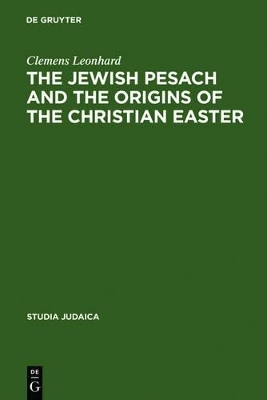
The Jewish Pesach and the Origins of the Christian Easter
Open Questions in Current Research
Seiten
| Ausstattung: Hardcover & eBook
2012
De Gruyter
9783111850351 (ISBN)
De Gruyter
9783111850351 (ISBN)
- Titel leider nicht mehr lieferbar
- Artikel merken
After World War II, Ernst Ludwig Ehrlich (1921–2007) published works in English and German by eminent Israeli scholars, in this way introducing them to a wider audience in Europe and North America. The series he founded for that purpose, Studia Judaica, continues to offer a platform for scholarly studies and editions that cover all eras in the history of the Jewish religion. Nach dem Zweiten Weltkrieg hat Ernst Ludwig Ehrlich (1921–2007) herausragende israelische Gelehrte in englisch- und deutschsprachigen Veröffentlichungen in Europa und Nordamerika bekannt gemacht. Die zu diesem Zweck von ihm begründete Reihe Studia Judaica bietet heute ein Forum für wissenschaftliche Studien und Editionen aus allen Epochen der jüdischen Religionsgeschichte.
The study assesses the main issues in the current debate about the early history of Pesach and Easter and provides new insights into the development of these two festivals. The author argues that the prescriptions of Exodus 12 provide the celebration of the Pesach in Jerusalem with an etiological background in order to connect the pilgrim festival with the story of the Exodus. The thesis that the Christian Easter evolved as a festival against a Jewish form of celebrating Pesach in the second century and that the development of Easter Sunday is dependent upon this custom is endorsed by the author’s close study of relevant texts such as the Haggada of Pesach; the “Poem of the four nights” in the Palestinian Targum Tradition; the structure of the Easter vigil.
The study assesses the main issues in the current debate about the early history of Pesach and Easter and provides new insights into the development of these two festivals. The author argues that the prescriptions of Exodus 12 provide the celebration of the Pesach in Jerusalem with an etiological background in order to connect the pilgrim festival with the story of the Exodus. The thesis that the Christian Easter evolved as a festival against a Jewish form of celebrating Pesach in the second century and that the development of Easter Sunday is dependent upon this custom is endorsed by the author’s close study of relevant texts such as the Haggada of Pesach; the “Poem of the four nights” in the Palestinian Targum Tradition; the structure of the Easter vigil.
Clemens Leonhard, Westfälische Wilhelms-Universität Münster.
| Reihe/Serie | Studia Judaica ; 35 |
|---|---|
| Zusatzinfo | Includes a print version and an ebook |
| Verlagsort | Berlin/Boston |
| Sprache | englisch |
| Gewicht | 1001 g |
| Themenwelt | Geisteswissenschaften ► Religion / Theologie ► Judentum |
| Schlagworte | Easter • Easter; Jewish studies; liturgy science; Pesach • Jewish Studies • Judastik • Liturgiewissenschaft • liturgy science • Ostern • Passah • Pesach |
| ISBN-13 | 9783111850351 / 9783111850351 |
| Zustand | Neuware |
| Informationen gemäß Produktsicherheitsverordnung (GPSR) | |
| Haben Sie eine Frage zum Produkt? |


