


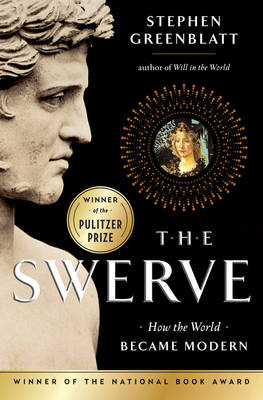
The Swerve
How the World Became Modern
Seiten
2011
WW Norton & Co (Verlag)
978-0-393-06447-6 (ISBN)
WW Norton & Co (Verlag)
978-0-393-06447-6 (ISBN)
- Titel ist leider vergriffen;
keine Neuauflage - Artikel merken
Winner of the 2012 Pulitzer Prize for Non-Fiction
Winner of the 2011 National Book Award for Non-Fiction
One of the world's most celebrated scholars, Stephen Greenblatt has crafted both an innovative work of history and a thrilling story of discovery, in which one manuscript, plucked from a thousand years of neglect, changed the course of human thought and made possible the world as we know it.
Nearly six hundred years ago, a short, genial, cannily alert man in his late thirties took a very old manuscript off a library shelf, saw with excitement what he had discovered, and ordered that it be copied. That book was the last surviving manuscript of an ancient Roman philosophical epic, On the Nature of Things, by Lucretius—a beautiful poem of the most dangerous ideas: that the universe functioned without the aid of gods, that religious fear was damaging to human life, and that matter was made up of very small particles in eternal motion, colliding and swerving in new directions.
The copying and translation of this ancient book-the greatest discovery of the greatest book-hunter of his age-fueled the Renaissance, inspiring artists such as Botticelli and thinkers such as Giordano Bruno; shaped the thought of Galileo and Freud, Darwin and Einstein; and had a revolutionary influence on writers such as Montaigne and Shakespeare and even Thomas Jefferson.
Winner of the 2011 National Book Award for Non-Fiction
One of the world's most celebrated scholars, Stephen Greenblatt has crafted both an innovative work of history and a thrilling story of discovery, in which one manuscript, plucked from a thousand years of neglect, changed the course of human thought and made possible the world as we know it.
Nearly six hundred years ago, a short, genial, cannily alert man in his late thirties took a very old manuscript off a library shelf, saw with excitement what he had discovered, and ordered that it be copied. That book was the last surviving manuscript of an ancient Roman philosophical epic, On the Nature of Things, by Lucretius—a beautiful poem of the most dangerous ideas: that the universe functioned without the aid of gods, that religious fear was damaging to human life, and that matter was made up of very small particles in eternal motion, colliding and swerving in new directions.
The copying and translation of this ancient book-the greatest discovery of the greatest book-hunter of his age-fueled the Renaissance, inspiring artists such as Botticelli and thinkers such as Giordano Bruno; shaped the thought of Galileo and Freud, Darwin and Einstein; and had a revolutionary influence on writers such as Montaigne and Shakespeare and even Thomas Jefferson.
Stephen Greenblatt is Cogan University Professor of the Humanities at Harvard University. He has written extensively on English Renaissance literature and acts as general editor of The Norton Anthology of English Literature and The Norton Shakespeare. He is the author of fourteen books, including The Swerve, winner of the Pulitzer Prize and National Book Award, and Will in the World, a Pulitzer Prize finalist.
| Erscheint lt. Verlag | 26.9.2011 |
|---|---|
| Zusatzinfo | 16 pages full-color illustrations |
| Verlagsort | New York |
| Sprache | englisch |
| Maße | 165 x 244 mm |
| Gewicht | 682 g |
| Themenwelt | Geschichte ► Allgemeine Geschichte ► Mittelalter |
| Geschichte ► Allgemeine Geschichte ► Neuzeit (bis 1918) | |
| ISBN-10 | 0-393-06447-6 / 0393064476 |
| ISBN-13 | 978-0-393-06447-6 / 9780393064476 |
| Zustand | Neuware |
| Informationen gemäß Produktsicherheitsverordnung (GPSR) | |
| Haben Sie eine Frage zum Produkt? |
Mehr entdecken
aus dem Bereich



aus dem Bereich
Geschichte einer Augsburger Familie (1367-1650)
Buch | Softcover (2024)
Kohlhammer (Verlag)
CHF 47,60


