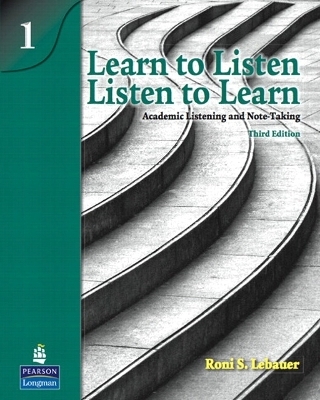
Learn to Listen, Listen to Learn 1
Pearson Education (US)
978-0-13-217030-7 (ISBN)
- Titel z.Zt. nicht lieferbar
- Versandkostenfrei
- Auch auf Rechnung
- Artikel merken
The expanded Learn to Listen, Listen to Learn series prepares students for the rigors of academic classwork, helping them acquire the listening-comprehension and note-taking skills necessary for success.
This two-book series offers students valuable tips for getting the most from college lectures, including note-taking skills, organization of information, recognition of language cues, and the acquisition of vocabulary. Students are shown how a typical lecture is organized, using extensive excerpts and transcripts from authentic lectures on high-interest topics from a wide range of academic discipline.
Features:
Includes new and updated material, including expanded vocabulary, extension, and post-lecture activities to encourage students to discuss, research, and write about ideas raised in the lectures.
Teaches students how to recognize lecture organization, and how to evaluate and predict information.
Focuses on the acquisition of vocabulary, especially from the Academic Word List, and on the recognition of language cues.
Prepares students for academic testing with TOEFL-style test questions throughout the text.
See also Learn to Listen, Listen to Learn 2.
Unit 1 STARTING OUT: PRE-COURSEWORK EVALUATION
A. Evaluating Listening Comprehension and Note-Taking Skills
LECTURE 1: Study Tips (Psychology)
B. Teacher’s Note-Taking Feedback Form
Unit 2 UNDERSTANDING LECTURE DESIGN
A. Comparing the Language of Lecturing to the Language of Writing 1
B. Recognizing Cues
C. Recognizing Paraphrase, Repetition, Exemplification, and Digression
D. Summarizing Key Differences between the Language of Lecturing and
the Language of Writing
E. Getting the Main Ideas Using Context and Prediction
F. Predicting Content and Lecture Direction
Unit 3 RECOGNIZING INTRODUCTONS, CONCLUSIONS, AND DIGRESSIONS
A. Using Introductions to Recognize Lecture Focus and Direction
B. Recognizing and Comprehending Conclusions
C. Recognizing Digressions
Unit 4 THE BASICS OF NOTE-TAKING
A. Noting Key Words
B. Using Abbreviations Thoughtfully
C. Using Note-Taking Symbols and Abbreviations
D. Visually Representing Relationships and the Relative Importance
of Information
LECTURE 2: "Nu Shu": Women’s Unique Language (Linguistics)
E. Eight DOs and DON’Ts for Improving Lecture Comprehension and
Note-Taking
Unit 5 NOTING NUMBERS AND STATISTICS
A. Differentiating between Numbers That Sound Similar
B. Noting Years
C. Noting Large Numbers in Isolation
D. Noting Fractions and Decimals
E. Noting Ratios
LECTURE 3: Exploring a Market: Attitudes towards pets (Business/Sociology)
LECTURE 4: Tobacco through the Millennia (Agriculture/History)
Unit 6 FOCUS ON LECTURE ORGANIZATION (PART 1)
A. Why Listen for Organization?
B. Organizational Plans within Lectures
C. Defining a Term
D. Listing Subtopics
E. Describing a Causal Relationship
LECTURE 5: How to Deal with Stress (Psychology)
LECTURE 6: Acid Rain (Ecology/Chemistry)
Unit 7 FOCUS ON LECTURE ORGANIZATION (PART 2)
A. Exemplifying a Topic
B. Describing a Process or Sequence of Events
C. Classifying Subtopics
LECTURE 7: Archaeological Dating Methods (Anthropology)
LECTURE 8: Pheromones (Biology)
Unit 8 FOCUS ON LECTURE ORGANIZATION (PART 3)
A. Describing Characteristics
B. Comparing and Contrasting
C. Making a Generalization and Providing Evidence
LECTURE 9: The Near Side of the Moon (Astronomy)
LECTURE 10: Drink Your Green Tea! (Food Science)
Unit 9 TYING IT TOGETHER: END-OF-COURSE EVALUATION
LECTURE 11: Voter Turnout in the United States (Political Science)
LECTURE 12: The Pyramids of Egypt: An Engineering Feat (Engineering/History)
Appendix A Academic Word List Vocabulary
Appendix B Lecture Index by Organizational Plan
Appendix C Lecture Index by Subject Matter
Appendix D Rewritten Notes for Lectures 5–10
| Erscheint lt. Verlag | 26.4.2012 |
|---|---|
| Verlagsort | Upper Saddle River |
| Sprache | englisch |
| Maße | 210 x 270 mm |
| Gewicht | 588 g |
| Themenwelt | Schulbuch / Wörterbuch ► Wörterbuch / Fremdsprachen |
| Geisteswissenschaften ► Sprach- / Literaturwissenschaft ► Sprachwissenschaft | |
| Sozialwissenschaften ► Pädagogik | |
| ISBN-10 | 0-13-217030-2 / 0132170302 |
| ISBN-13 | 978-0-13-217030-7 / 9780132170307 |
| Zustand | Neuware |
| Informationen gemäß Produktsicherheitsverordnung (GPSR) | |
| Haben Sie eine Frage zum Produkt? |
aus dem Bereich