


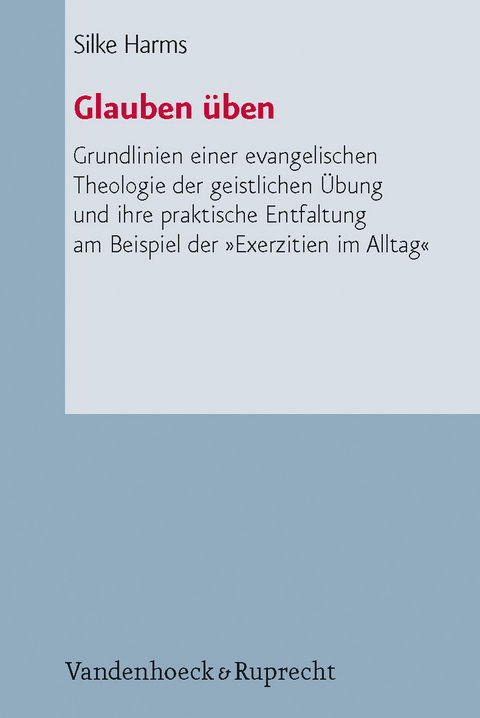
Glauben üben
Vandenhoeck & Ruprecht (Verlag)
978-3-525-57016-6 (ISBN)
Asceticism, the teaching of religious practicing, was long neglected by practical theology. The question whether it is at all possible to "practice" one´s faith was less the problem than the question how to learn to believe. In this volume the author studies the meaning of practicing for Protestant theology and religious life. She proves that the transfer of substance of faith today necessarily means practicing Christian tenets. As an example she uses the course model entitled "Everyday Exercises," which stems originally from Jesuit circles and became popular among Protestants in the 1990s. She examines the path this method of religious exercises took before it became part of Protestant practice, and shows that it can now rightly be considered part of the Protestant tradition. Based on an extensive study of the writings of Martin Luther and Friedrich Schleiermacher the author points out the importance of these two theologians for Protestant asceticism today. Religious practicing within the Protestant Church is marked by a relational-communicative approach: The goal is not to become a "master," but to be transformed by encountering the living God. Practicing occurs in the polarity between individuality and sociality, between activity and passivity, between everyday life and special events and places. Protestant asceticism has as its goal to keep all three dimensions in perspective and not to be limited by the one or other influence.
Dr. theol. Silke Harms ist Referentin des Geistlichen Zentrums Kloster Bursfelde in der Landeskirche Hannover.
Ascetics the reflection on spiritual exercises has for a long time been the poor cousin of practical theology. The question whether one can "exercise" faith has been less frequently looked into than the question whether one can "learn" faith. Silke Harms investigates the significance of exercise for Protestant theology and practise. She demonstrates that in present times the communication of the content of faith requires the practical initiation into Christian living. Harms takes an exemplary look at the course "Exercises in Daily Life" which has its origins in Jesuit spirituality and has become increasingly popular in the Protestant church in Germany since the 90s. She not only expounds the way in which the exercises were adopted into Protestant praxis which was a remarkable process from the point of view of church history , but she also demonstrates that spiritual exercises can be applied with good reason to the Protestant heritage. The author unfolds the significance of Martin Luther and Friedrich Schleiermacher for modern Protestant ascetics by means of a detailed analysis of their writings. A distinct feature of spiritual exercises in the Protestant church is the emphasis on the relational-communicative dimension. The aim is not perfection but the transformation through an existential encounter with the living God. Exercise is done within the polarity of individuality and sociality, activity and passivity, and everyday life and special times and places. Protestant ascetics has to ascertain that all three polarities are kept in balance.
| Erscheint lt. Verlag | 4.4.2012 |
|---|---|
| Reihe/Serie | Arbeiten zur Pastoraltheologie, Liturgik und Hymnologie ; Band 067 |
| Zusatzinfo | mit 4 Abb. und 2 Tab. |
| Verlagsort | Göttingen |
| Sprache | deutsch |
| Maße | 155 x 232 mm |
| Gewicht | 490 g |
| Themenwelt | Geisteswissenschaften ► Religion / Theologie ► Christentum |
| Schlagworte | Evangelische Theologie • Exerzitien • Geistliches Leben • Praktische Theologie • Spiritualität |
| ISBN-10 | 3-525-57016-3 / 3525570163 |
| ISBN-13 | 978-3-525-57016-6 / 9783525570166 |
| Zustand | Neuware |
| Informationen gemäß Produktsicherheitsverordnung (GPSR) | |
| Haben Sie eine Frage zum Produkt? |
aus dem Bereich


