


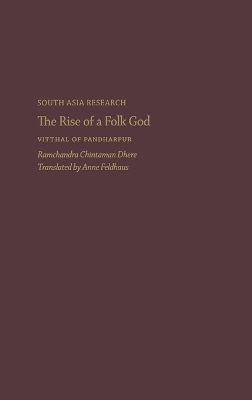
Rise of a Folk God
Vitthal of Pandharpur
Seiten
2011
Oxford University Press Inc (Verlag)
978-0-19-977759-4 (ISBN)
Oxford University Press Inc (Verlag)
978-0-19-977759-4 (ISBN)
Vitthal, also called Vithoba, is the most popular god in the western Indian state of Maharashtra, and the best-known Hindu god of that region outside of India. This book by Ramchandra Chintaman Dhere is the foremost study of the history of Vitthal, his worship, and his worshippers.
Vitthal, also called Vithoba, is the most popular Hindu god in the western Indian state of Maharashtra, and the best-known god of that region outside India. His temple at Pandharpur is the goal of an annual pilgrimage that is one of the largest and most elaborate in the world.
This book is the foremost study of the history of Vitthal, his worship, and his worshippers. First published in Marathi in 1984, the book remains the most thorough and insightful work on Vitthal and his cult in any language, and provides an exemplary model for understanding the history and morphology of lived Hinduism. The author, Ramachandra Chintaman Dhere, is the leading scholar of religious traditions in Maharashtra and throughout the Deccan, the plateau that covers most of central India.
Vitthal exemplifies the synthesis of Vaisnava and Saiva elements that not only typifies Maharashtrian Hindu religious life but also marks Vitthal's resemblance to another prominent South Indian god, Venkates of Tirupati in Andhra Pradesh. Dhere's analysis highlights Vitthal's connection with pastoralist hero cults, and demonstrates the god's development from a god of shepherds to a god of the majority of the population, including Brahmans. In addition, Dhere also explores the connections of Vitthal with Buddhist and Jain traditions. In the book's final chapter, Dhere presents a culminating stage in the evolution of the worship of Vitthal: the interpretation in spiritual terms of the god, his temple, the town of Pandharpur, and the river that flows past the town.
Dhere received India's highest literary award, the Sahitya Akademi prize, for this book.
Vitthal, also called Vithoba, is the most popular Hindu god in the western Indian state of Maharashtra, and the best-known god of that region outside India. His temple at Pandharpur is the goal of an annual pilgrimage that is one of the largest and most elaborate in the world.
This book is the foremost study of the history of Vitthal, his worship, and his worshippers. First published in Marathi in 1984, the book remains the most thorough and insightful work on Vitthal and his cult in any language, and provides an exemplary model for understanding the history and morphology of lived Hinduism. The author, Ramachandra Chintaman Dhere, is the leading scholar of religious traditions in Maharashtra and throughout the Deccan, the plateau that covers most of central India.
Vitthal exemplifies the synthesis of Vaisnava and Saiva elements that not only typifies Maharashtrian Hindu religious life but also marks Vitthal's resemblance to another prominent South Indian god, Venkates of Tirupati in Andhra Pradesh. Dhere's analysis highlights Vitthal's connection with pastoralist hero cults, and demonstrates the god's development from a god of shepherds to a god of the majority of the population, including Brahmans. In addition, Dhere also explores the connections of Vitthal with Buddhist and Jain traditions. In the book's final chapter, Dhere presents a culminating stage in the evolution of the worship of Vitthal: the interpretation in spiritual terms of the god, his temple, the town of Pandharpur, and the river that flows past the town.
Dhere received India's highest literary award, the Sahitya Akademi prize, for this book.
Ramachandra Chintaman Dhere, the foremost scholar of religious traditions in Maharashtra, has published over 100 books in this area. The dozens of awards he has received for his scholarly work include the highly coveted Maharashtra State Prize and the Sahitya Akademi prize. Anne Feldhaus is Foundation Professor of Religious Studies at Arizona State University, Tempe, where she teaches Hinduism, Sanskrit, and religious geography.
INTRODUCTION; GLOSSARY; ABBREVIATIONS; BIBLIOGRAPHY; INDEX
| Erscheint lt. Verlag | 3.11.2011 |
|---|---|
| Reihe/Serie | South Asia Research |
| Übersetzer | Anne Feldhaus |
| Zusatzinfo | 33 b&w halftones, 1 map |
| Verlagsort | New York |
| Sprache | englisch |
| Maße | 236 x 160 mm |
| Gewicht | 635 g |
| Themenwelt | Geisteswissenschaften ► Religion / Theologie ► Hinduismus |
| ISBN-10 | 0-19-977759-4 / 0199777594 |
| ISBN-13 | 978-0-19-977759-4 / 9780199777594 |
| Zustand | Neuware |
| Informationen gemäß Produktsicherheitsverordnung (GPSR) | |
| Haben Sie eine Frage zum Produkt? |
Mehr entdecken
aus dem Bereich


aus dem Bereich
Spiritual Living for Today Based on India's Thousand Names of …
Buch | Softcover (2025)
Nilgiri Press (Verlag)
CHF 35,90
Unearthing and Enacting the Feelings of Nine Himalayan Hindu …
Buch | Hardcover (2025)
De Gruyter (Verlag)
CHF 142,00


