


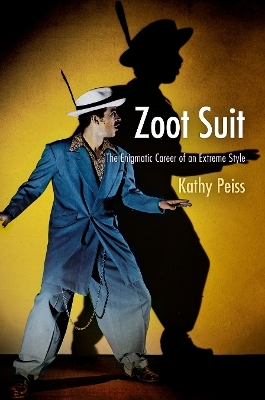
Zoot Suit
The Enigmatic Career of an Extreme Style
Seiten
2011
University of Pennsylvania Press (Verlag)
978-0-8122-4337-6 (ISBN)
University of Pennsylvania Press (Verlag)
978-0-8122-4337-6 (ISBN)
- Titel ist leider vergriffen;
keine Neuauflage - Artikel merken
Focusing on the most notorious fashion of the 1940s, Zoot Suit traces its enigmatic career during World War II and after, as it spread from Harlem across the United States and around the world. In so doing, this book offers a new perspective on youth culture and the politics of style.
ZOOT SUIT (n.): the ultimate in clothes. The only totally and truly American civilian suit.
-Cab Calloway, The Hepster's Dictionary, 1944
Before the fashion statements of hippies, punks, or hip-hop, there was the zoot suit, a striking urban look of the World War II era that captivated the imagination. Created by poor African American men and obscure tailors, the "drape shape" was embraced by Mexican American pachucos, working-class youth, entertainers, and swing dancers, yet condemned by the U.S. government as wasteful and unpatriotic in a time of war. The fashion became notorious when it appeared to trigger violence and disorder in Los Angeles in 1943-events forever known as the "zoot suit riot." In its wake, social scientists, psychiatrists, journalists, and politicians all tried to explain the riddle of the zoot suit, transforming it into a multifaceted symbol: to some, a sign of social deviance and psychological disturbance, to others, a gesture of resistance against racial prejudice and discrimination. As controversy swirled at home, young men in other places-French zazous, South African tsotsi, Trinidadian saga boys, and Russian stiliagi-made the American zoot suit their own.
In Zoot Suit, historian Kathy Peiss explores this extreme fashion and its mysterious career during World War II and after, as it spread from Harlem across the United States and around the world. She traces the unfolding history of this style and its importance to the youth who adopted it as their uniform, and at the same time considers the way public figures, experts, political activists, and historians have interpreted it. This outrÉ style was a turning point in the way we understand the meaning of clothing as an expression of social conditions and power relations. Zoot Suit offers a new perspective on youth culture and the politics of style, tracing the seam between fashion and social action.
ZOOT SUIT (n.): the ultimate in clothes. The only totally and truly American civilian suit.
-Cab Calloway, The Hepster's Dictionary, 1944
Before the fashion statements of hippies, punks, or hip-hop, there was the zoot suit, a striking urban look of the World War II era that captivated the imagination. Created by poor African American men and obscure tailors, the "drape shape" was embraced by Mexican American pachucos, working-class youth, entertainers, and swing dancers, yet condemned by the U.S. government as wasteful and unpatriotic in a time of war. The fashion became notorious when it appeared to trigger violence and disorder in Los Angeles in 1943-events forever known as the "zoot suit riot." In its wake, social scientists, psychiatrists, journalists, and politicians all tried to explain the riddle of the zoot suit, transforming it into a multifaceted symbol: to some, a sign of social deviance and psychological disturbance, to others, a gesture of resistance against racial prejudice and discrimination. As controversy swirled at home, young men in other places-French zazous, South African tsotsi, Trinidadian saga boys, and Russian stiliagi-made the American zoot suit their own.
In Zoot Suit, historian Kathy Peiss explores this extreme fashion and its mysterious career during World War II and after, as it spread from Harlem across the United States and around the world. She traces the unfolding history of this style and its importance to the youth who adopted it as their uniform, and at the same time considers the way public figures, experts, political activists, and historians have interpreted it. This outrÉ style was a turning point in the way we understand the meaning of clothing as an expression of social conditions and power relations. Zoot Suit offers a new perspective on youth culture and the politics of style, tracing the seam between fashion and social action.
Kathy Peiss is Roy F. and Jeannette P. Nichols Professor of American History at the University of Pennsylvania. She is the author of Hope in a Jar: The Making of America's Beauty Culture, also available from the University of Pennsylvania Press, and Cheap Amusements: Working Women and Leisure in Turn-of-the-Century New York.
Introduction
1 Making the Suit Zoot
2 Going to Extremes
3 Into the Public Eye
4 From Rags to Riot
5 Reading the Riddle
6 Zooting Around the World
Aftermath
Notes
Index
Acknowledgments
| Erscheint lt. Verlag | 20.6.2011 |
|---|---|
| Zusatzinfo | 28 illus. |
| Verlagsort | Pennsylvania |
| Sprache | englisch |
| Maße | 152 x 229 mm |
| Themenwelt | Kunst / Musik / Theater ► Design / Innenarchitektur / Mode |
| Kunst / Musik / Theater ► Kunstgeschichte / Kunststile | |
| Geisteswissenschaften ► Geschichte ► Regional- / Ländergeschichte | |
| Geschichte ► Teilgebiete der Geschichte ► Kulturgeschichte | |
| Sozialwissenschaften | |
| ISBN-10 | 0-8122-4337-4 / 0812243374 |
| ISBN-13 | 978-0-8122-4337-6 / 9780812243376 |
| Zustand | Neuware |
| Informationen gemäß Produktsicherheitsverordnung (GPSR) | |
| Haben Sie eine Frage zum Produkt? |
Mehr entdecken
aus dem Bereich



aus dem Bereich
Die Revolution des Gemeinen Mannes
Buch | Softcover (2024)
C.H.Beck (Verlag)
CHF 16,80
Eine Geschichte des Geschmacks
Buch | Hardcover (2025)
C.H.Beck (Verlag)
CHF 49,95
vom Mittelalter bis zur Gegenwart
Buch | Softcover (2024)
C.H.Beck (Verlag)
CHF 16,80


