


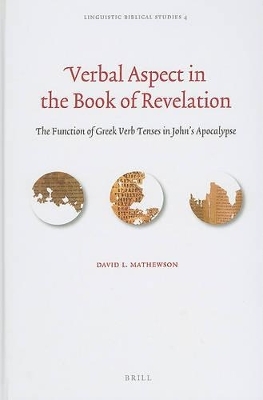
Verbal Aspect in the Book of Revelation
The Function of Greek Verb Tenses in John’s Apocalypse
Seiten
2010
Brill (Verlag)
978-90-04-18668-2 (ISBN)
Brill (Verlag)
978-90-04-18668-2 (ISBN)
Drawing on recent research into verbal aspect in New Testament Greek by Stanley E. Porter, Buist M. Fanning and others, this work addresses the issue of verb tenses in the book of Revelation and how they function within its visions and discourse.
The book of Revelation is well-known for its grammatical infelicities. More specifically, Revelation exhibits apparently "odd" use of Greek verb tenses. Most attemtps to describe this "odd" use of verb tenses start with the assumption that Greek verb tenses are primarily temporal in meaning. In order to explain Revelation's apparent violation of these temporal values, scholars have proposed some level of semitic influence from the Hebrew tense system as making sense of this "odd" use of tenses. However, recent research into verbal aspect, which calls into question this temporal orientation, and suggests that Greek verb tenses grammaticalize aspect and not time, has opened up new avenues for explaining the Greek verb tense usage in Revelation. This book applies verbal aspect theory to tense usage in Revelation and focuses on how the tenses, as communicating verbal aspect, function within sections of Revelation.
The book of Revelation is well-known for its grammatical infelicities. More specifically, Revelation exhibits apparently "odd" use of Greek verb tenses. Most attemtps to describe this "odd" use of verb tenses start with the assumption that Greek verb tenses are primarily temporal in meaning. In order to explain Revelation's apparent violation of these temporal values, scholars have proposed some level of semitic influence from the Hebrew tense system as making sense of this "odd" use of tenses. However, recent research into verbal aspect, which calls into question this temporal orientation, and suggests that Greek verb tenses grammaticalize aspect and not time, has opened up new avenues for explaining the Greek verb tense usage in Revelation. This book applies verbal aspect theory to tense usage in Revelation and focuses on how the tenses, as communicating verbal aspect, function within sections of Revelation.
David L. Mathewson, Ph.D. (1998) in New Testament, University of Aberdeen, Scotland, is Associate Professor of Biblical Studies at Gordon College, Wenham, MA, USA. He is the author of numerous articles on the book of Revelation, and the author of A New Heaven and a New Earth: The Meaning and Function of the Old Testament in Revelation 21.1-22.5 (Sheffield, 2003).
| Reihe/Serie | Linguistic Biblical Studies ; 4 |
|---|---|
| Verlagsort | Leiden |
| Sprache | englisch |
| Maße | 160 x 240 mm |
| Gewicht | 508 g |
| Themenwelt | Sonstiges ► Geschenkbücher |
| Religion / Theologie ► Christentum ► Bibelausgaben / Bibelkommentare | |
| Religion / Theologie ► Christentum ► Kirchengeschichte | |
| Geisteswissenschaften ► Sprach- / Literaturwissenschaft ► Sprachwissenschaft | |
| ISBN-10 | 90-04-18668-9 / 9004186689 |
| ISBN-13 | 978-90-04-18668-2 / 9789004186682 |
| Zustand | Neuware |
| Informationen gemäß Produktsicherheitsverordnung (GPSR) | |
| Haben Sie eine Frage zum Produkt? |
Mehr entdecken
aus dem Bereich


aus dem Bereich
Buch | Softcover (2021)
De Gruyter (Verlag)
CHF 44,90


