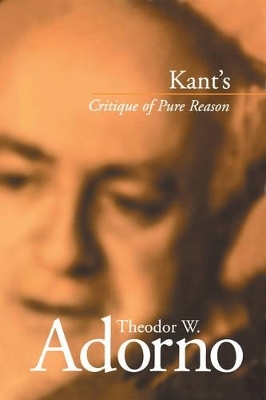
Kant's Critique of Pure Reason
Polity Press (Verlag)
978-0-7456-2183-8 (ISBN)
- Titel z.Zt. nicht lieferbar
- Versandkostenfrei
- Auch auf Rechnung
- Artikel merken
Kant is a pivotal thinker in Adorno's intellectual world. Yet although he wrote monographs on Hegel, Husserl and Kierkegaard, the closest he came to an extended discussion of Kant are two lecture courses, one concentrating on the Critique of Pure Reason and the other on the Critique of Practical Reason. This new volume by Adorno comprises his lectures on the former.
Adorno attempts to make Kant's thought comprehensible to students by focusing on what he regards as problematic aspects of Kant's philosophy. Adorno examines his dualism and what he calls the Kantian 'block': the contradictions arising from Kant's resistance to the idealism that his successors, Fichte, Schelling and Hegel, saw as the inevitable outcome of his ideas. But these lectures also provide an accessible introduction to and rationale for Adorno's own philosophy as expounded in Negative Dialectics and his other major writings. Adorno's view of Kant forms an integral part of his own philosophy, since he argues that the way out of the Kantian contradictions is to show the necessity of the dialectical thinking that Kant himself spurned. This in turn enables Adorno to criticize Anglo-Saxon scientistic or positivist thought, as well as the philosophy of existentialism.
This book will be of great interest to those working in philosophy and in social and political thought, and it will be essential reading for anyone interested in the foundations of Adorno's own work.
Theodor W. Adorno (1903-1969) was a prominent member of the Frankfurt School, and one of the most influential thinkers of the twentieth century in the areas of social theory, philosophy, literary criticism and aesthetics.
Lecture One: Methods and Intentions. Lecture Two: The Concept of the Transcendental.
Lecture Three: The Concept of the Transcendental (II).
Lecture Four: Metaphysics.
Lecture Five: Metaphysics (II).
Lecture Six: Enlightenment.
Lecture Seven: Knowledge as Tautology.
Lecture Eight: The Concept of the Self.
Lecture Nine: The Concept of the Thing.
Lecture Ten: The Concept of the Thing (II).
Lecture Eleven: 'Deduction of the Categories'.
Lecture Twelve: Schematism.
Lecture Thirteen; Constituens and Constitutum.
Lecture Fourteen: Constituens and Constitutum (II).
Lecture Fifteen: Constituens and Constitutum (III).
Lecture Sixteen: Society; 'Block'.
Lecture Seventeen: Ideology; The Concept of Depth.
Lecture Eighteen: Psychology.
Lecture Nineteen: The Concept of the Transcendental (III).
Lecture Twenty: The Concept of the Transcendental (IV).
Lecture Twenty-One: The Transcendental Aesthetic.
Bibliographical References.
Editor's Notes.
Editor's Afterword.
Acknowledgements.
Index
| Erscheint lt. Verlag | 28.4.2001 |
|---|---|
| Verlagsort | Oxford |
| Sprache | englisch |
| Maße | 163 x 233 mm |
| Gewicht | 595 g |
| Themenwelt | Geisteswissenschaften ► Philosophie ► Erkenntnistheorie / Wissenschaftstheorie |
| Geisteswissenschaften ► Philosophie ► Geschichte der Philosophie | |
| Geisteswissenschaften ► Philosophie ► Philosophie der Neuzeit | |
| ISBN-10 | 0-7456-2183-X / 074562183X |
| ISBN-13 | 978-0-7456-2183-8 / 9780745621838 |
| Zustand | Neuware |
| Informationen gemäß Produktsicherheitsverordnung (GPSR) | |
| Haben Sie eine Frage zum Produkt? |
aus dem Bereich