Zum Hauptinhalt springen
Nicht aus der Schweiz? Besuchen Sie lehmanns.de
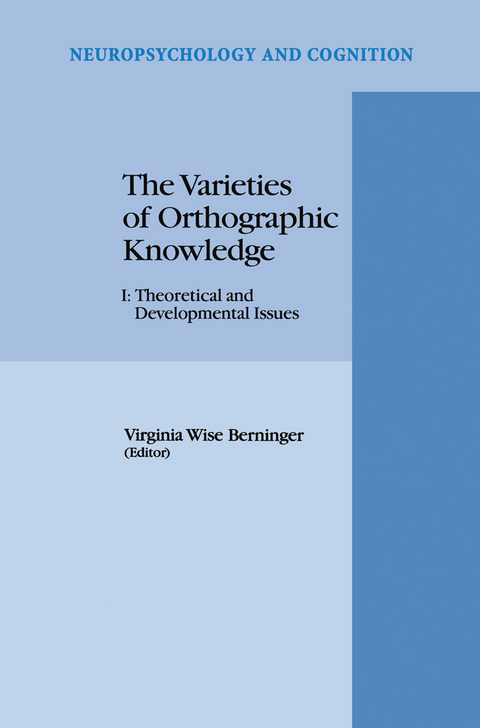
The Varieties of Orthographic Knowledge -

The Varieties of Orthographic Knowledge

I: Theoretical and Developmental Issues

V.W. Berninger (Herausgeber)

Buch | Softcover
382 Seiten
2010 | Softcover reprint of hardcover 1st ed. 1994
Springer (Verlag)
9789048144600 (ISBN)
CHF 224,65 inkl. MwSt
  • Versand in 10-15 Tagen
  • Versandkostenfrei
  • Auch auf Rechnung
  • Artikel merken
The role of orthography in reading and writing is not a new topic of inquiry. For example, in 1970 Venezky made a seminal contribution with The Structure of English Orthography in which he showed how both sequential redundancy (probable and permissible letter sequences) and rules of letter-sound correspondence contribute to orthographic structure. In 1980 Ehri introduced the concept of orthographic images, that is, the representation of written words in memory, and proposed that the image is created by an amalgamation of the word's orthographic and phonological properties. In 1981 Taylor described the evolution of orthographies in writing systems-from the earliest logographies for pictorial representation of ideas to syllabaries for phonetic representation of sounds to alphabets for phonemic representation of sounds. In 1985 Frith proposed a stage model for the role of orthographic knowledge in development of word recognition: Initially in the logographic stage a few words can be recognized on the basis of partial spelling information; in the alphabetic stage words are. recognized on the basis of grapheme-phoneme correspondence; in the orthographic stage spelling units are recognized automatically without phonological mediation. For an historical overview of research on visual processing of written language spanning the earliest records of writing to the early work in experimental psychology, see Venezky (1993).

Table of Contents — Volume I.- to Volume I.- Biological Constraints: Twin Studies.- 1 Genes, Environment, and the Development of Orthographic Skills.- Linguistic Constraints: Cross-Linguistic Studies.- 2 Reading Chinese and Reading English: Similarities, Differences, and Second-Language Reading.- 3 Higher-Order Linguistic Influences on Development of Orthographic Knowledge: Illustrations from Spelling Problems in Dutch and Assessment Tools.- 4 Towards a More Universal Understanding of the Developmental Dyslexias: The Contribution of Orthographic Factors.- Orthographic-Linguistic Relationships: Literacy Acquisition Studies.- 5 Limits Upon Orthographic Knowledge due to Processes Indexed by Naming Speed.- 6 The Sound-to-Spelling Connection: Orthographic Activation in Auditory Word Recognition and Its Implications for the Acquisition of Phonological Awareness and Literacy Skills.- 7 The Development of Orthographic Processing Ability.- 8 Multiple Orthographic and Phonological Codes in Literacy Acquisition: An Evolving Research Program.- Commentaries on Volume I.- Phonological and Orthographic Processing: Separate But Equal?.- Orthographic Knowledge Is Orthographic Knowledge Is Orthographic Knowledge.

Erscheint lt. Verlag 15.12.2010
Reihe/Serie Neuropsychology and Cognition ; 8
Zusatzinfo XVI, 382 p.
Verlagsort Dordrecht
Sprache englisch
Maße 155 x 235 mm
Themenwelt Geisteswissenschaften Psychologie Allgemeine Psychologie
Geisteswissenschaften Psychologie Verhaltenstherapie
Geisteswissenschaften Sprach- / Literaturwissenschaft Sprachwissenschaft
Medizin / Pharmazie Medizinische Fachgebiete Neurologie
ISBN-13 9789048144600 / 9789048144600
Zustand Neuware
Informationen gemäß Produktsicherheitsverordnung (GPSR)
Haben Sie eine Frage zum Produkt?
Mehr entdecken
aus dem Bereich
Das Trainer-Manual

von Martin Bohus; Ruben Vonderlin

Buch | Softcover (2025)
Schattauer (Verlag)
CHF 96,55
Lernen, Emotion, Motivation, Gedächtnis

von Gernot Horstmann; Gesine Dreisbach

Buch | Softcover (2025)
Beltz (Verlag)
CHF 39,20
Wahrnehmung, Aufmerksamkeit, Denken, Sprache

von Miriam Spering; Thomas Schmidt

Buch | Softcover (2025)
Julius Beltz (Verlag)
CHF 39,20